Time, Speed, and Distance
What you will learn
Time, speed, and distance questions are about movement.
A person may walk to school. A car may drive between two towns. A train may cross a platform. A boat may travel in a river. Two runners may move on a circular track. The story keeps changing, but the basic idea stays the same.
Every movement question uses three things:
- Distance
- Speed
- Time
If you know any two of them, you can find the third.
By the end of this section, you will learn:
- How to use
- How to convert km/h into m/s and m/s into km/h
- How to compare two journeys using ratios
- How to solve late, early, miss, and catch questions
- How to solve slowdown and accident questions
- How to use relative speed
- How to solve train crossing questions
- How to solve boats and streams questions
- How to solve race margin questions
- How to find average speed correctly
- How to handle stoppage time
- How to solve escalator questions
- How to solve circular track questions
- How to solve clock-hand questions
- How to avoid common traps in time, speed, and distance
The basic formula
Speed means distance covered per unit of time.
If a person travels 60 km in 2 hours, the speed is:
The main formula is:
Here:
- means distance
- means speed
- means time
The same formula can be written in three ways:
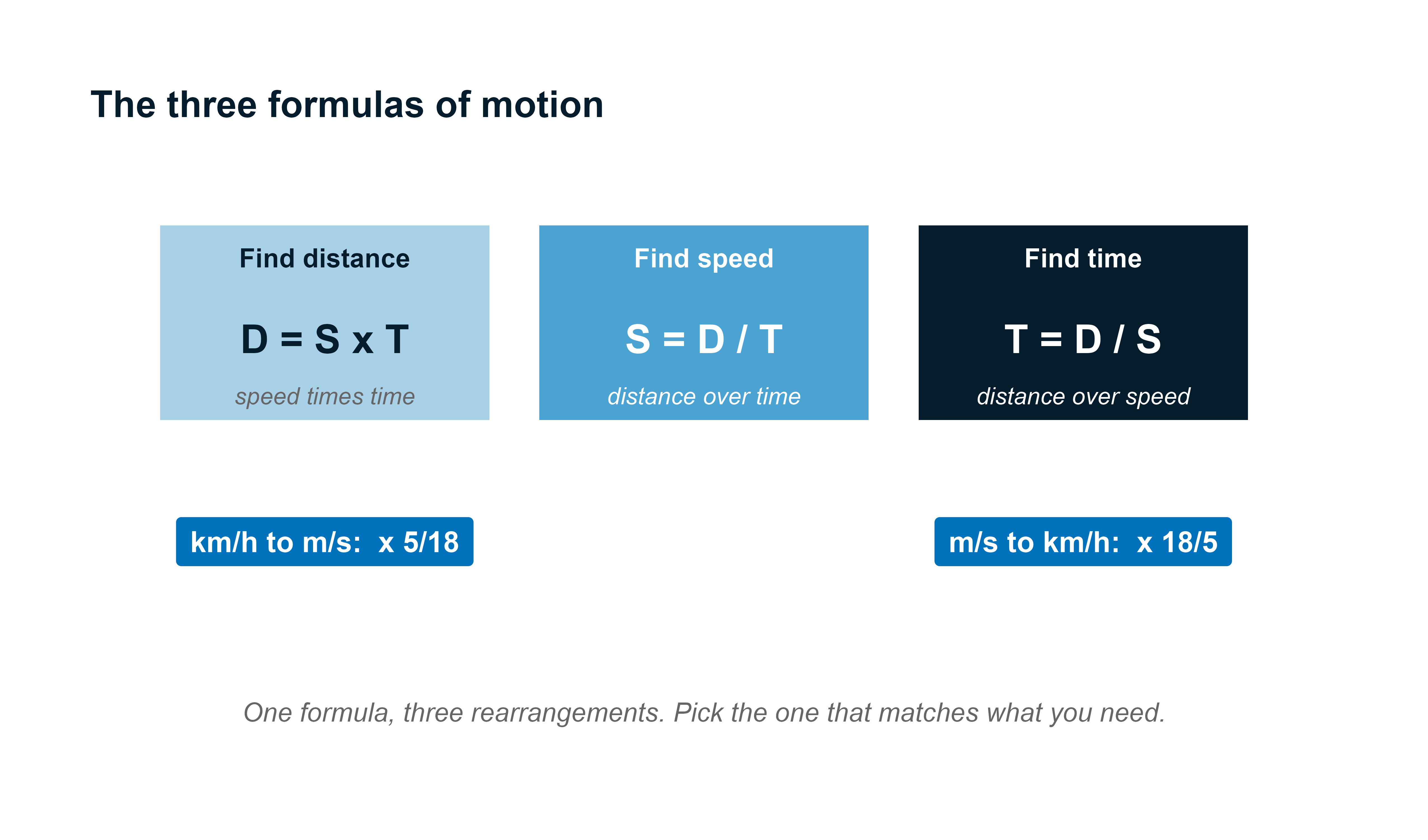
Use the form that gives the missing value.
| Given | Find | Use |
|---|---|---|
| Speed and time | Distance | |
| Distance and time | Speed | |
| Distance and speed | Time |
Example: Finding total time
Riya jogs 3.6 km at 6 km/h.
Then she jogs another 2.4 km at 8 km/h.
Find the total time.
For the first part:
For the second part:
Total time:
So Riya jogged for 54 minutes.
In a journey with parts, add the times.
Do not add the speeds.
Unit conversion
Many questions mix units.
A train's speed may be given in km/h.
Its length may be given in metres.
The crossing time may be given in seconds.
So before using the formula, the units must match.
Converting km/h to m/s
To convert km/h into m/s, multiply by:
Example:
So 72 km/h = 20 m/s.
This means the object covers 20 metres every second.
Converting m/s to km/h
To convert m/s into km/h, multiply by:
Example:
So 20 m/s = 72 km/h.
Common conversion table
| Speed in km/h | Speed in m/s |
|---|---|
| 18 | 5 |
| 36 | 10 |
| 45 | 12.5 |
| 54 | 15 |
| 72 | 20 |
| 90 | 25 |
| 108 | 30 |
These values appear often in train questions.
Example: Speed conversion
A train moves at 90 km/h.
Find its speed in m/s.
So the train moves at 25 m/s.
That means it covers 25 metres every second.
Two-scenario questions
Many questions describe the same journey in two different ways.
For example:
- A person travels slowly and reaches late.
- The same person travels faster and reaches early.
- A car covers the same distance in less time.
- A train travels at normal speed first and reduced speed later.
In these questions, first ask:
What stays the same?
There are three common cases.
Case 1: Distance is constant
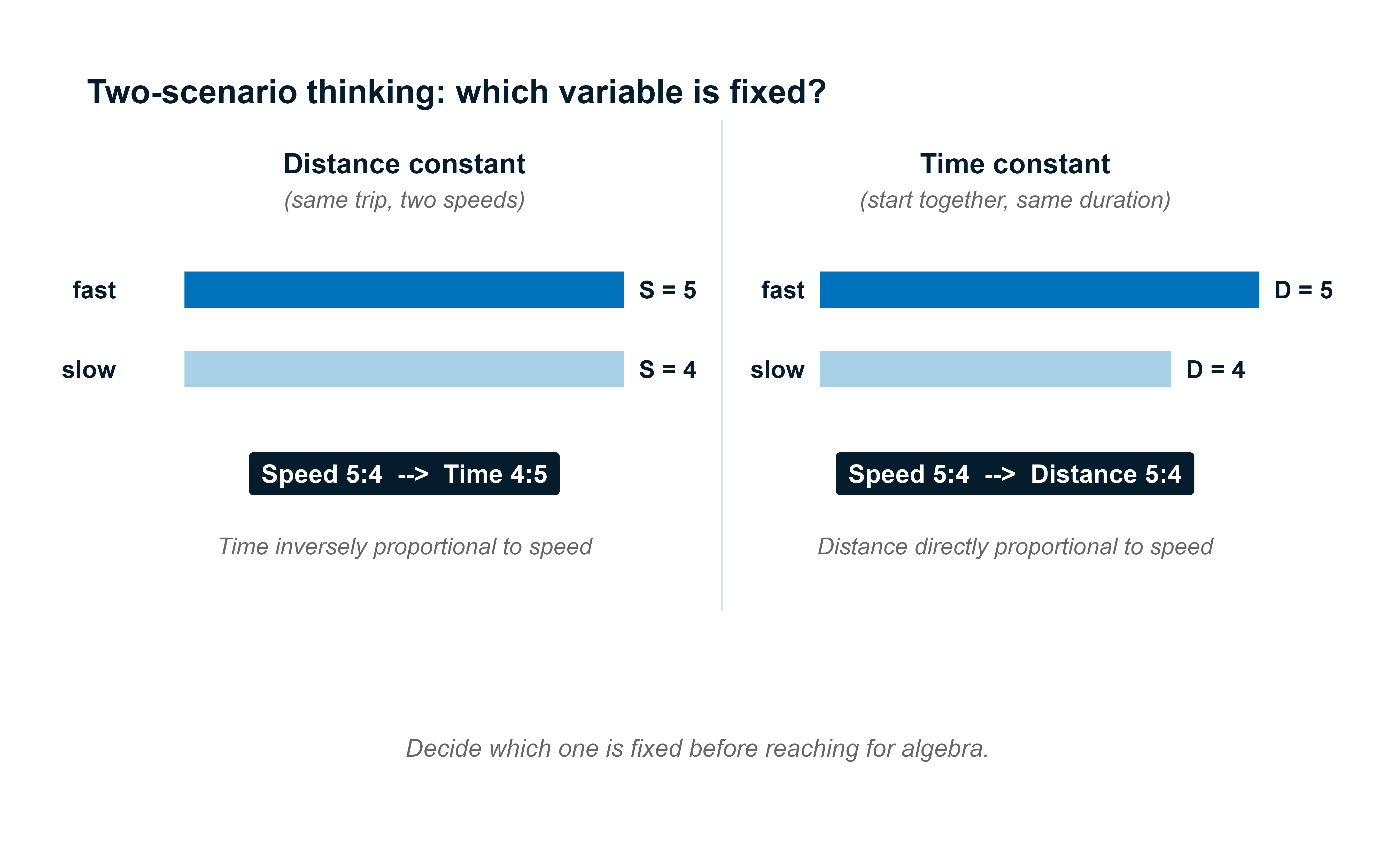
If the distance is the same, speed and time are inversely related.
If speed increases, time decreases.
If speed decreases, time increases.
For the same distance:
So:
This means the speed ratio and time ratio are reverse of each other.
If the speed ratio is:
then the time ratio is:
Example: Lower speed and late arrival
Anand normally reaches office on time.
One day he drives at of his usual speed and reaches 9 minutes late.
Find his usual journey time.
The distance is the same on both days.
Today's speed is of the usual speed.
So:
For the same distance, time ratio is reversed.
The difference is:
This 1 unit equals 9 minutes because today he is 9 minutes late.
So usual time is:
Anand's usual journey time is 36 minutes.
Case 2: Time is constant
If time is the same, distance is directly proportional to speed.
If speed doubles, distance doubles.
If speed becomes three times, distance becomes three times.
For the same time:
Example: Two cars start together
Two cars start from the same town at the same time.
One car drives at 60 km/h.
The other drives at 75 km/h.
Find how far ahead the faster car is after 2 hours.
First car distance:
Second car distance:
Difference:
So the faster car is 30 km ahead.
Here, the time is the same for both cars.
So the faster car covers more distance.
Case 3: Speed is constant
If speed is the same, distance is directly proportional to time.
If time doubles, distance doubles.
If time triples, distance triples.
For the same speed:
Example: Same speed, different times
A car moves at 50 km/h.
In 2 hours, it covers:
In 3 hours, it covers:
The speed is the same.
The time increased from 2 hours to 3 hours.
So the distance also increased in the same ratio.
Proportionality table
| What stays fixed? | Relationship | Meaning |
|---|---|---|
| Distance | Speed and time are inverse | Faster speed means less time |
| Time | Distance and speed are direct | Faster speed means more distance |
| Speed | Distance and time are direct | More time means more distance |
Another way to write it:
| Constant | Formula relation |
|---|---|
| Distance | |
| Time | |
| Speed |
Late, early, miss, and catch questions
These questions usually have the same journey done at two different speeds.
The distance is fixed.
Only the time changes.
Common wordings are:
- At 12 km/h, he is late by 8 minutes.
- At 16 km/h, he is early by 4 minutes.
- At 12 km/h, he misses the bus by 8 minutes.
- At 16 km/h, he reaches 4 minutes before the bus leaves.
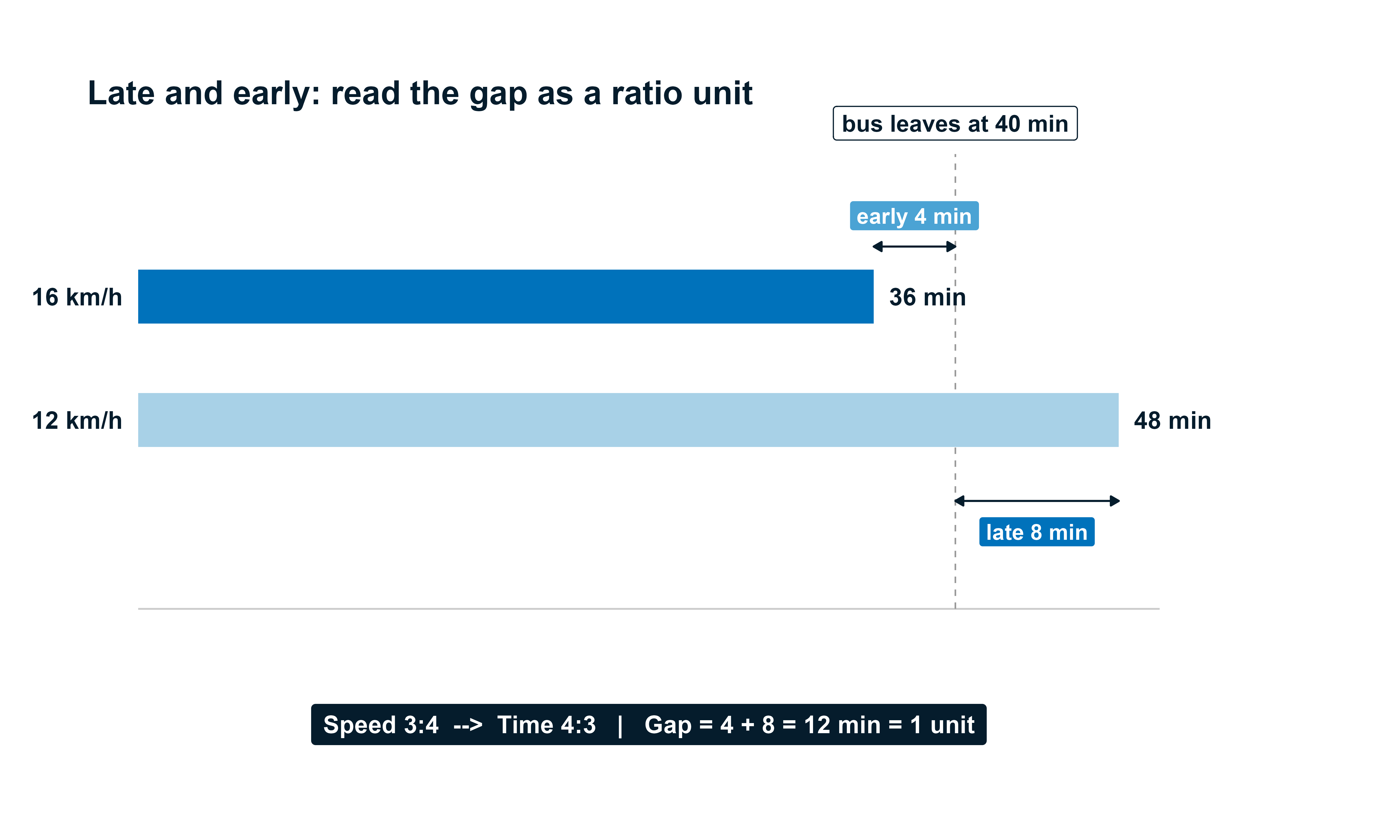
The key is to find the gap between the two travel times.
If one case is 8 minutes late and the other case is 4 minutes early, the gap is:
Do not subtract 8 and 4.
They are on opposite sides of the scheduled time.
Example: Bus stop question
Bishnu has to reach the bus stop.
At 12 km/h, he misses the bus by 8 minutes.
At 16 km/h, he reaches 4 minutes before the bus leaves.
Find the distance to the bus stop.
The distance is the same in both cases.
Speed ratio:
For the same distance, time ratio is reversed.
The time difference is:
In the ratio (4 : 3), the difference is:
So:
The slower trip takes 4 units.
Convert to hours:
Distance:
So the bus stop is 9.6 km away.
Speed change and time change
When distance is fixed, speed and time move in reverse.
If speed becomes of the original speed, time becomes of the original time.
So a 20% speed decrease gives a 25% time increase.
If speed becomes of the original speed, time becomes of the original time.
So a 20% speed increase gives a 16.66% time decrease.
This is the same idea as reverse percentage.
Train slowdown and accident questions
Some train questions say that a train slows down and reaches late.
There are two common types.
Type 1: Slowdown for the whole trip
If the train travels the whole trip at a reduced speed, treat it like a normal late-arrival question.
Example: Reduced speed for whole trip
A train runs at of its usual speed and reaches 30 minutes late.
Find the usual journey time.
Speed ratio:
For the same distance, time ratio is reversed.
Difference:
These 3 units equal 30 minutes.
So:
Usual time:
So the usual journey time is 50 minutes.
Type 2: Slowdown starts after a point
Sometimes the train travels normally first and slows down after an accident point.
Only the part after the accident creates delay.
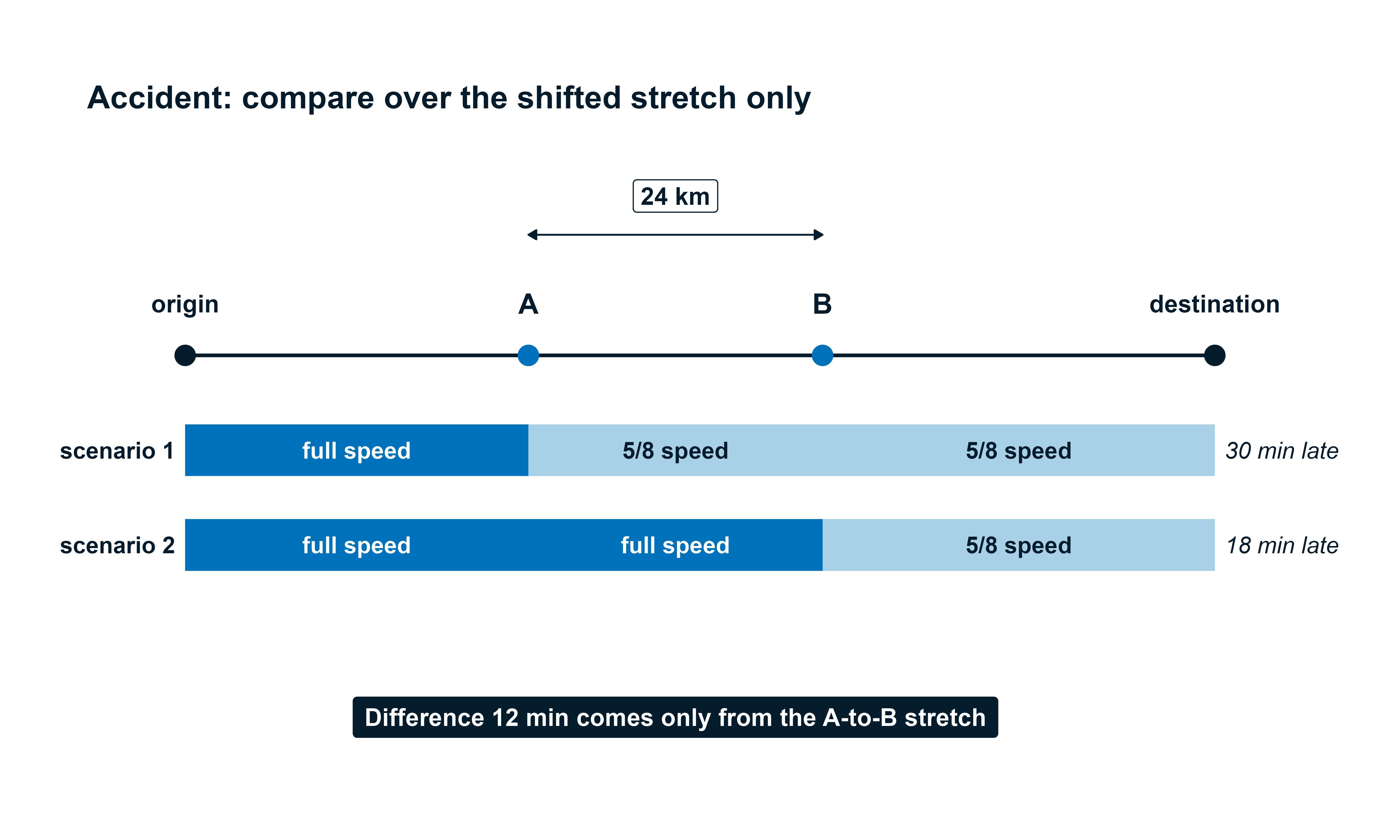
If two accident points are compared, focus only on the stretch between those points.
Example: Accident happens later
A train normally travels from origin to destination at its usual speed.
After an accident at point A, it travels at of its usual speed and reaches 30 minutes late.
If the accident had happened 24 km later, at point B, the delay would have been only 18 minutes.
Find the usual speed.
The difference between the delays is:
This 12-minute difference comes only from the 24 km stretch between A and B.
In one case, the train covers A to B at reduced speed.
In the other case, it covers A to B at usual speed.
Speed ratio:
So time ratio:
Difference:
These 3 units equal 12 minutes.
So:
Usual time for 24 km:
Convert to hours:
Usual speed:
So the usual speed is 72 km/h.
Speeds in AP and times in HP
Sometimes a question gives equally spaced arrival times.
If the distance is the same, then speed and time are inverse.
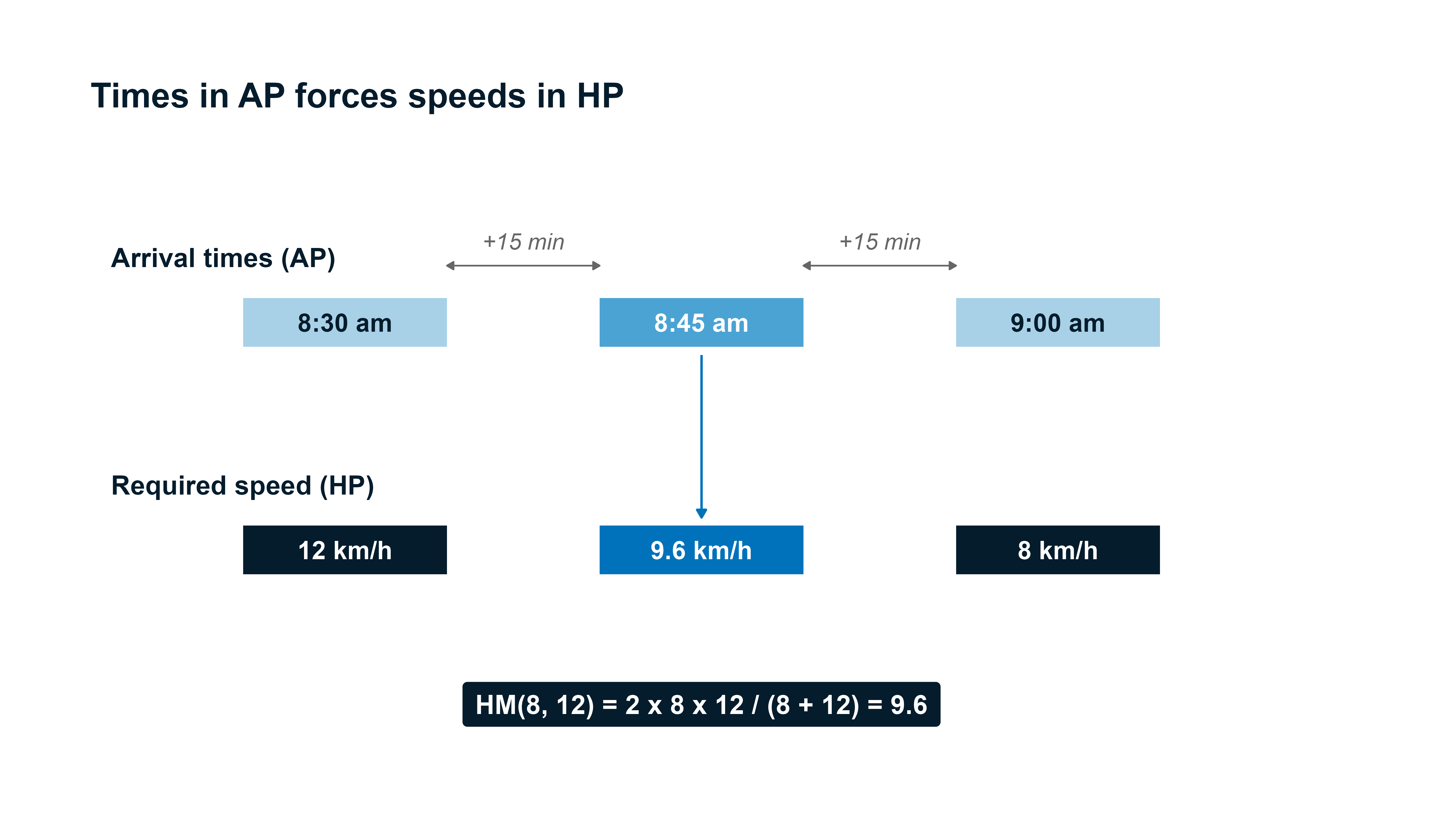
So if times are in arithmetic progression, speeds are in harmonic progression.
A common shortcut is the harmonic mean.
If two speeds are and , the harmonic mean is:
Example: Equal time gaps
Riya cycles to a meeting.
At 8 km/h, she reaches at 9:00 am.
At 12 km/h, she reaches at 8:30 am.
Find the speed at which she reaches at 8:45 am.
The three arrival times are:
- 9:00
- 8:45
- 8:30
These are equally spaced by 15 minutes.
The middle speed is the harmonic mean of 8 and 12.
So she must ride at 9.6 km/h.
Relative speed
Relative speed is the speed at which the gap between two moving objects changes.
Use relative speed when two people, cars, trains, or runners move at the same time.
There are two main cases.
Opposite directions
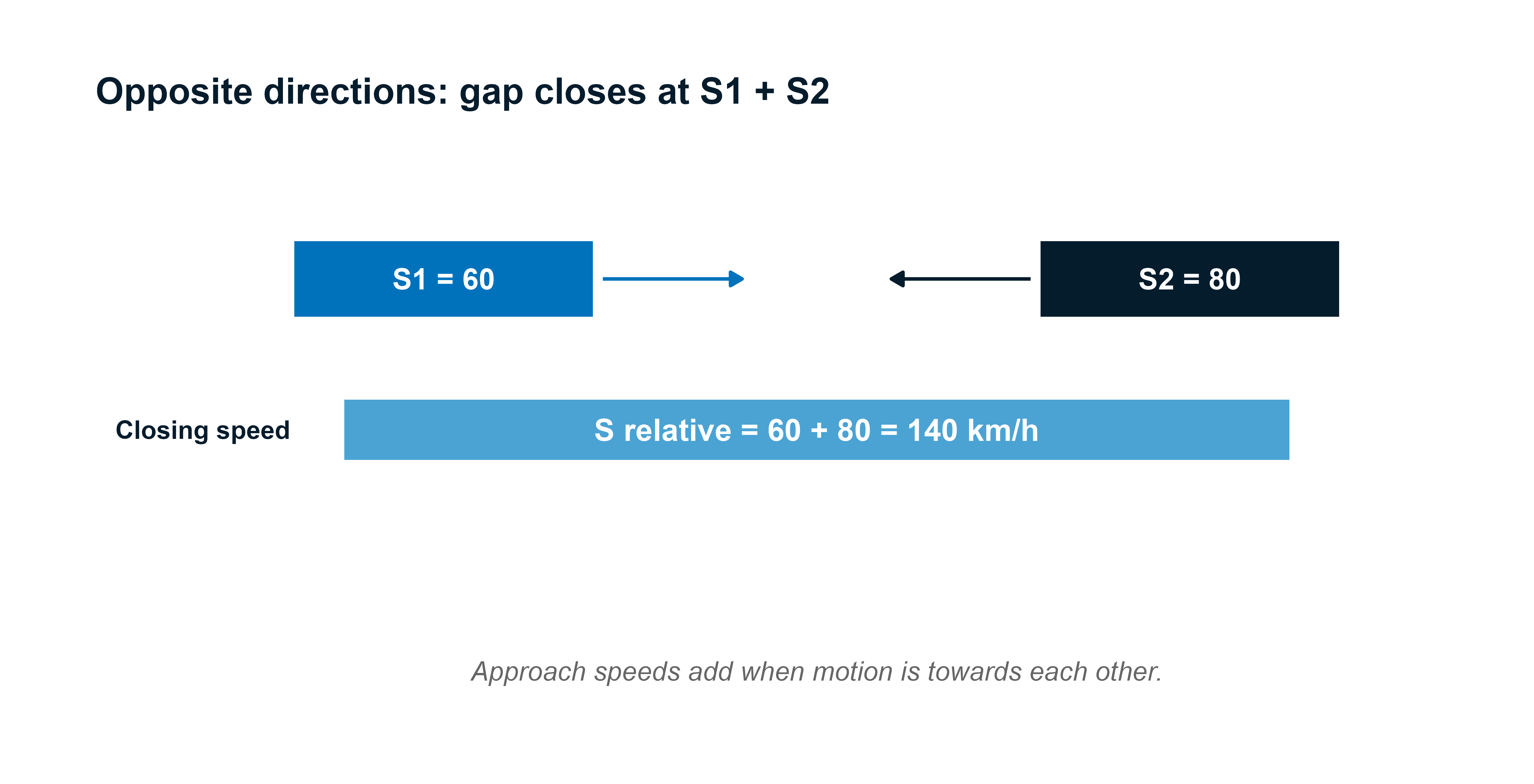
If two objects move towards each other, add their speeds.
Example: Two cyclists moving towards each other
Two cyclists are 12 km apart.
They ride towards each other at 7 km/h and 11 km/h.
Find when they meet.
Relative speed:
Time:
So they meet after 40 minutes.
Same direction
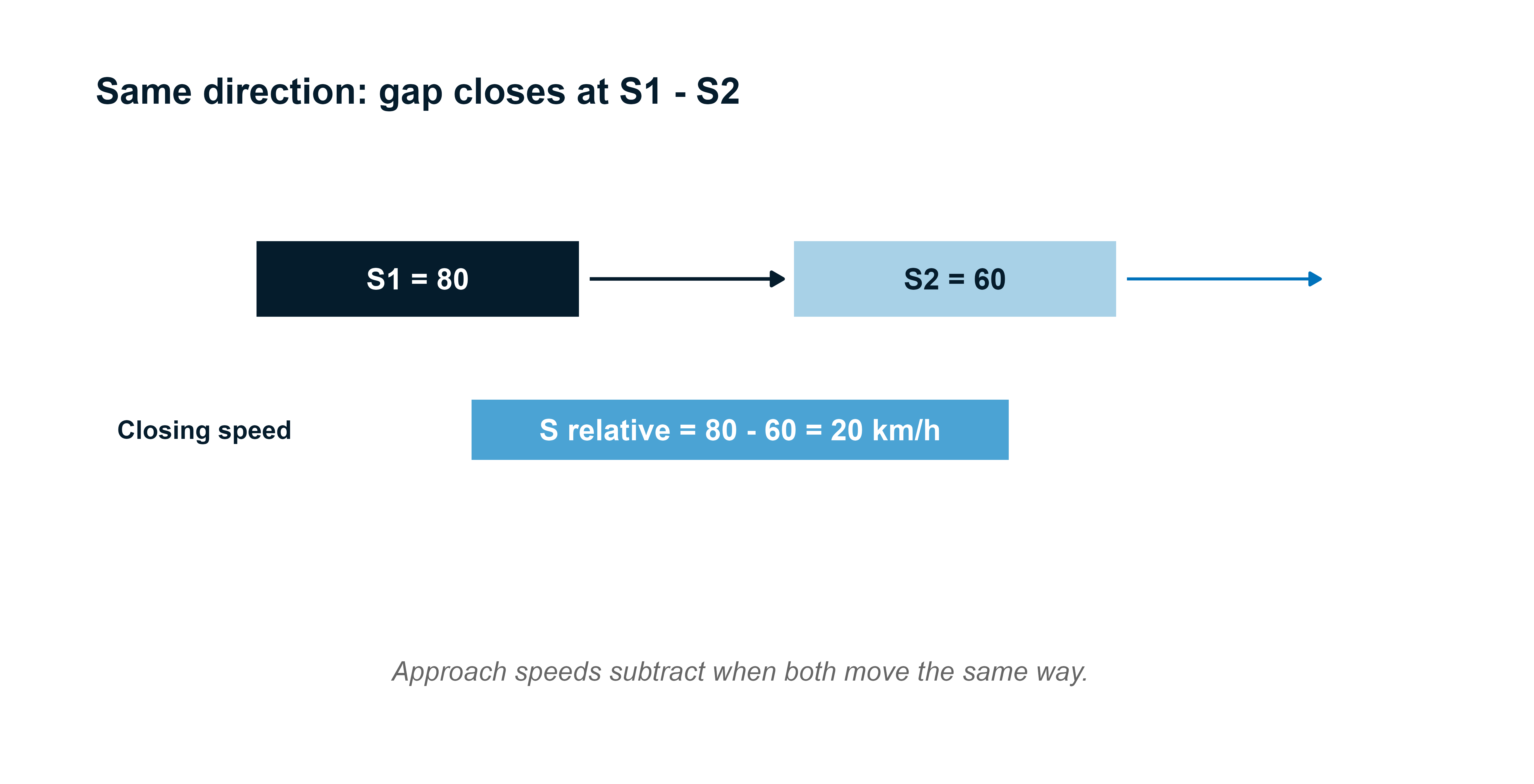
If two objects move in the same direction, subtract their speeds.
Example: Chasing with a head start
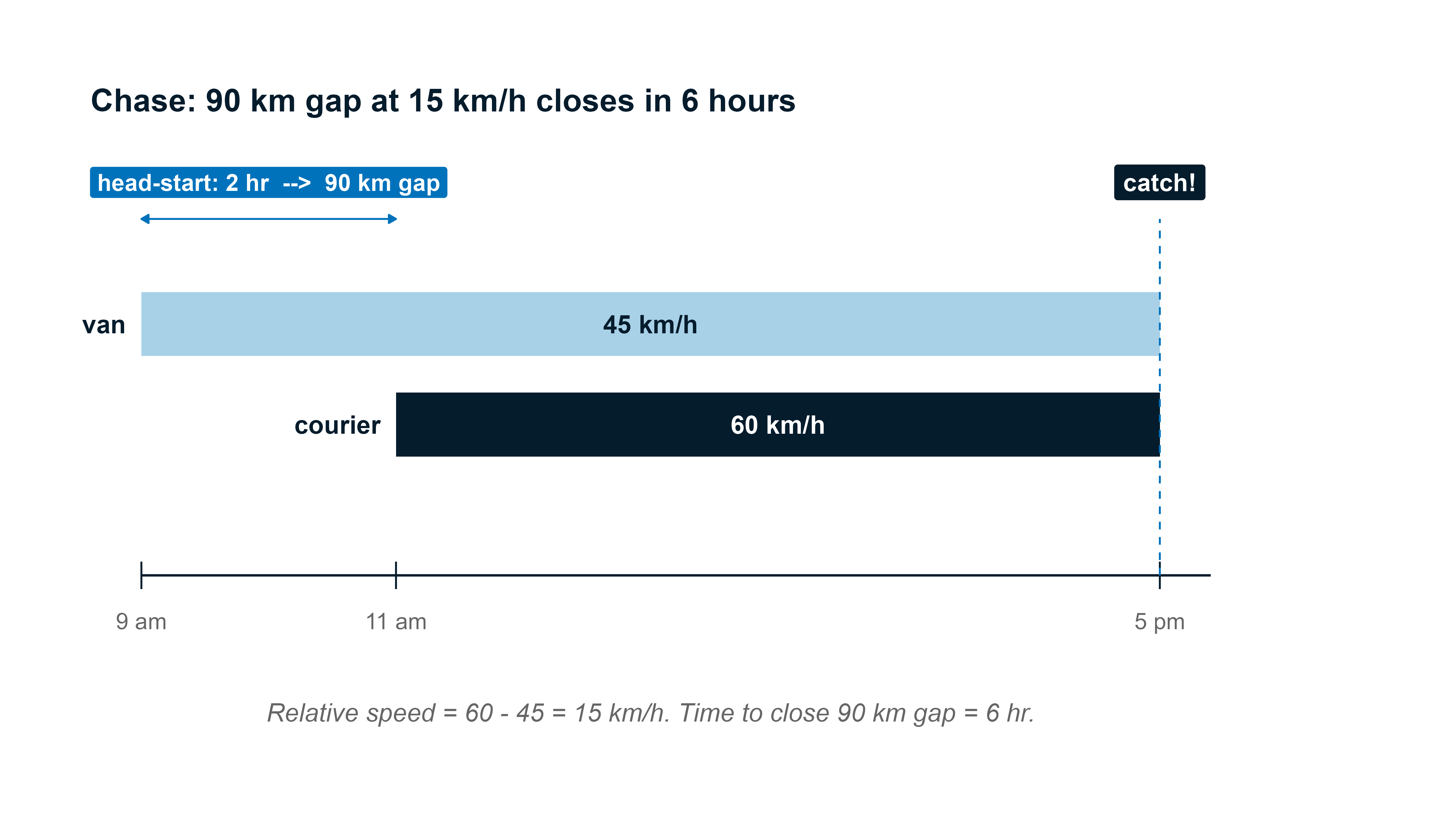
A delivery van leaves a depot at 9:00 am.
It drives at 45 km/h.
A courier leaves from the same depot at 11:00 am.
The courier drives at 60 km/h on the same road.
Find when the courier catches the van.
By 11:00 am, the van has travelled for 2 hours.
Van's head start:
Now the courier starts chasing.
Relative speed:
Time to close the gap:
The courier starts at 11:00 am.
So the catch-up time is:
The courier catches the van at 5:00 pm.
Meeting with delayed start
Sometimes two people move towards each other, but one starts earlier.
First calculate the distance already covered by the early starter.
Then use relative speed from the time both are moving.
Example: One person starts later
Anand starts from town X at 7:00 am at 60 km/h.
Tara starts from town Y at 7:30 am at 80 km/h.
Town Y is 250 km east of town X.
They travel towards each other.
Find when they meet.
By 7:30 am, Anand has already travelled:
So the remaining gap is:
From 7:30 onward, both are moving towards each other.
Relative speed:
Time to meet:
This is about 1 hour 34 minutes.
So they meet around 9:04 am.
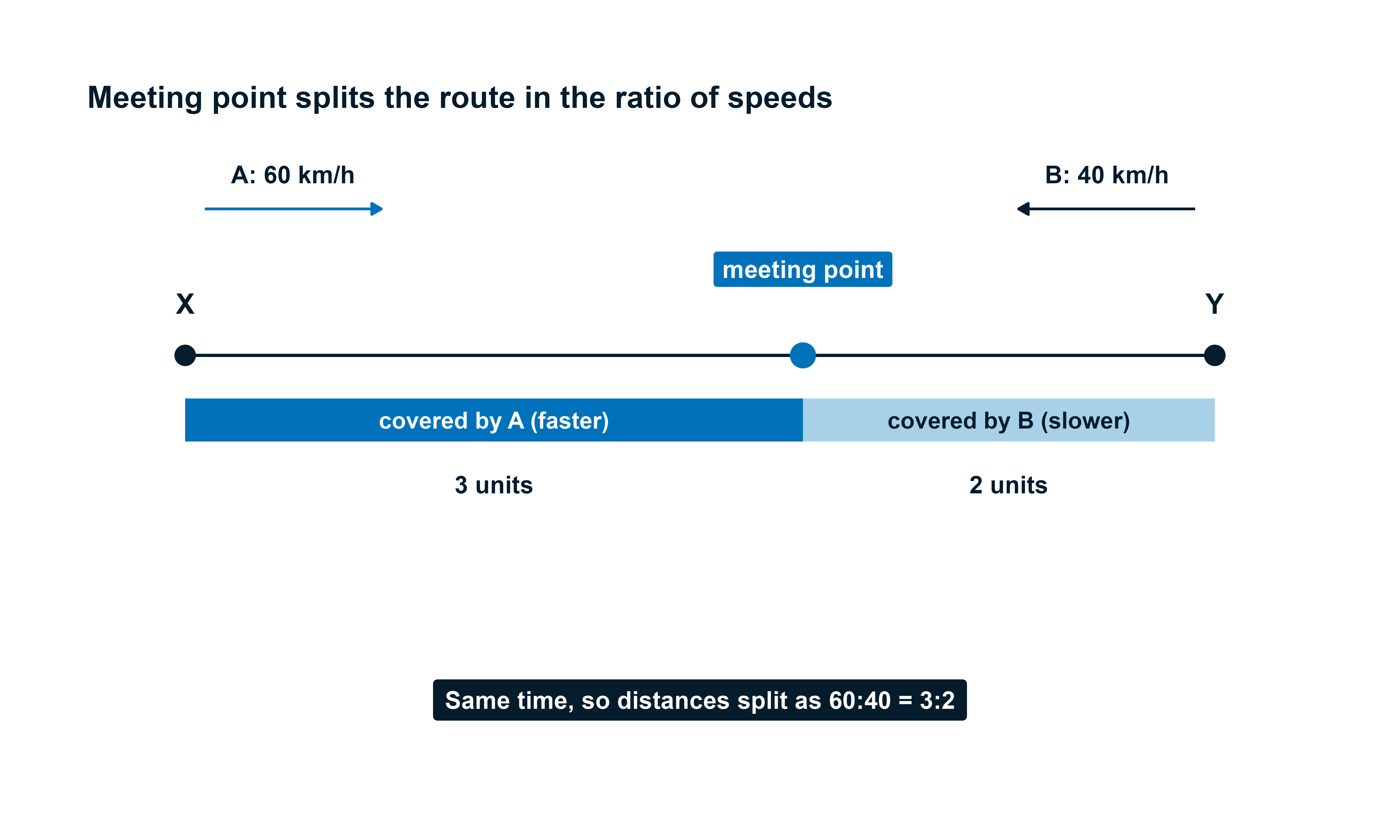
Meeting point ratio
If two people start from opposite ends at the same time and meet, they travel for the same time.
So the distances they cover are in the ratio of their speeds.
Example:
A moves at 60 km/h.
B moves at 80 km/h.
They start from opposite ends and meet.
So the meeting point divides the total distance in the ratio (3:4).
Right-angle movement
Sometimes two objects start at the same point and move at right angles.
For example:
- One ship moves south.
- Another ship moves west.
In this case, do not add or subtract their speeds.
Use Pythagoras.
If one object moves at km/h and the other moves at km/h, then after hours the distance between them is:
Example: Right-angle separation
One cyclist goes east at 6 km/h.
Another cyclist goes north at 8 km/h.
They start from the same point.
Find the distance between them after 1 hour.
East distance:
North distance:
Distance between them:
So they are 10 km apart.
Trains crossing objects
A train has length.
So when a train crosses something, the whole train must clear that object.
The universal formula is:
For trains:
Here:
- is the train's length
- is the object's length
- is the relative speed
Train crossing a pole
A pole has no length.
So the train needs to cover only its own length.
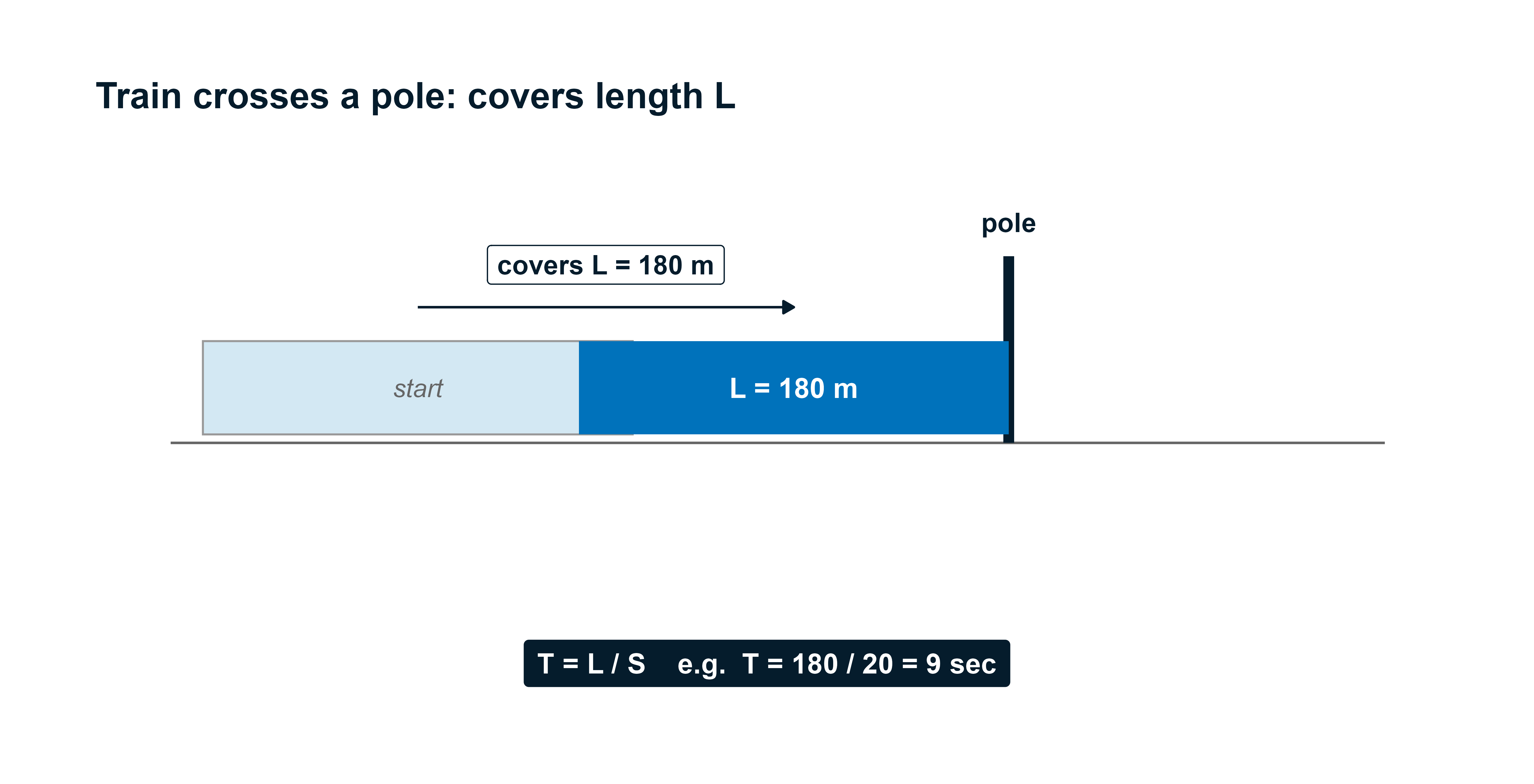
Example: Train crossing a pole
A 180 m train crosses a pole in 9 seconds.
Find its speed.
The train covers its own length.
Distance covered:
Time:
Speed:
Convert to km/h:
So the train's speed is 72 km/h.
Train crossing a platform or bridge
A platform or bridge has length.
So the train must cover:
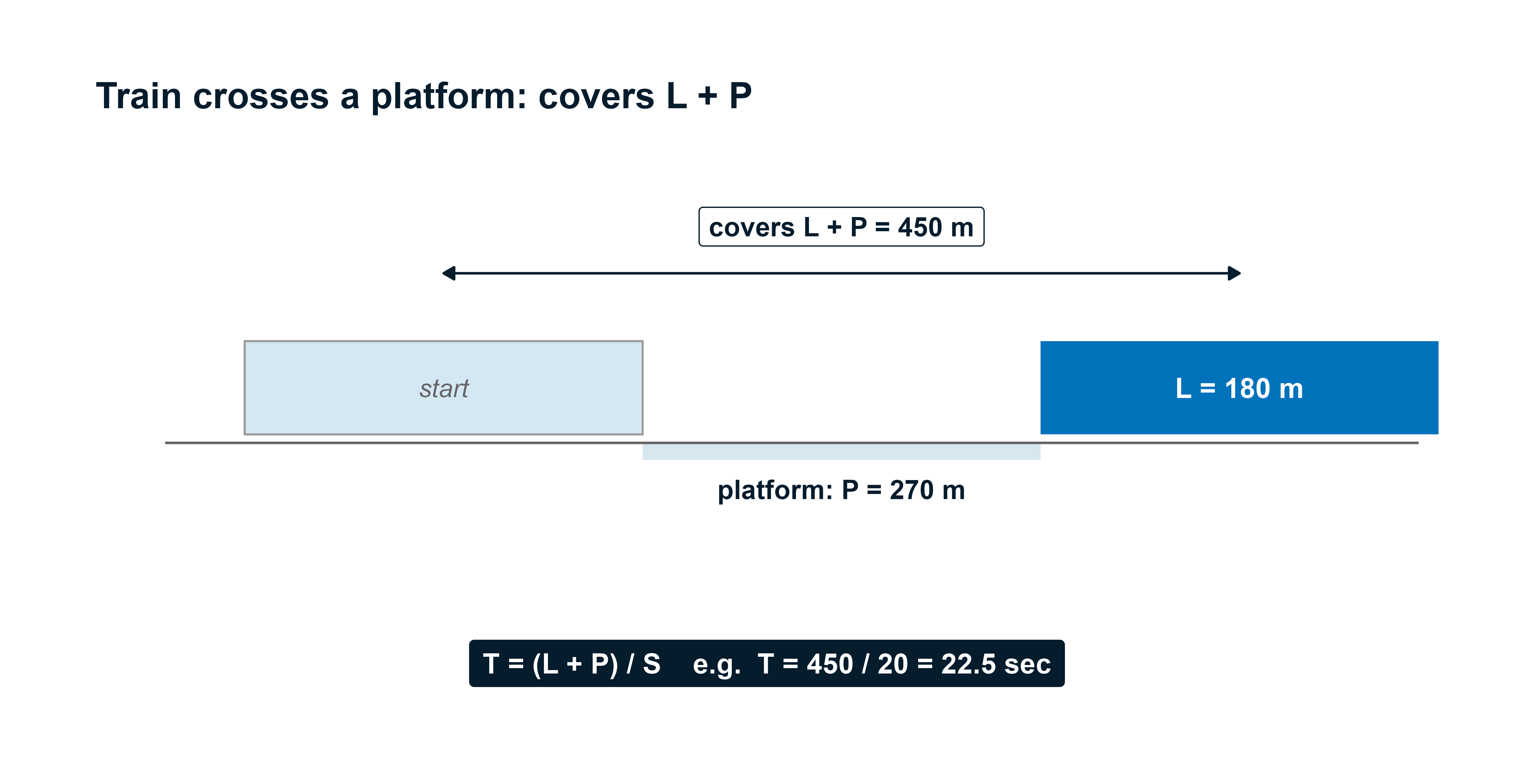
Example: Train crossing a platform
A 180 m train crosses a 270 m platform.
The train's speed is 20 m/s.
Find the time taken.
Total distance to be covered:
Time:
So the train takes 22.5 seconds.
Train crossing a walking man
A man is treated as a point.
So his length is taken as zero.
But if he is walking, his speed matters.
If the train and man move in the same direction:
If they move in opposite directions:
Example: Train crossing a man walking in the same direction
A 200 m train moves at 90 km/h.
It passes a man walking at 6 km/h in the same direction.
Find the time taken.
Relative speed:
Convert to m/s:
The train must cover 200 m.
So the train crosses the man in about 8.57 seconds.
Two trains crossing each other
If two trains cross each other, both lengths matter.
Total length to be crossed:
If the trains move in opposite directions, add their speeds.
If they move in the same direction, subtract their speeds.
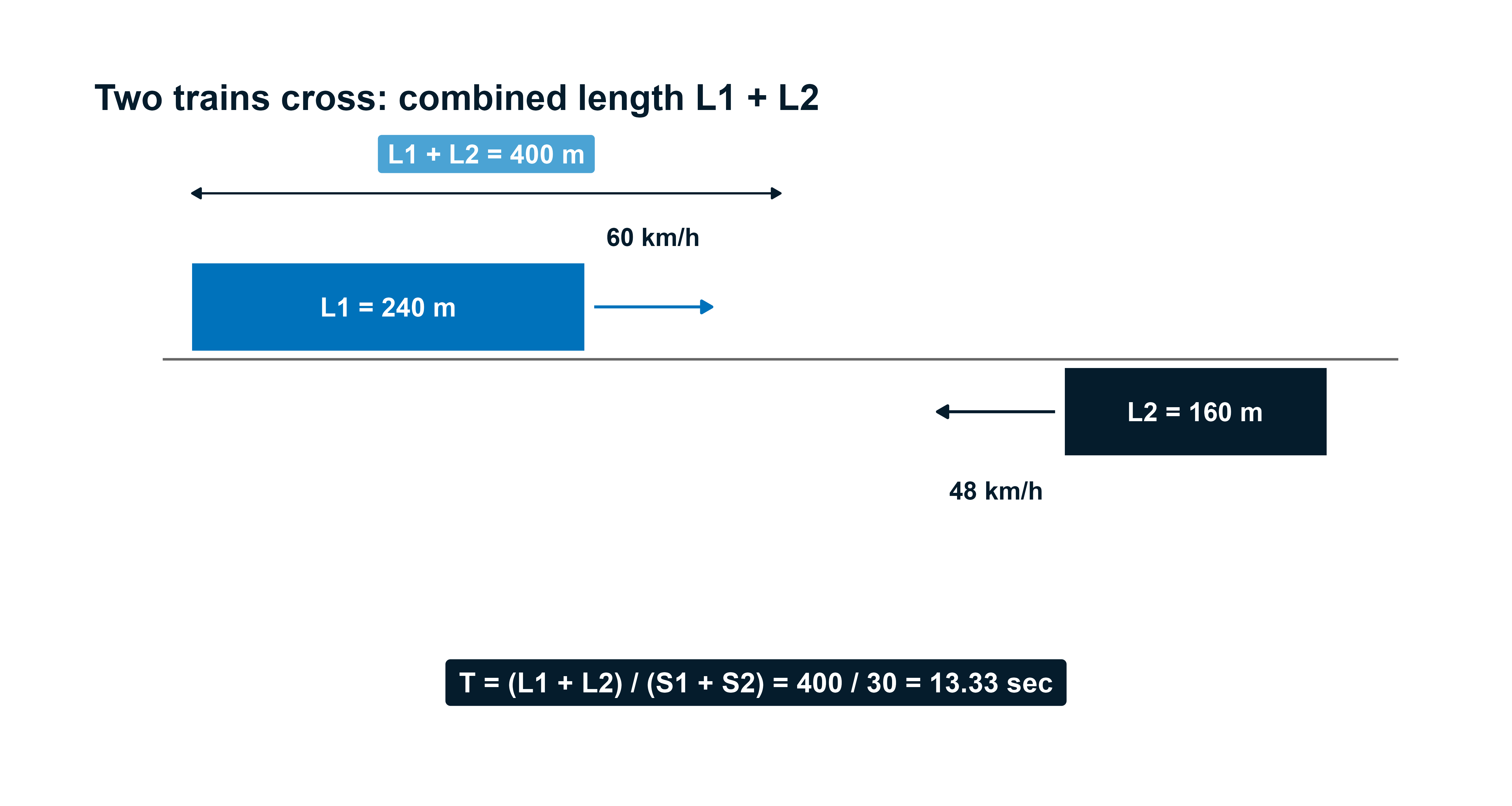
Example: Two trains in opposite directions
Two trains have lengths 240 m and 160 m.
They run in opposite directions at 60 km/h and 48 km/h.
Find the crossing time.
Total length:
Relative speed:
Convert to m/s:
Time:
So the trains cross each other in 13.33 seconds.
Example: Same trains in the same direction
Now suppose the same trains move in the same direction.
Relative speed:
Convert to m/s:
Total length:
Time:
So in the same direction, they take 120 seconds to cross.
Same direction crossing is slower because relative speed is smaller.
Man walking inside a train
Sometimes a man is walking inside one train, and another train crosses him.
First find the man's actual ground speed.
Then compare that speed with the other train.
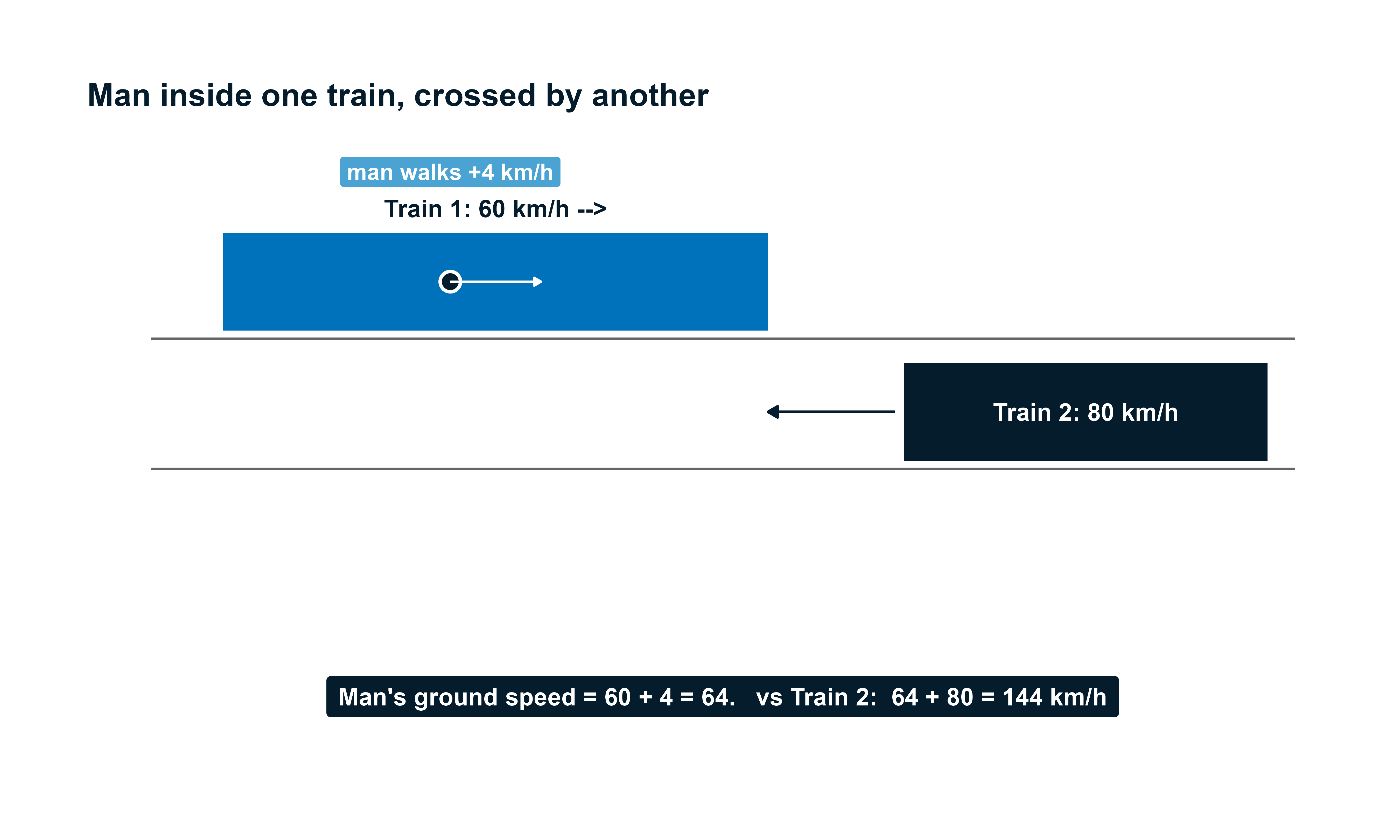
Example: Man inside train
Train 1 moves at 60 km/h.
A man walks forward inside Train 1 at 4 km/h.
So the man's ground speed is:
Train 2 comes from the opposite direction at 80 km/h.
Relative speed between Train 2 and the man:
Convert to m/s:
If Train 2 has length , then crossing time is:
The object being crossed is the man, so only Train 2's length is used.
Boats and streams
In boat questions, the river current changes the boat's speed.
If the boat goes with the current, it moves faster.
If the boat goes against the current, it moves slower.
Let:
- = boat speed in still water
- = stream speed
- = downstream speed
- = upstream speed
Then:
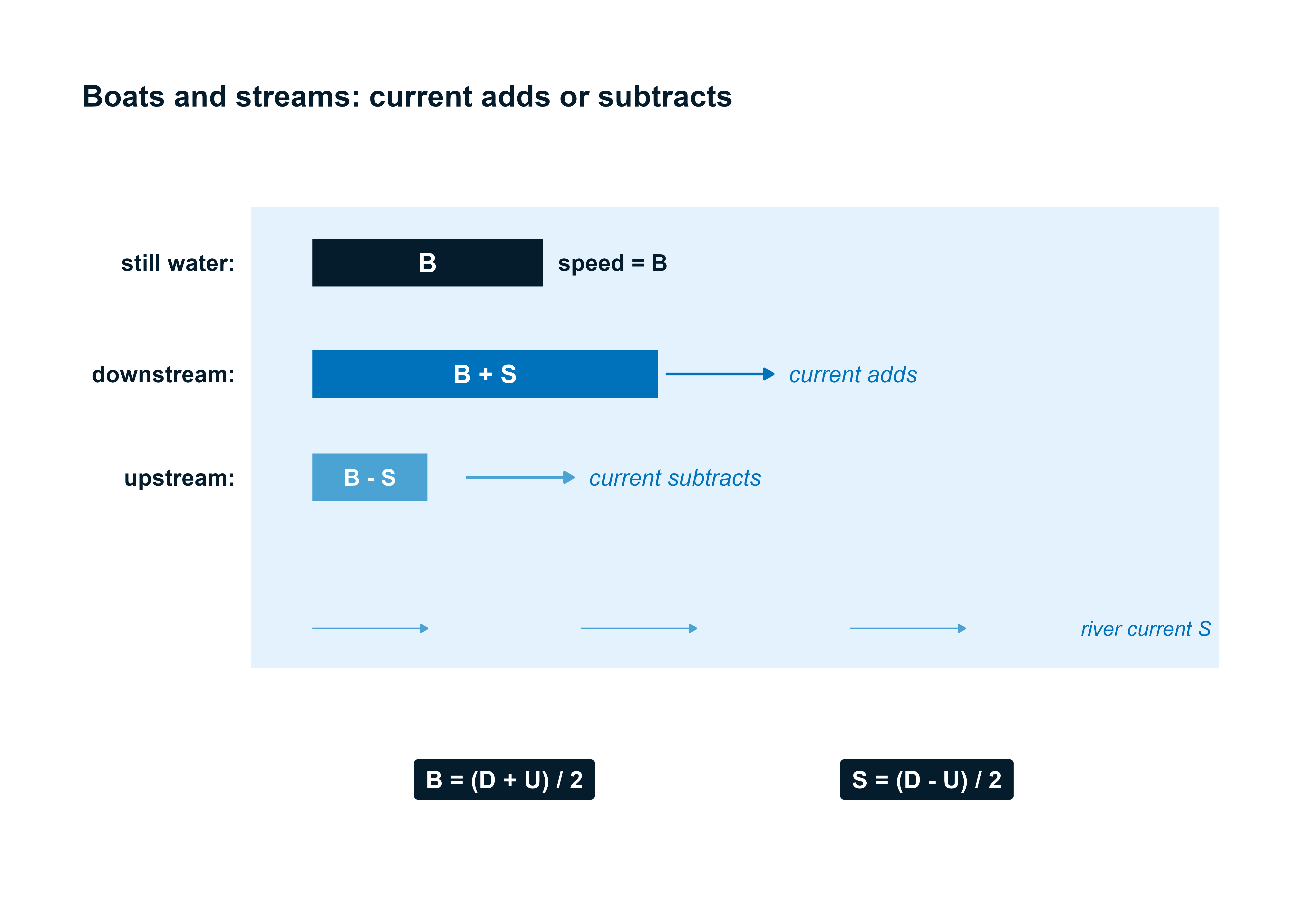
If downstream and upstream speeds are known, then:
Example: Finding boat speed and stream speed
A motorboat covers 28 km downstream in 1 hour 24 minutes.
It covers the same 28 km upstream in 2 hours 20 minutes.
Find the boat's still-water speed and stream speed.
Convert the times.
1 hour 24 minutes:
2 hours 20 minutes:
Downstream speed:
Upstream speed:
Now find boat speed:
Find stream speed:
So the boat's speed in still water is 16 km/h, and the stream speed is 4 km/h.
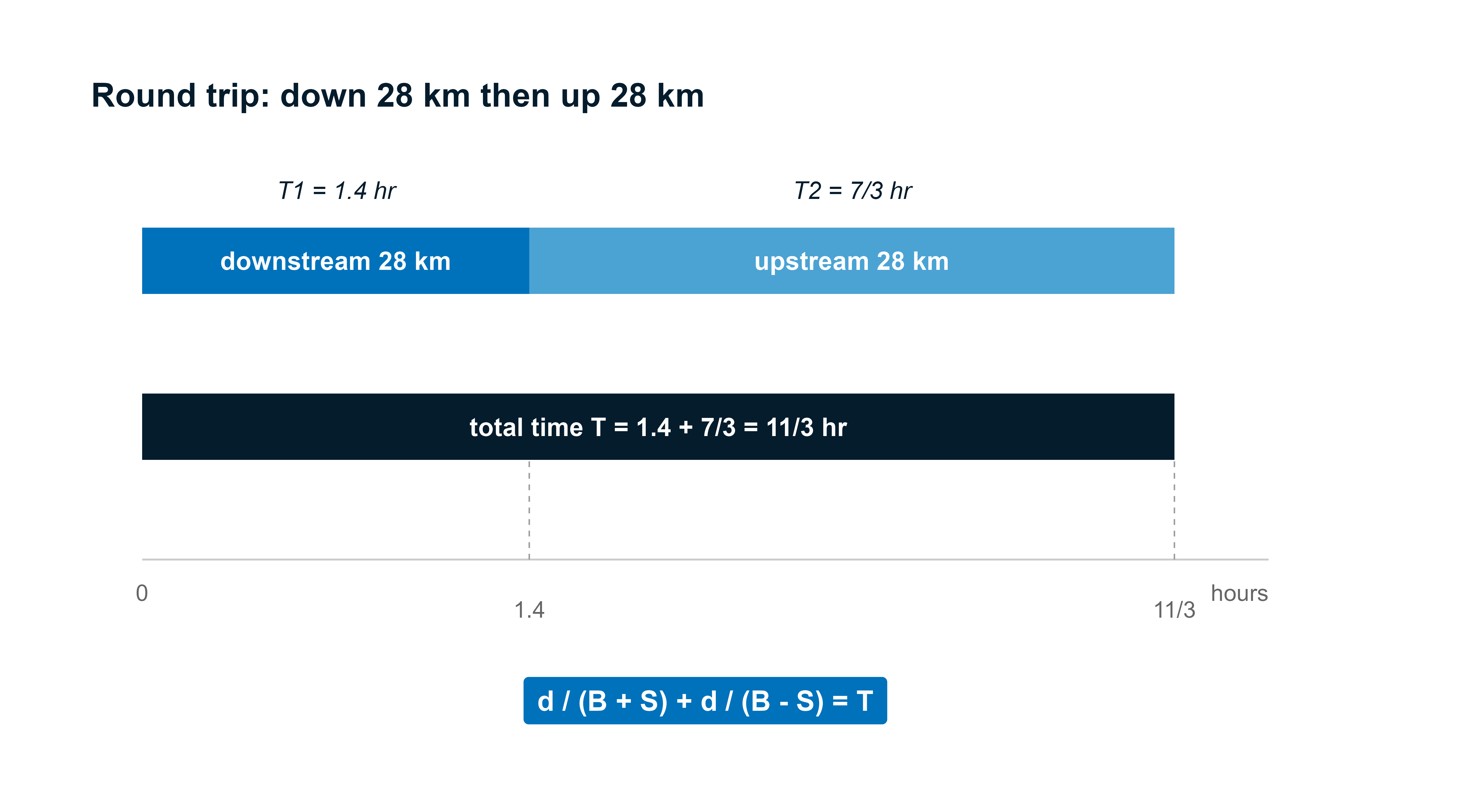
Boat round trips
If a boat goes downstream and upstream, calculate the two times separately.
If it goes distance downstream and distance upstream, total time is:
Example: Two boat trips
A boatman covers 30 km upstream and 44 km downstream in 10 hours.
He also covers 40 km upstream and 55 km downstream in 13 hours.
Find the still-water speed and stream speed.
Let:
Here:
- means time taken per km upstream
- means time taken per km downstream
From the first trip:
From the second trip:
Now solve.
Multiply the first equation by 4:
Multiply the second equation by 3:
Subtract the second equation from the first:
So:
Now use:
So:
Now we have:
Add both equations:
Then:
So the boat's still-water speed is 8 km/h, and the stream speed is 3 km/h.
Races
Race questions compare how far two people or vehicles have travelled in the same time.
A common phrase is:
A beats B by 60 m in a 600 m race.
This means:
When A finishes 600 m, B is still 60 m behind.
So B has covered:
Since A and B ran for the same time, their speed ratio is the same as their distance ratio.
Example: Race margin chain
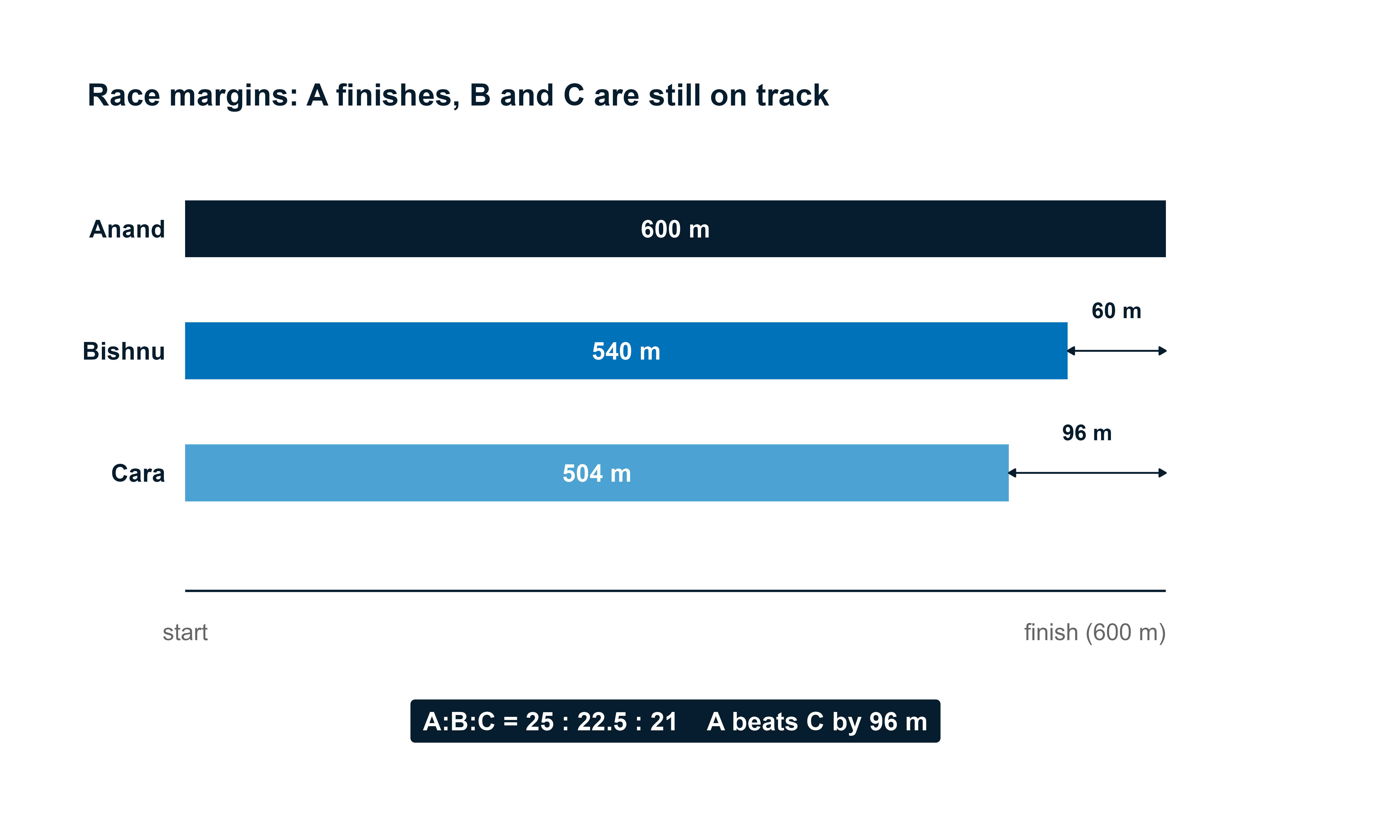
In a 600 m race, Anand beats Bishnu by 60 m.
Bishnu beats Cara by 40 m.
Find by how much Anand beats Cara.
When Anand finishes 600 m, Bishnu covers:
So:
When Bishnu finishes 600 m, Cara covers:
So:
Now combine:
Make the value the same.
LCM of 9 and 15 is 45.
Multiply (10:9) by 5:
Multiply (15:14) by 3:
So:
Therefore:
When Anand covers 600 m, Cara covers:
So Anand beats Cara by:
Anand beats Cara by 96 m.
Average speed
Average speed is:
Do not simply average the speeds unless the time spent at both speeds is equal.
Example: Unequal distances
A truck travels 60 km at 30 km/h.
Then it travels 90 km at 60 km/h.
Find the average speed.
Time for first part:
Time for second part:
Total distance:
Total time:
Average speed:
So the average speed is 42.86 km/h.
It is not:
because the truck did not spend equal time at both speeds.
Equal-distance average speed
If equal distances are travelled at speeds and , average speed is the harmonic mean.
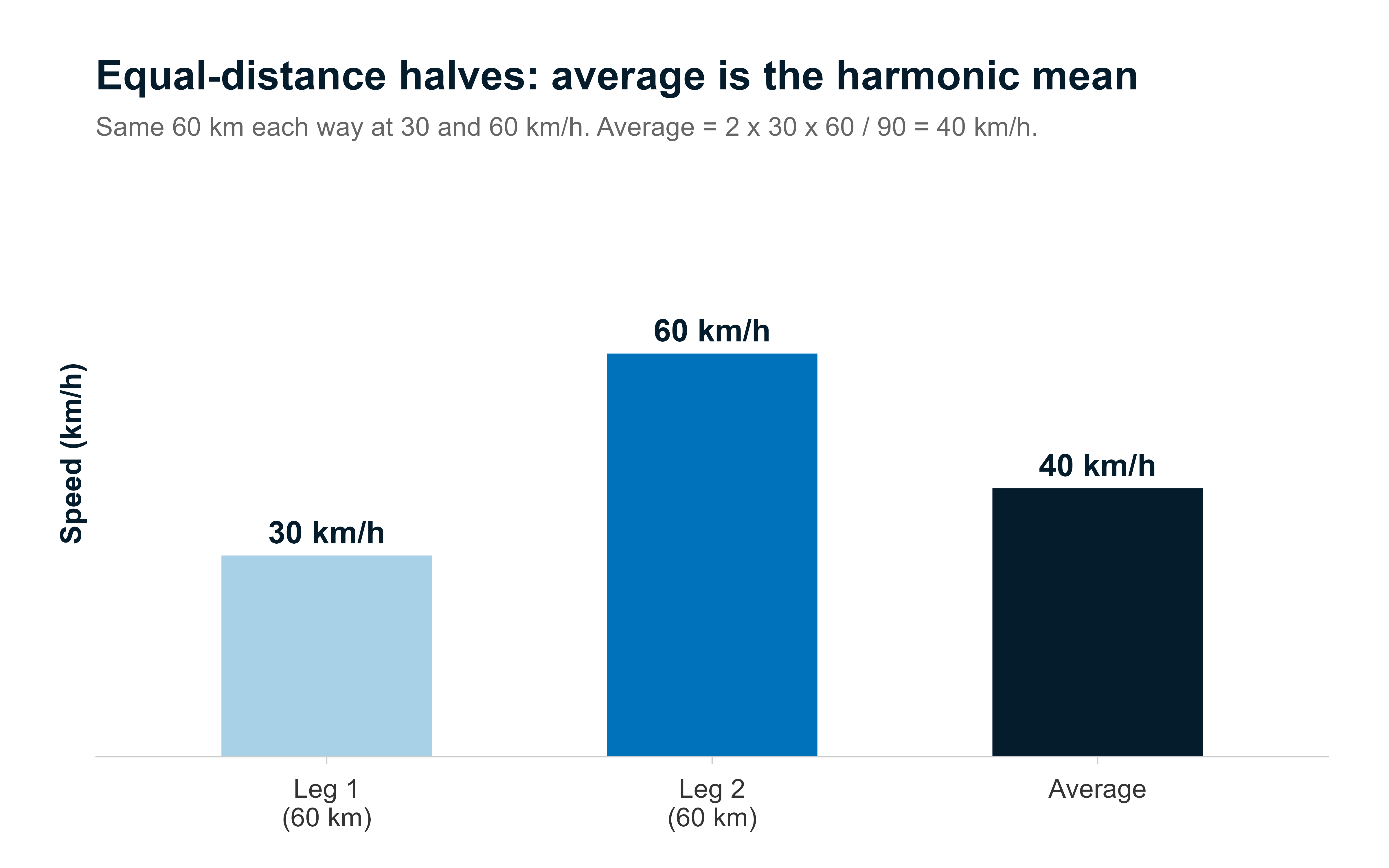
Example: Same distance each way
A person goes uphill at 18 km/h.
Then comes back the same distance at 30 km/h.
Find the average speed.
So the average speed is 22.5 km/h.
It is closer to 18 than to 30 because more time is spent at the slower speed.
Equal-time average speed
If the time spent at both speeds is equal, average speed is the arithmetic mean.
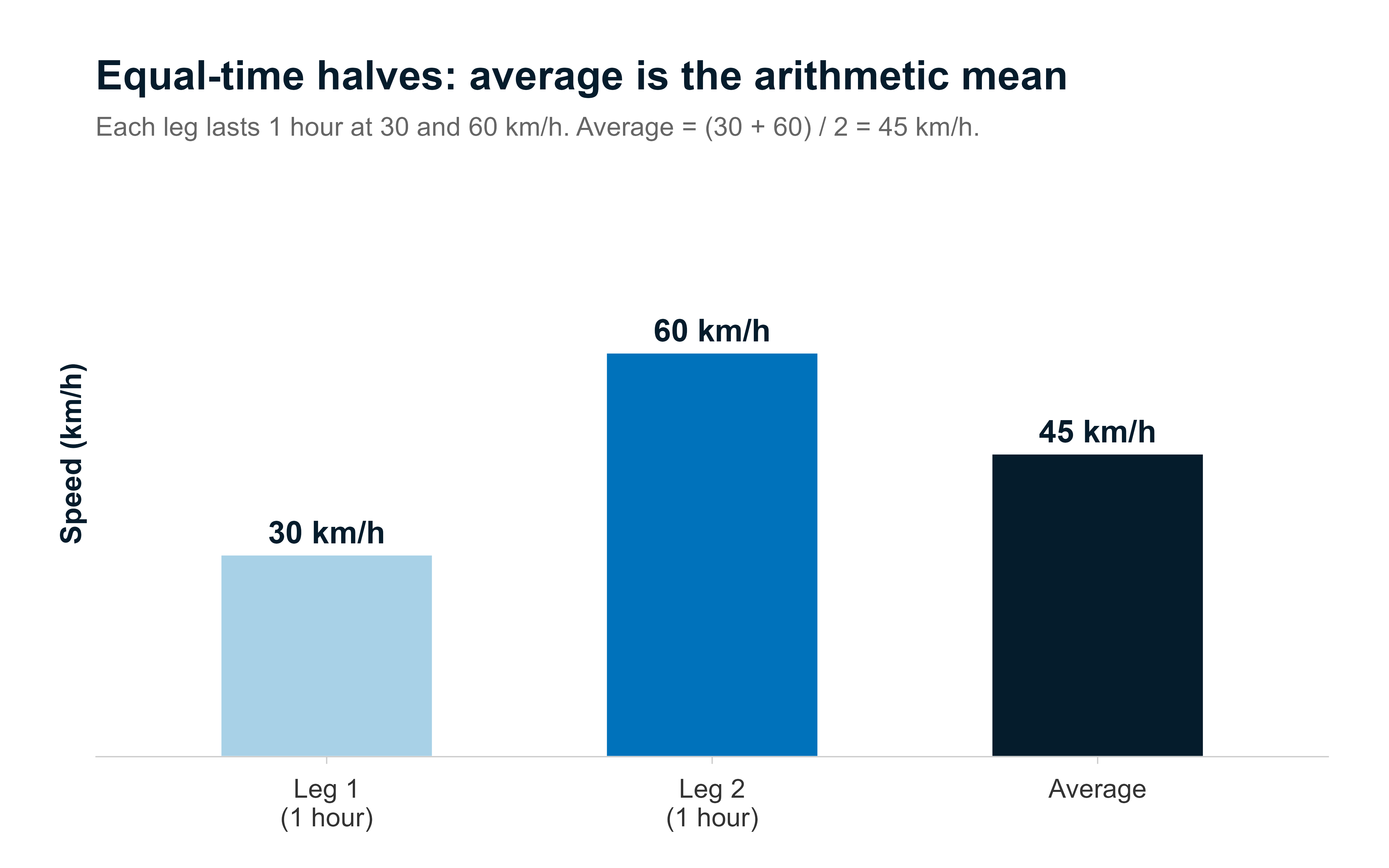
Example: Same time at both speeds
A person travels for 1 hour at 30 km/h.
Then travels for 1 hour at 60 km/h.
Average speed:
This works because the time spent at both speeds is equal.
Impossible average speed case
Sometimes an average speed target is impossible.
Example: Impossible average
A person travels the first half of a journey at 30 km/h.
Can they travel the second half fast enough to make the overall average speed 60 km/h?
No.
Take total distance as 60 km.
First half:
Time for first half:
To average 60 km/h over 60 km, total time must be:
But 1 hour has already been used in the first half.
So there is no time left for the second half.
Therefore, the target average speed is impossible.
Stoppage time
A bus may have two speeds:
- Speed excluding stoppages
- Average speed including stoppages
The speed excluding stoppages is the speed when the bus is moving.
The average speed including stoppages is lower because it includes waiting time.
The formula is:
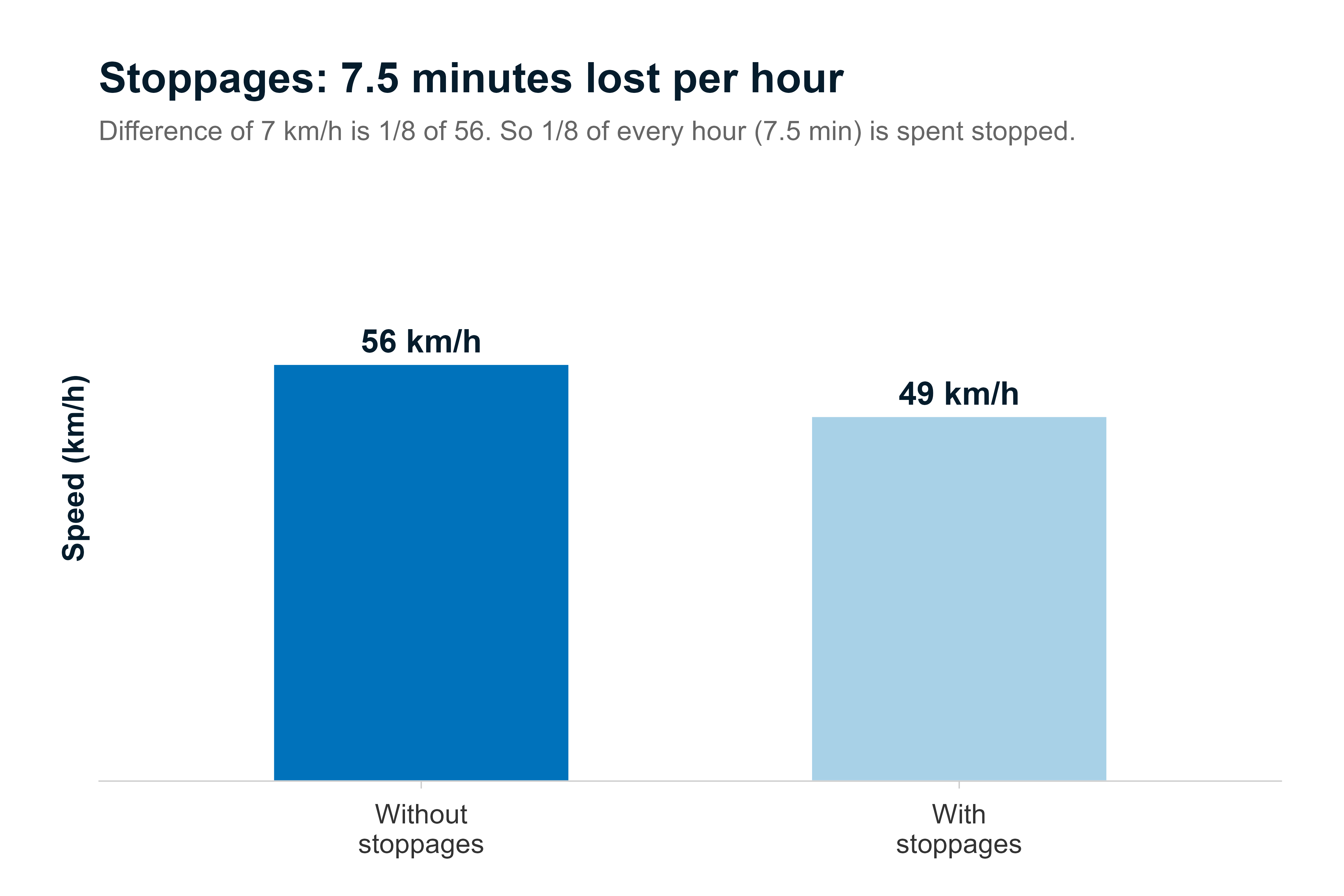
Example: Bus stoppage
A bus averages 49 km/h including stoppages.
It averages 56 km/h excluding stoppages.
Find how long it stops per hour.
So the bus stops for 7.5 minutes per hour.
Hidden pause in a trip
Sometimes a trip has a hidden stop.
First find the travel time without stoppage.
Then compare it with the actual reported time.
The difference is the stoppage.
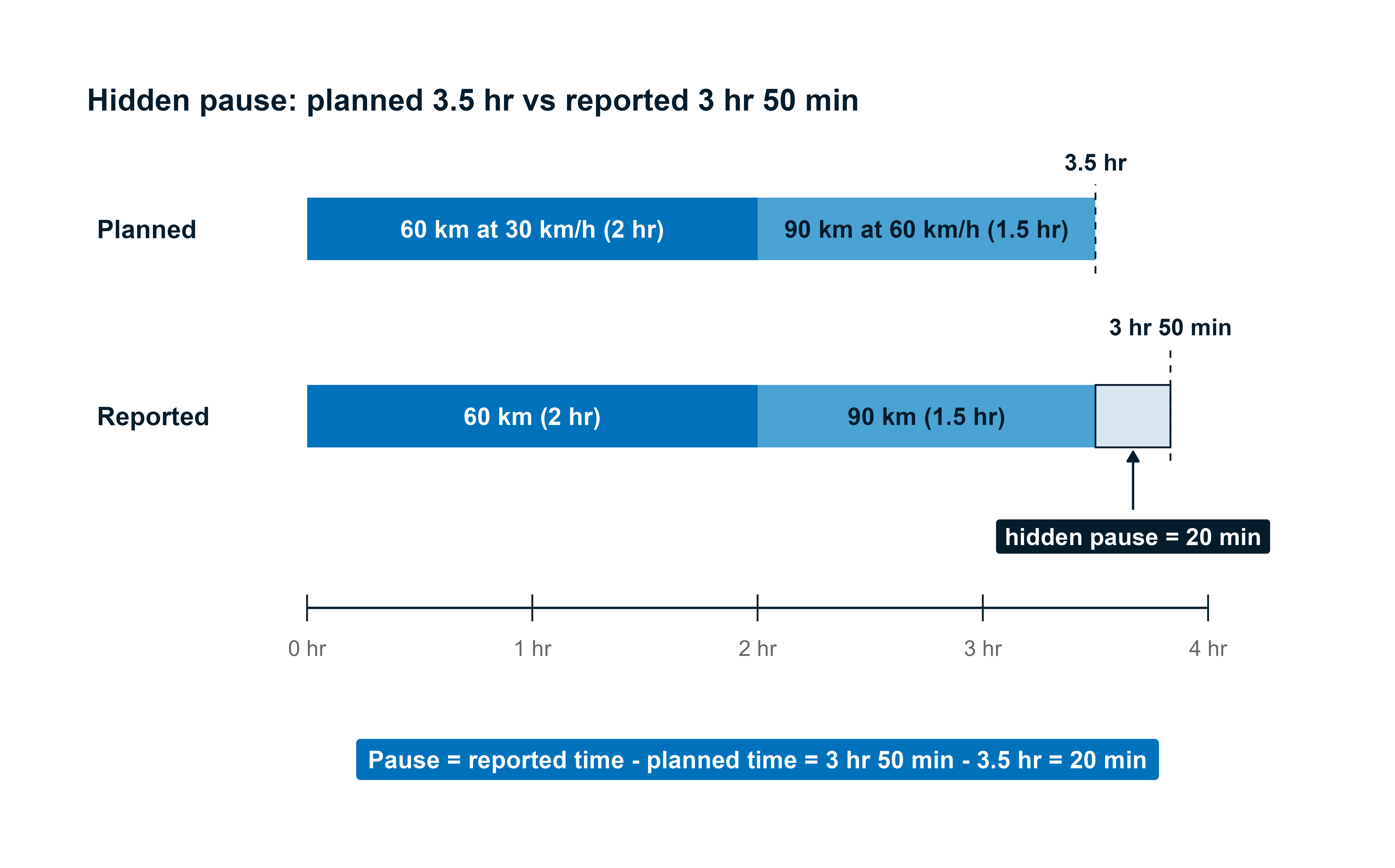
Example: Hidden pause
A person travels 60 km at 30 km/h and 90 km at 60 km/h.
Without stoppage, time is:
If the actual reported time is 3 hours 50 minutes, then:
Stoppage time:
So the hidden pause is 20 minutes.
Escalators and moving walkways
An escalator moves by itself.
A person may also walk on it.
So the total speed depends on both the person and the escalator.
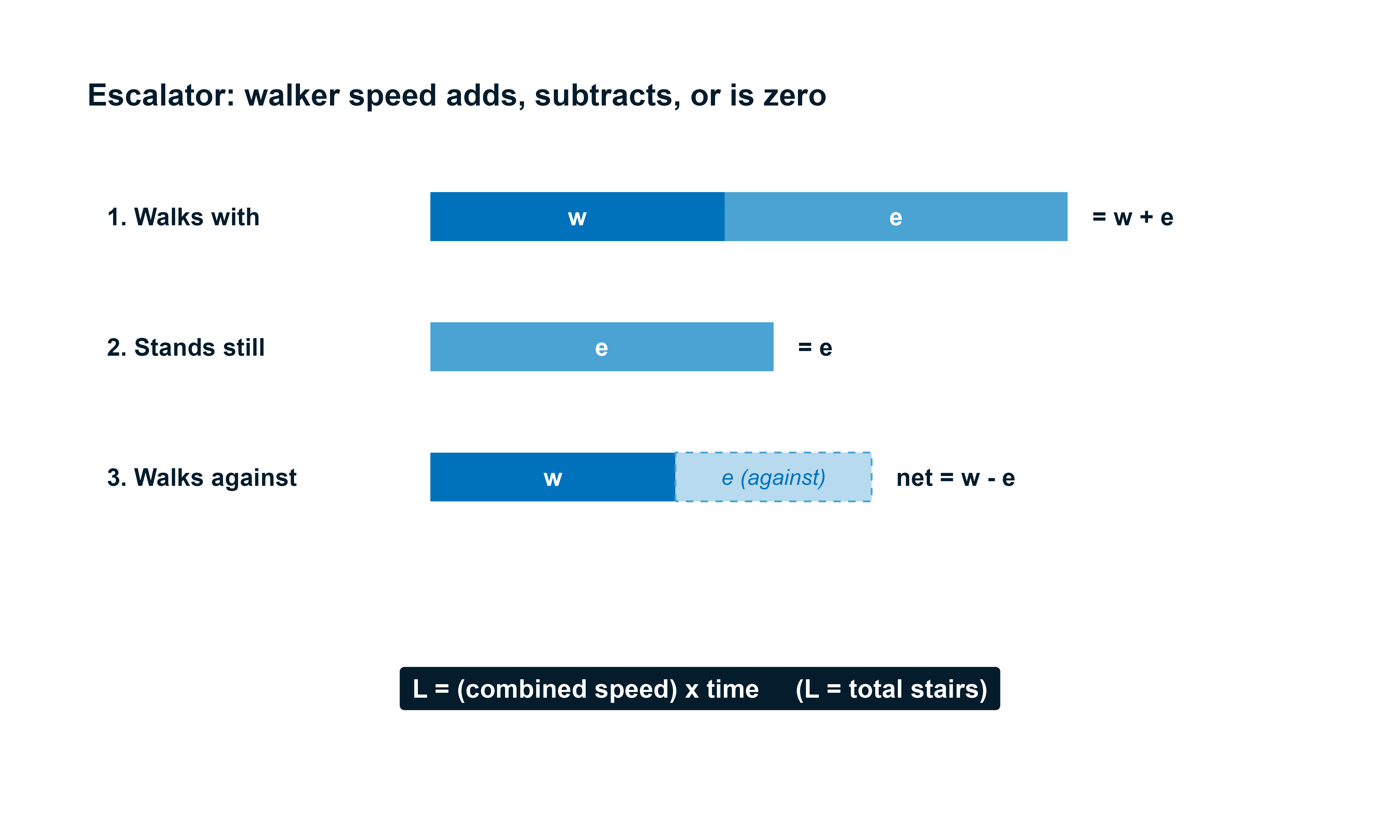
Let:
- = walking speed
- = escalator speed
- = length of the escalator in steps
If the person walks with the escalator:
If the person stands still:
If the person walks against the escalator:
assuming .
Example: Escalator stopped time
Riya takes 24 seconds to ride a moving up-escalator while walking on it.
She takes 40 seconds standing still on the same escalator.
Find how long she would take if the escalator stopped and she walked.
Let:
- = Riya's walking speed
- = escalator speed
- = length of escalator
When she walks on the moving escalator:
When she stands still:
Both equal , so:
Now, if the escalator stops, Riya covers the same length using only her walking speed.
We know:
So stopped-escalator time:
So she would take 60 seconds.
Circular motion
Circular motion questions involve movement around a closed track.
A runner may keep coming back to the same point.
Two runners may meet again and again.
The main idea is relative speed.
First meeting: Opposite directions
If two runners start at the same point and run in opposite directions, they meet when together they cover one full track length.
Formula:
Here:
- = track length
- = relative speed
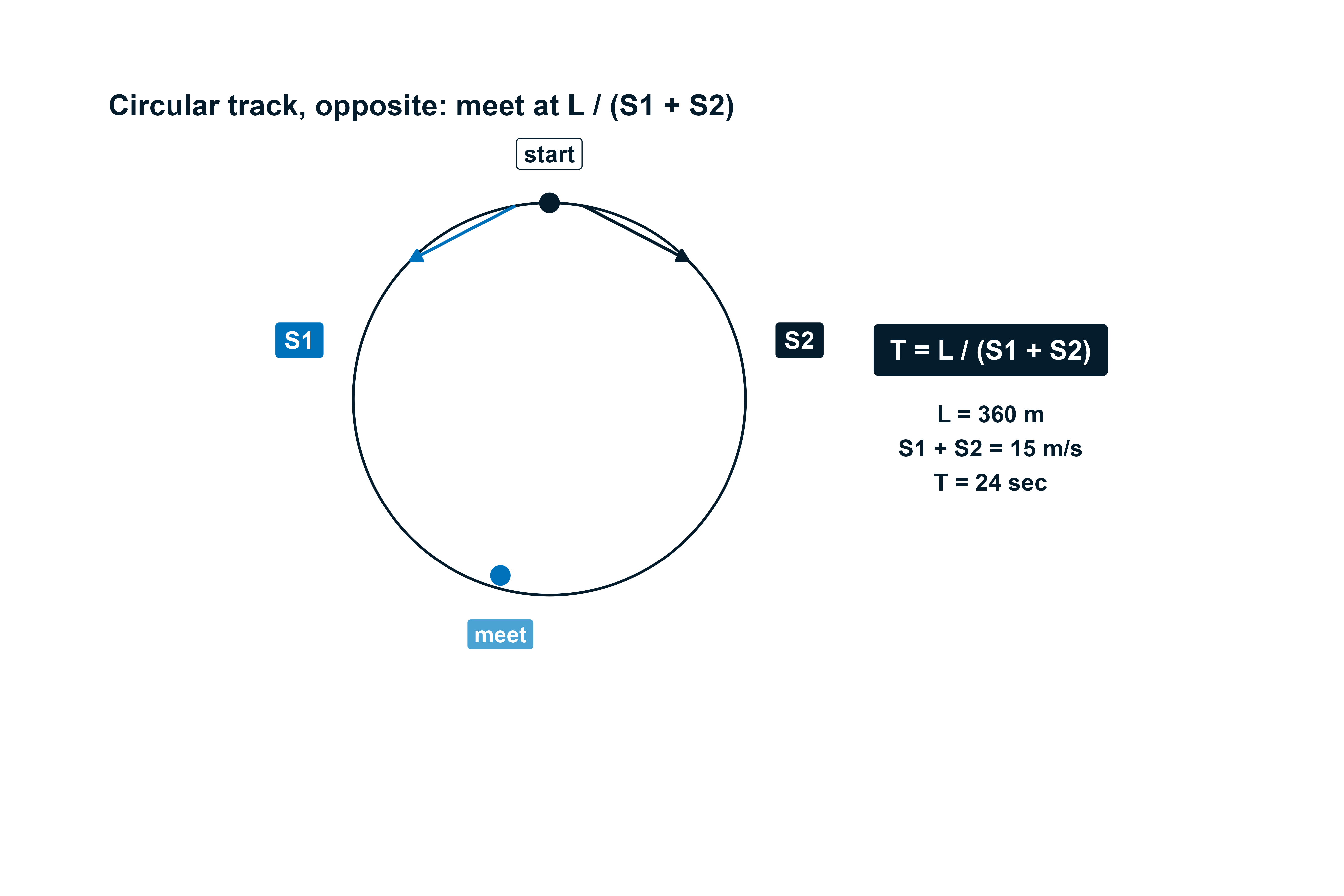
Example: First meeting in opposite directions
Two runners run on a 360 m circular track.
Their speeds are 6 m/s and 9 m/s.
They run in opposite directions.
Find when they first meet.
Relative speed:
Time:
So they first meet after 24 seconds.
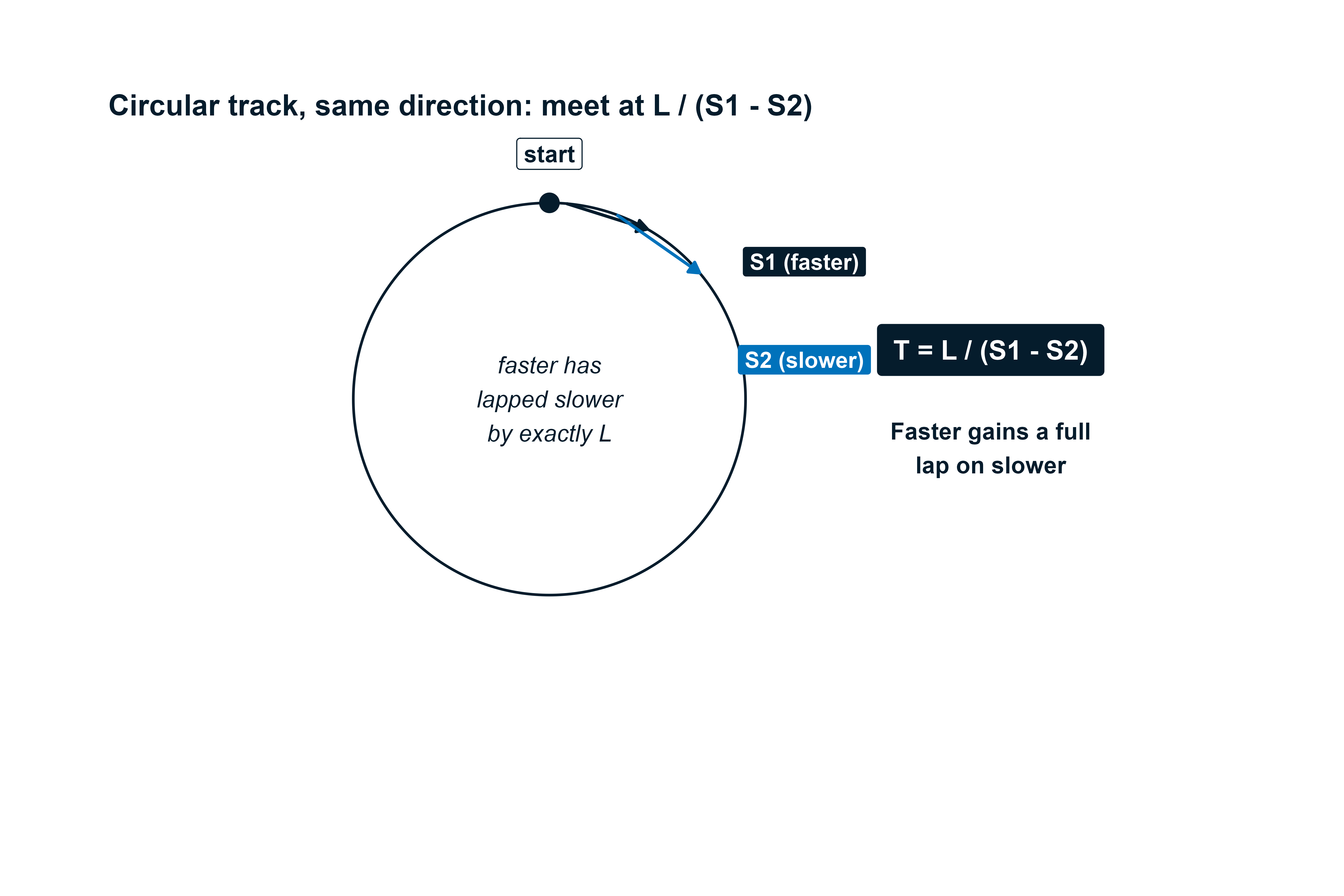
First meeting: Same direction
If two runners start at the same point and run in the same direction, the faster runner must gain one full lap on the slower runner.
Formula:
Example: First meeting in same direction
Two runners run on a 400 m circular track in the same direction.
Their speeds are 8 m/s and 6 m/s.
Find when they first meet again.
Relative speed:
Time:
So they first meet again after 200 seconds.
Meeting at the starting point
Meeting anywhere on the track is different from meeting at the starting point.
For meeting at the starting point, use lap times.
Find the time each runner takes to complete one lap.
Then take the LCM.
Example: Meet at starting point
Two runners have lap times 48 seconds and 60 seconds.
Find when they first meet again at the starting line.
So they meet at the starting line after 240 seconds.
So the answer is 4 minutes.
Number of meetings in a fixed time
Suppose two runners run for a fixed time.
First find how many laps each runner covers.
Let:
- = laps covered by faster runner
- = laps covered by slower runner
If they run in opposite directions:
If they run in the same direction:
The symbol means take the whole-number part.
Example: Meetings in 10 minutes
Two runners run on a 200 m circular track.
Their speeds are 4 m/s and 6 m/s.
They run in the same direction for 10 minutes.
Find how many times they meet.
Convert 10 minutes into seconds:
Faster runner distance:
Number of laps:
Slower runner distance:
Number of laps:
Same direction meetings:
So they meet 6 times.
Distinct meeting points
The number of meetings and the number of distinct meeting points are different.
Two runners may meet many times, but some meetings may happen at the same physical points.
If speeds are in the ratio (a:b) in lowest form:
| Direction | Distinct meeting points | ||
|---|---|---|---|
| Opposite directions | (a+b) | ||
| Same direction | ( | a-b | ) |
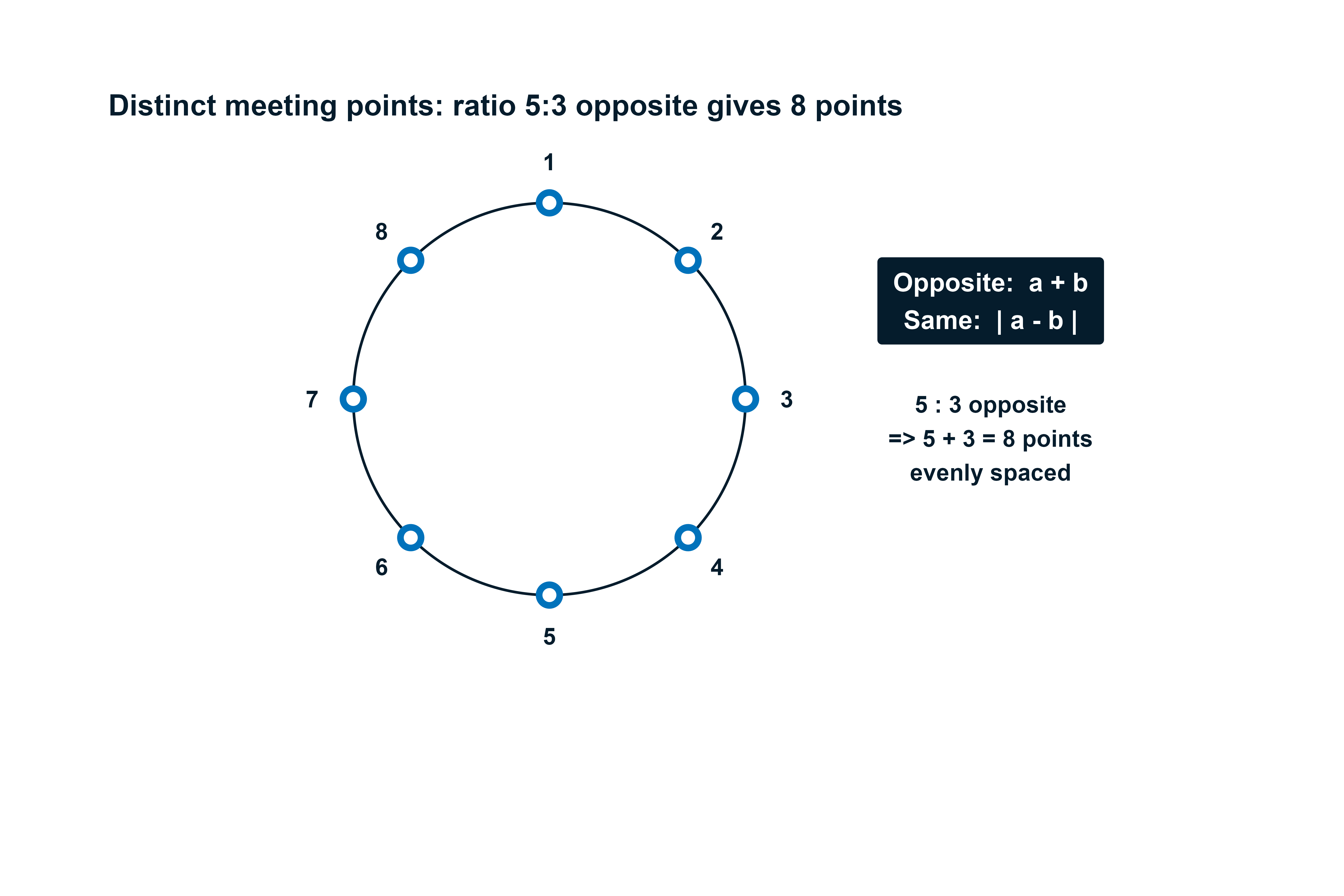
Example: Distinct meeting points
Two runners have speed ratio (5:3).
If they run in opposite directions:
So there are 8 distinct meeting points.
If they run in the same direction:
So there are 2 distinct meeting points.
Circular motion summary
| Question type | Formula | ||
|---|---|---|---|
| First meeting, opposite directions | |||
| First meeting, same direction | |||
| Meet again at starting point | LCM of lap times | ||
| Meetings in fixed time, opposite directions | |||
| Meetings in fixed time, same direction | |||
| Distinct meeting points, opposite directions | (a+b) | ||
| Distinct meeting points, same direction | ( | a-b | ) |
Three or more runners
For three runners, use pairwise thinking.
If the question asks when all three meet at the starting point, use the LCM of their lap times.
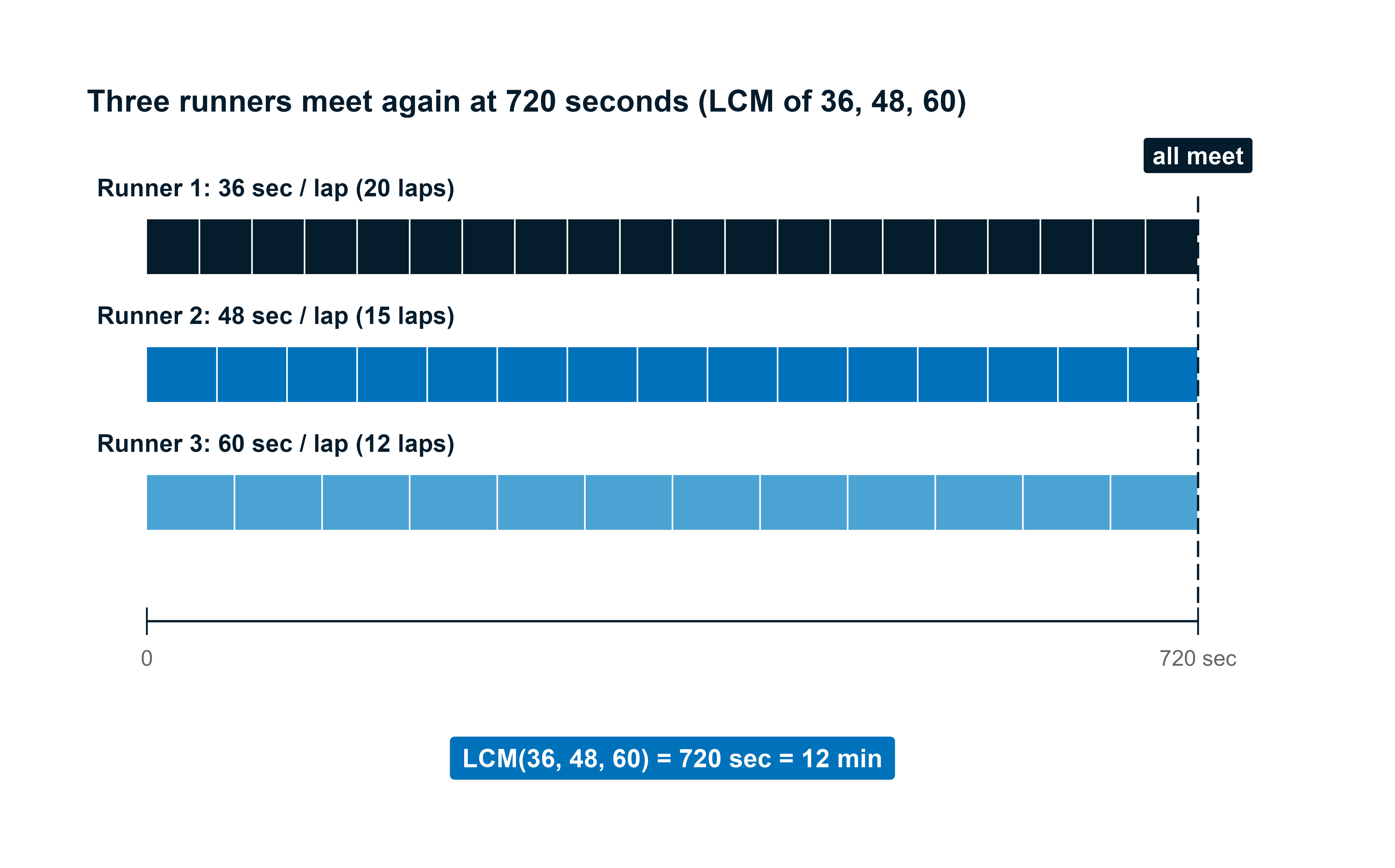
Example: Three runners meet at start
Three runners have lap times:
- 36 seconds
- 48 seconds
- 60 seconds
Find when they all meet again at the starting point.
So they all meet at the starting point after 720 seconds.
Clock hands
Clock-hand questions are circular motion questions.
The minute hand moves faster than the hour hand.
In one hour:
- Minute hand moves 360 degrees
- Hour hand moves 30 degrees
So the minute hand gains on the hour hand at:
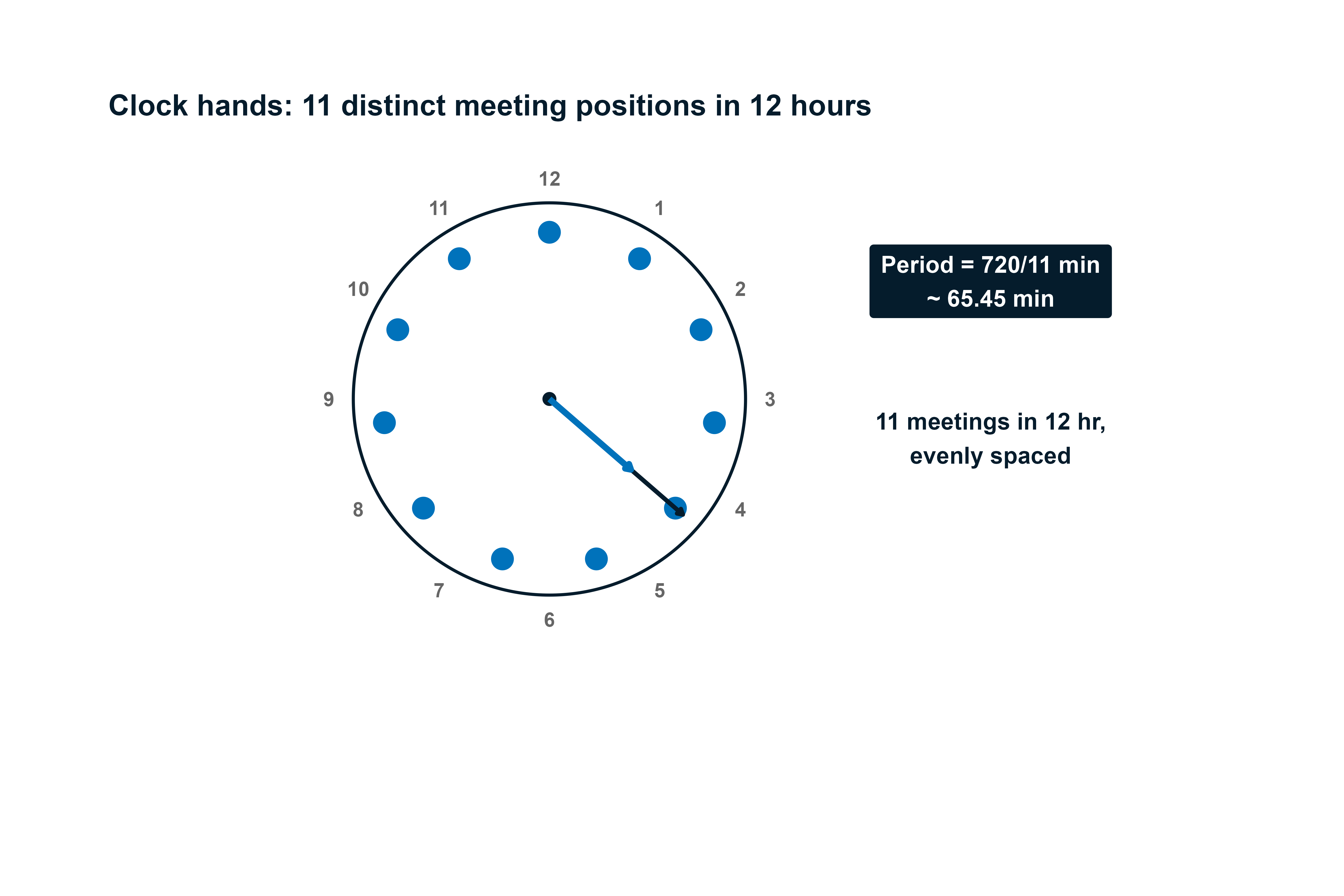
The hands overlap when the minute hand gains 360 degrees.
Time between two overlaps:
So the hands overlap every minutes.
In 12 hours, they overlap 11 times.
Example: Clock hands between 4 and 5
Find when the hour and minute hands overlap between 4:00 and 5:00.
At 4:00:
- Minute hand is at 12
- Hour hand is at 4
The angle between them is:
The minute hand gains at:
Time needed:
Convert to minutes:
So the hands overlap about 21.82 minutes after 4:00.
That is about 4:21:49.
Trigger phrases and methods
| If the question says... | Use this idea |
|---|---|
| Same distance, different speeds | Time ratio is reverse of speed ratio |
| Same time, different speeds | Distance ratio equals speed ratio |
| Same speed, different times | Distance ratio equals time ratio |
| Late by / early by | Find the difference in arrival times |
| Misses by / catches before | Add the two time gaps |
| Speed becomes a fraction of usual speed | Time becomes the inverse fraction |
| Towards each other | Add speeds |
| Same direction / chasing | Subtract speeds |
| Crosses a pole | Train covers its own length |
| Crosses a platform or bridge | Train covers train length + platform/bridge length |
| Two trains cross | Use combined length and relative speed |
| Boat downstream | (B+S) |
| Boat upstream | (B-S) |
| Race beaten by metres | Use distance ratio at the same time |
| Equal-distance average speed | Harmonic mean |
| Equal-time average speed | Arithmetic mean |
| Including and excluding stoppages | Compare the two average speeds |
| Circular track, opposite directions | |
| Circular track, same direction | |
| Meet at starting point | LCM of lap times |
| Clock hands overlap | Relative angular speed = 330 degrees/hour |
| Escalator or moving walkway | Add or subtract walking speed and escalator speed |
When to make cases
Most time, speed, and distance questions do not need many cases.
But cases may be needed when the question gives more than one possible direction, route, or value.
Case from direction
Example:
Two trains may be moving in the same direction or opposite directions.
The crossing time changes depending on direction.
| Case | Direction | Relative speed |
|---|---|---|
| Case 1 | Opposite directions | |
| Case 2 | Same direction |
Use the condition in the question to decide which case is correct.
Case from route
Example:
A person may go from A to C directly, or through B.
| Case | Route |
|---|---|
| Case 1 | A to C directly |
| Case 2 | A to B to C |
Find the time for each route and compare.
Case from circular motion direction
On a circular track, the formula depends on direction.
| Case | Direction | First meeting time |
|---|---|---|
| Case 1 | Same direction | |
| Case 2 | Opposite directions |
Always check whether the runners move in the same direction or opposite directions.
Case from two roots
Some algebra-based time-speed-distance equations may give two possible answers.
If two values come out, test both.
Remove the value that gives negative time, impossible speed, or breaks a given condition.
Checklist
- Use for every motion question
- Rearrange it as or when needed
- Convert km/h to m/s using
- Convert m/s to km/h using
- Check which quantity is constant: distance, time, or speed
- If distance is constant, speed and time are inverse
- If time is constant, distance and speed are direct
- If speed is constant, distance and time are direct
- In late/early questions, convert the arrival gap into ratio units
- In miss/catch questions, add the two time gaps
- For relative speed, add speeds in opposite directions
- For relative speed, subtract speeds in the same direction
- For trains crossing a pole, use the train's length
- For trains crossing a platform or bridge, use train length plus platform or bridge length
- For two trains crossing, use both train lengths and relative speed
- For boats, remember downstream = (B+S) and upstream = (B-S)
- For races, use distance ratio at the same time
- For average speed, use total distance divided by total time
- For equal-distance average speed, use harmonic mean
- For equal-time average speed, use arithmetic mean
- For stoppage questions, compare average speed with and without stoppages
- For circular motion, use relative speed for meeting anywhere
- For meeting at the start, use LCM of lap times
- For clock hands, use relative speed of 330 degrees per hour
- Check final units before writing the answer
Practice questions
Question 1 (CAT 2020 Slot 1)
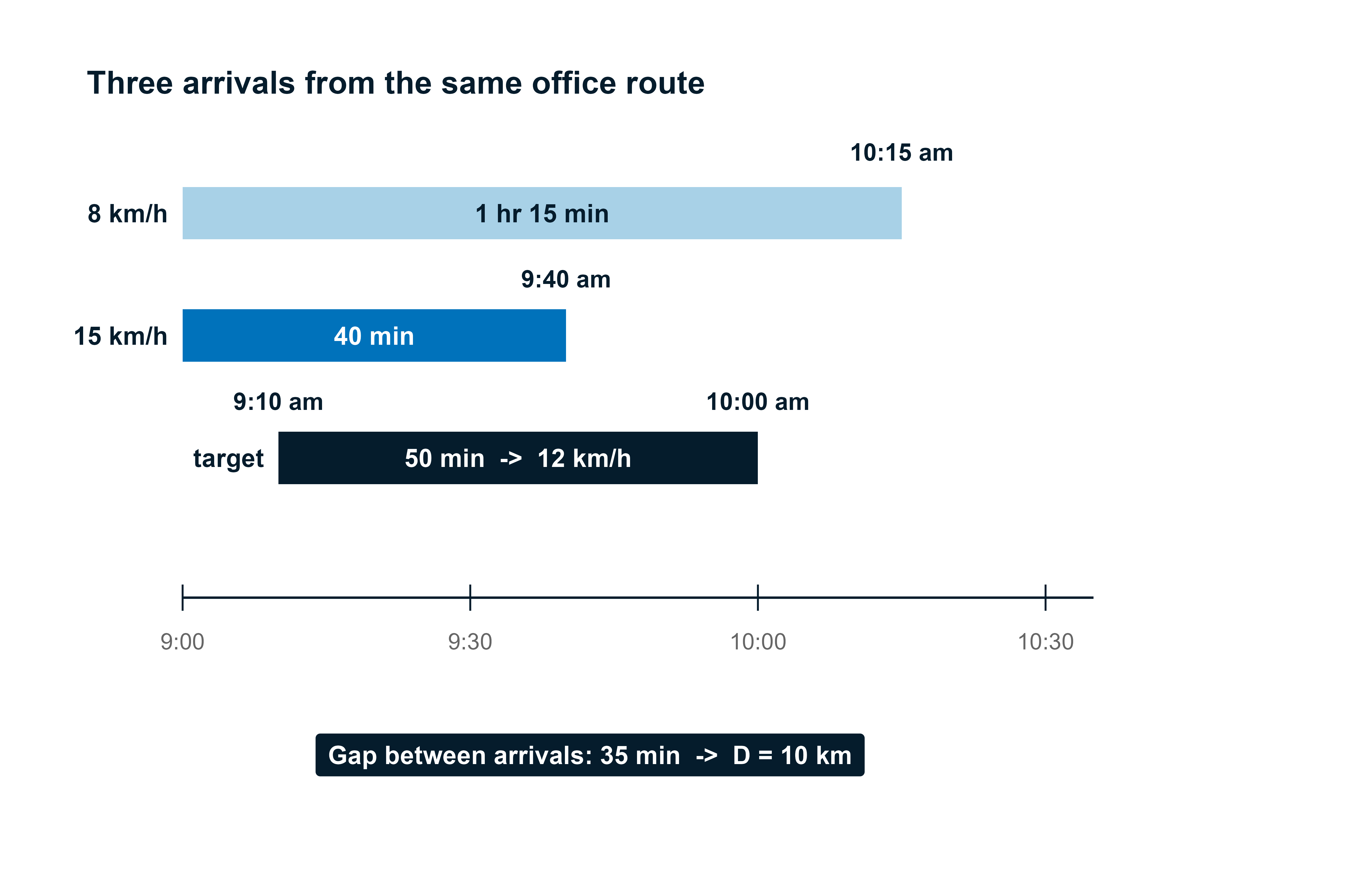
Leaving home at the same time, Amal reaches the office at am if he travels at km/hr, and at am if he travels at km/hr. Leaving home at am, at what speed, in km/hr, must he travel so as to reach the office exactly at am?
A. 13 B. 12 C. 14 D. 11
Answer: B.
We know that Amal travels the same distance to his office in both scenarios. By comparing his arrival times, we can find out how long the journey actually is.
The difference between arriving at am and am is minutes. Because his speeds are given in km/hr, let's convert this time difference into hours:
If we let be the distance from home to the office in km, we can use the relationship that time is distance divided by speed. The difference in the time taken for the two trips is:
To solve for , we find a common denominator for and , which is :
Multiplying both sides by gives us , which means km.
Now that we know the office is km away, we can determine the time Amal usually leaves home. Let's look at his km/hr trip. The time it takes is:
Since hours is the same as minutes ( of minutes), the trip takes hour and minutes. If he arrives at am, we can subtract the travel time to find his departure time:
So, Amal normally leaves home at am.
In the final scenario, Amal leaves home at am and needs to reach the office by am.
The time available for this journey is minutes. To use our speed formula, we convert this into hours:
To find the required speed, we divide the km distance by this new time:
When we divide by a fraction, we multiply by its reciprocal (the flipped fraction):
Question 2 (CAT 2019 Slot 1)
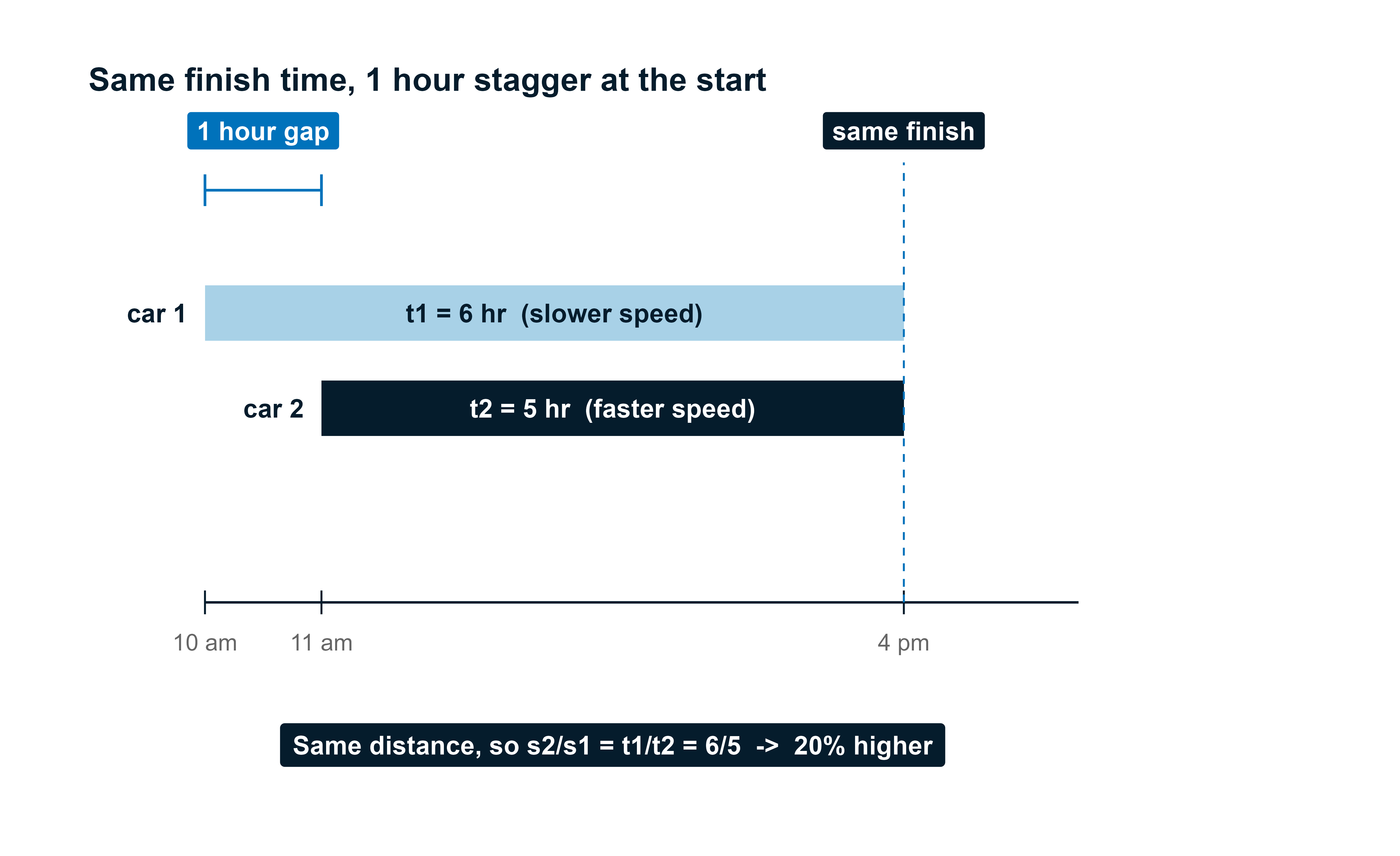
Two cars travel the same distance starting at am and am, respectively, on the same day. They reach their common destination at the same point of time. If the first car travelled for at least hours, then the highest possible value of the percentage by which the speed of the second car could exceed that of the first car is
A. 20 B. 30 C. 25 D. 10
Answer: A.
Let's start by looking at the timing. Car starts at am and Car starts at am. Because they both reach the destination at the same time, Car must have been driving for exactly one hour more than Car .
If we call the time Car spent driving and the time Car spent driving , we have:
Now, let's think about their speeds. Both cars cover the same distance. When distance is constant, speed and time have an "inverse" relationship: if you take less time, you must be going faster.
This means the ratio of their speeds is the reverse of the ratio of their times. If is the speed of Car and is the speed of Car , then:
We want to find how much faster Car is than Car as a percentage.
Since we know that the speed ratio is the same as the time ratio, we can replace the speeds with times:
We already know that the difference in time is exactly hour. So the formula simplifies to:
To make this percentage as high as possible, the number on the bottom needs to be as small as possible.
The problem tells us that the first car traveled for at least hours, so . Since Car travels for hour less than Car , the minimum time for Car is:
The smallest possible value for is hours. Let's plug this into our percentage formula:
The highest possible value of the percentage is .
Question 3 (CAT 2020 Slot 2)
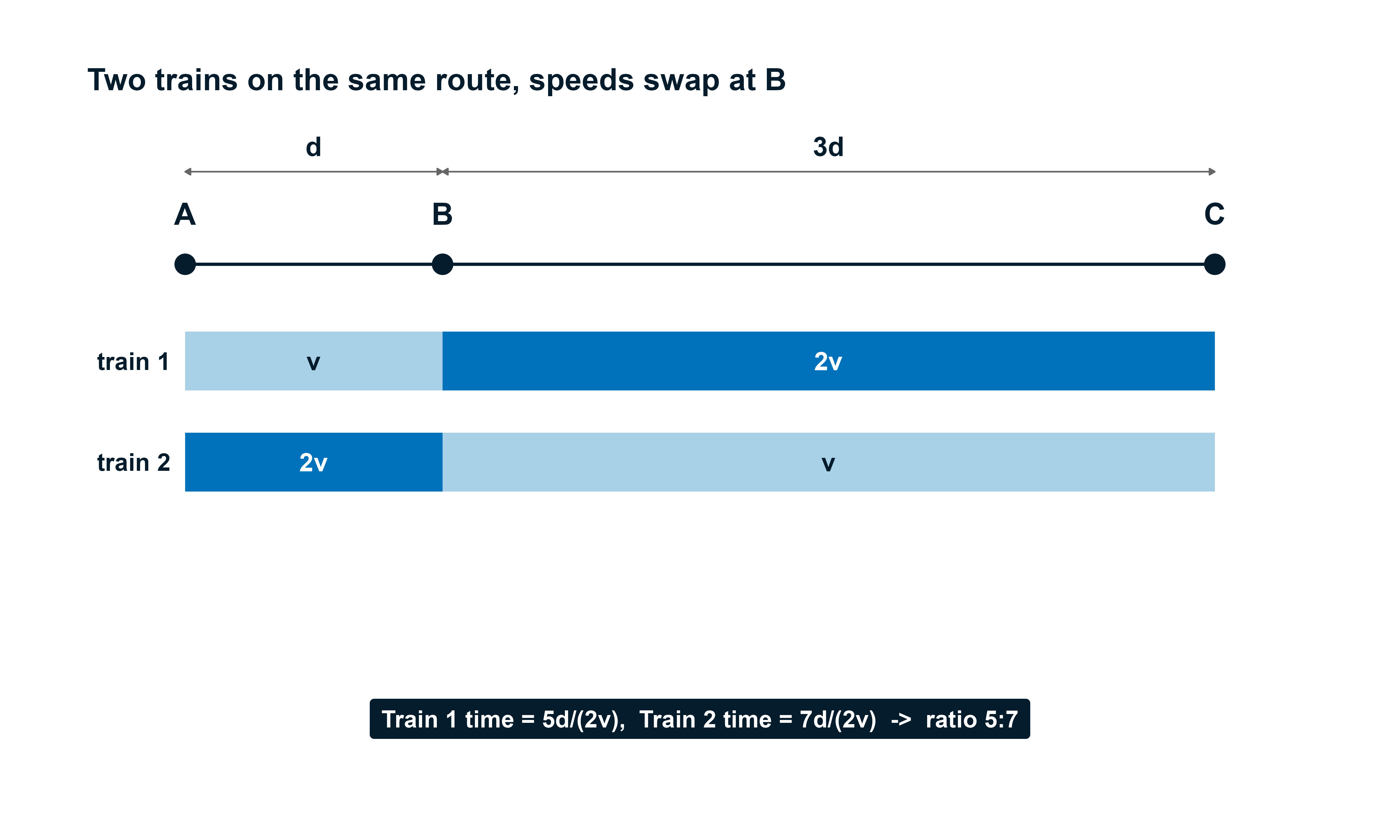
The distance from to is thrice that from to . Two trains travel from to via . The speed of train is double that of train while traveling from to and their speeds are interchanged while traveling from to . The ratio of the time taken by train to that taken by train in travelling from to is
A. B. C. D.
Answer: A.
Let's picture the journey in two parts. First, we have the distance from to . Let's call this distance . The problem tells us the next stretch, from to , is three times as long, so we can call it .
Next, let's look at the speeds. For the first part of the trip (from to ), let's say the speed of Train is . Since Train is twice as fast during this stretch, its speed is .
To find the time taken for any journey, we use the standard relationship:
For Train , the journey happens in two stages:
- From to : It covers distance at speed . The time taken is .
- From to : The problem says the speeds are interchanged for this part. This means Train now travels at the speed Train had originally, which was . It covers distance at this new speed. The time taken is .
To find the total time for Train , we add these two parts together:
To add these fractions, we need a common denominator of :
Now let's do the same for Train :
- From to : It covers distance at speed . The time taken is .
- From to : Because the speeds are interchanged, Train now travels at the speed Train had originally, which was . It covers distance at this speed. The time taken is .
Adding these together for the total time of Train :
Using the common denominator of again:
The question asks for the ratio of the time taken by Train to the time taken by Train .
Plugging in our results:
Since the terms and are present in both the numerator and the denominator of our main fraction, they cancel out during the division. This leaves us with the ratio:
Question 4 (CAT 2022 Slot 3)
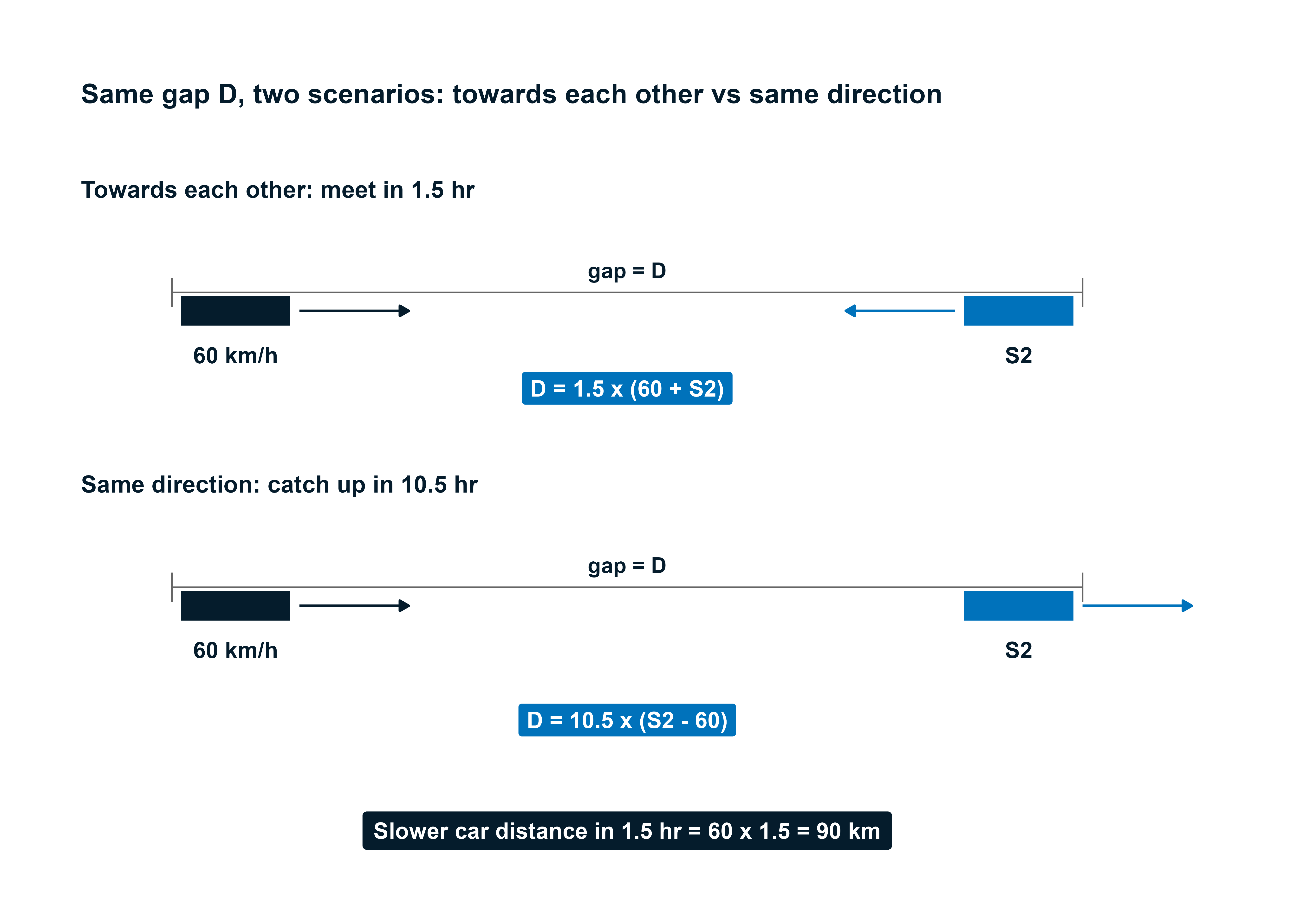
Two cars travel from different locations at constant speeds. To meet each other after starting at the same time, they take hours if they travel towards each other, but hours if they travel in the same direction. If the speed of the slower car is km/hr, then the distance traveled, in km, by the slower car when it meets the other car while traveling towards each other, is
A. 100 B. 90 C. 120 D. 150
Answer: B.
To find the distance the slower car travels, we need two pieces of information: its speed and the amount of time it was driving before it met the other car.
First, let's identify the speed. The problem tells us that the speed of the slower car is km/hr.
Next, we look for the time. The problem states that when the two cars travel towards each other, they start at the same time and take hours to meet. Since they start simultaneously, the slower car has been driving for exactly hours at the moment they meet.
The distance covered by any object moving at a constant speed is found by multiplying its speed by the time spent moving:
Now, we can plug in the values we found for the slower car:
Multiplying by gives us .
Notice that the problem also mentions a hour meeting time if the cars travel in the same direction. This information describes the relationship between the two cars' speeds, but because we are specifically asked about the "towards each other" scenario and were already given the slower car's speed, we can find the answer directly using the hour meeting time.
The distance traveled by the slower car is km.
Question 5 (CAT 2020 Slot 2)
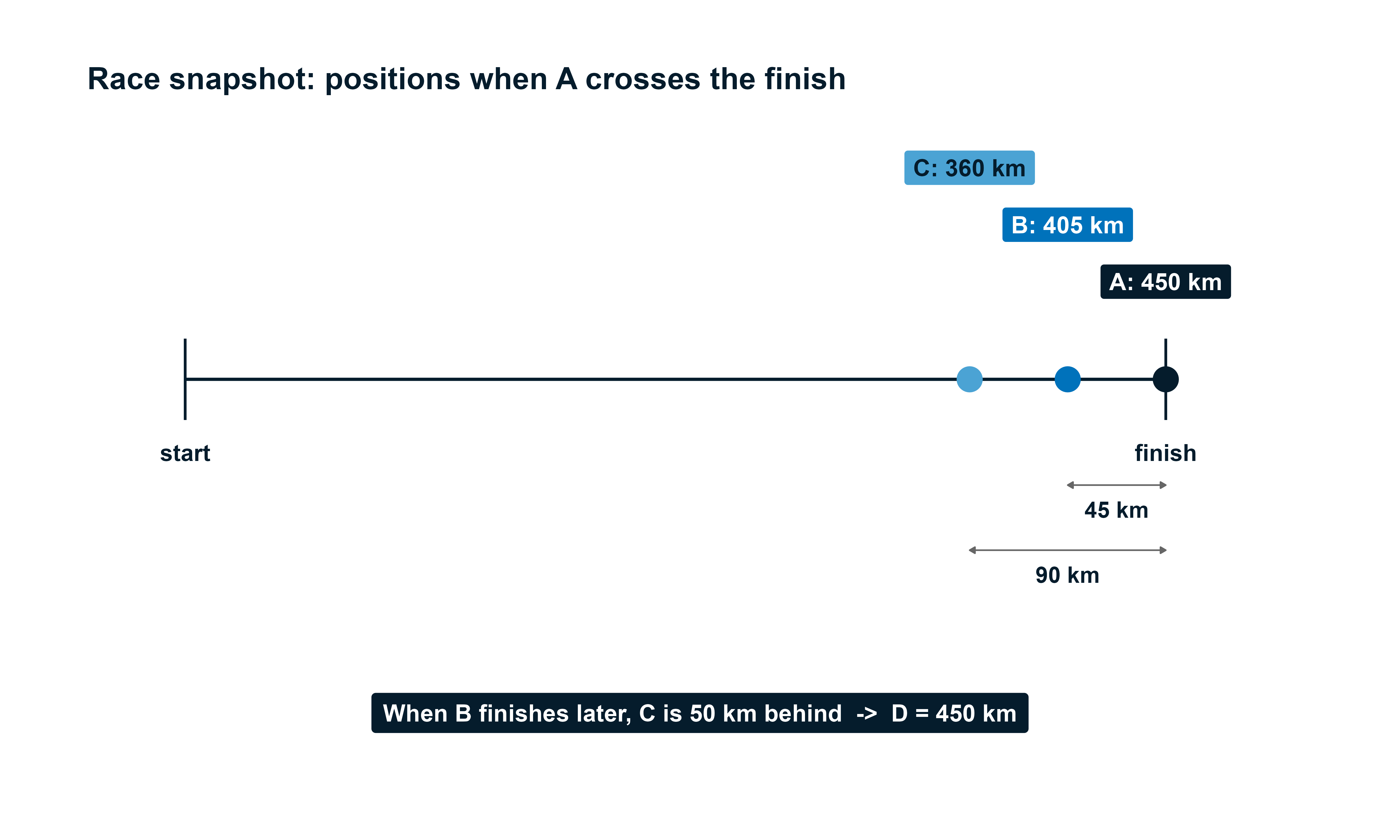
In a car race, car beats car by km. car beats car by km. and car beats car by km. The distance (in km) over which the race has been conducted is
A. 475 B. 450 C. 500 D. 550
Answer: B.
Let's start by imagining the race. In a race, "beating" someone by a certain distance means that when the winner crosses the finish line, the other person is still that many kilometers behind.
Let's call the total race distance . When Car finishes the race, it has covered the full km. At that exact moment, we can see how far the other cars have traveled based on the gaps mentioned:
- Car has covered km.
- Car is km behind, so it has covered km.
- Car is km behind Car , so it has covered km.
Now, consider what happens when Car finishes. The problem says Car beats Car by km. This gives us another look at the relationship between Car and Car when they reach the finish line:
- Car has covered the full km.
- Car is km behind it, so Car has covered km.
Since the cars are moving at steady speeds, the ratio of the distances they cover will stay the same throughout the race. We can organize what we know about Car and Car into a table:
| Moment in Time | Distance covered by | Distance covered by |
|---|---|---|
| When finishes | ||
| When finishes |
Because the ratio of their distances is constant, we can set up a relationship:
The ratio of distances in the first moment must equal the ratio in the second moment.
Plugging in our values from the table:
To find the value of , we can cross-multiply the terms:
Now, let's multiply out the brackets:
Since appears on both sides of the equals sign, they cancel each other out:
Next, we move the terms to the same side by adding to both sides:
Finally, divide by :
The total distance of the race is km.
Question 6 (CAT 2024 Slot 3)
A train travelled a certain distance at a uniform speed. Had the speed been km per hour more, it would have needed hours less. Had the speed been km per hour less, it would have needed hours more. The distance, in km, travelled by the train is
A. 720 B. 800 C. 780 D. 640
Answer: A.
Let's start by identifying the two things we do not know: the train's usual speed and the time it normally takes. We can call the original speed km/hr and the original time hours.
The relationship between these is:
The problem gives us two "what-if" scenarios where the distance remains the same. Let's organize these scenarios:
| Case | Speed | Time | Distance |
|---|---|---|---|
| Original | |||
| Scenario 1 | |||
| Scenario 2 |
In Scenario 1, the distance is still the same as the original journey, so we can set them equal:
Now, we multiply the brackets:
If we subtract from both sides, we are left with:
To make this equation easier to work with, we can divide every term by :
Now let's do the same for Scenario 2. Since the distance hasn't changed here either:
Multiplying these brackets gives:
Subtracting from both sides leaves us with:
We can divide every term by to get a much simpler equation:
Now we have a system of two equations. From the second equation , we know that:
We can take this value for and plug it into our first equation :
So, the original time taken was hours. Using our relation , we can find the speed:
Finally, we find the distance by multiplying the original speed and time:
The train travelled km.
Question 7 (CAT 2020 Slot 2)
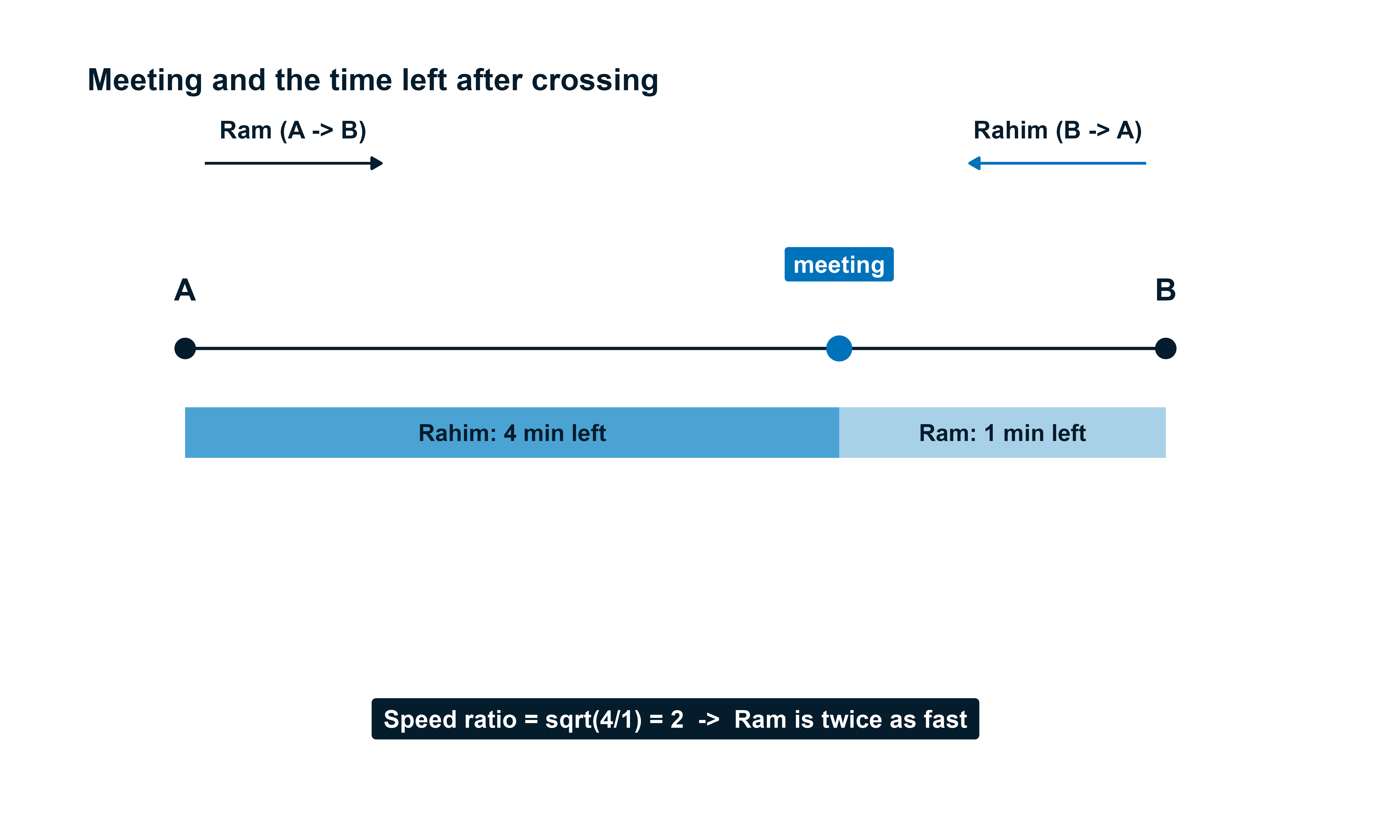
and are two points on a straight line. Ram runs from to while Rahim runs from to . After crossing each other. Ram and Rahim reach their destination in one minute and four minutes, respectively. if they start at the same time, then the ratio of Ram's speed to Rahim's speed is
A. B. C. 2 D.
Answer: C.
Imagine two runners, Ram and Rahim, starting at the same time from two different spots, and , and running towards each other. They meet somewhere in between and then keep going until they reach their respective destinations.
This specific scenario, where two people start simultaneously, meet, and then finish their journeys, has a very useful mathematical relationship. When this happens, their speeds are related to the time they take to finish the journey after they have crossed each other.
The logic here is that the faster person will take much less time to cover the remaining distance than the slower person. The rule for this situation is:
The ratio of their speeds is equal to the square root of the times they take to finish, but in reverse order.
In plain English:
Ram's speed / Rahim's speed = Square root of (Rahim's time / Ram's time)
Now, let's identify the times given in the problem to plug into our word equation:
- Time taken by Ram to reach his destination after meeting is one minute. Let's call this .
- Time taken by Rahim to reach his destination after meeting is four minutes. Let's call this .
Using our ratio:
Substitute the numbers:
Since the square root of is and the square root of is , we get:
The ratio of Ram's speed to Rahim's speed is 2.
Question 8 (CAT 2021 Slot 1)
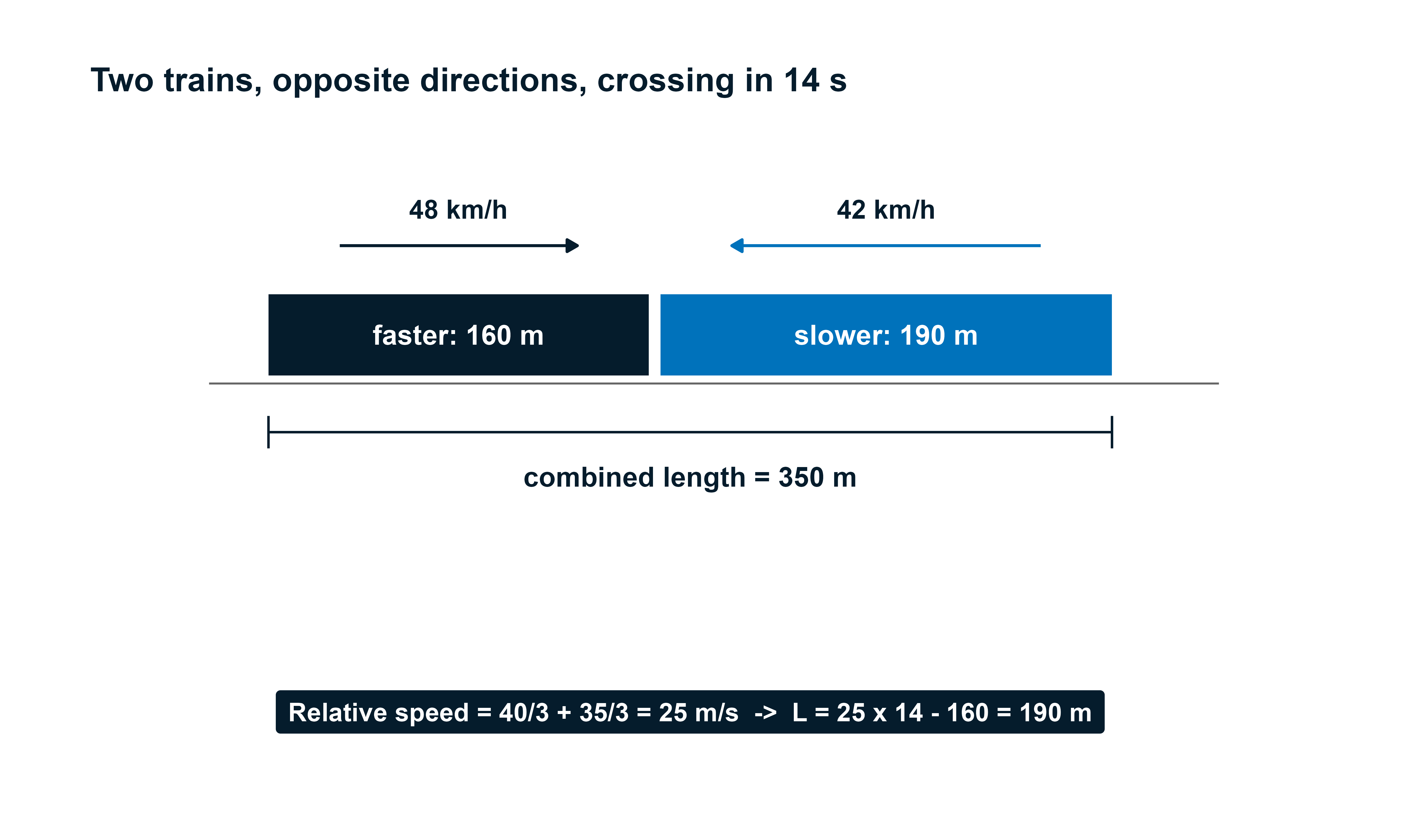
Two trains cross each other in seconds when running in opposite directions along parallel tracks. The faster train is m long and crosses a lamp post in seconds. If the speed of the other train is km/hr less than the faster one, its length, in m, is
A. 184 B. 192 C. 190 D. 180
Answer: C.
First, let's find the speed of the faster train. When a train crosses a lamp post, the distance it travels is exactly equal to its own length.
We know the distance is m and the time taken is seconds.
Let's call this speed :
The problem mentions that the other train's speed is km/hr slower. To compare these speeds easily, we should convert the faster train's speed from meters per second (m/s) to kilometers per hour (km/hr) by multiplying by .
Now we can find the speed of the second (slower) train. We are told it is km/hr slower than the first one.
Since the crossing time is given in seconds and the lengths are in meters, let's convert this speed back to m/s by multiplying by .
Let's call the slower speed :
When two trains move toward each other (opposite directions), they close the gap between them much faster. To account for this, we add their speeds together to get a "relative speed."
When two trains cross each other completely, the total distance they cover together is the sum of their individual lengths. We know the faster train is m long, but we don't know the slower train's length, so let's call it .
We can also calculate this total distance using the relative speed and the time it took them to cross ( seconds).
Finally, we set these two expressions for total distance equal to each other to find :
The length of the slower train is m.
Question 9 (CAT 2022 Slot 1)
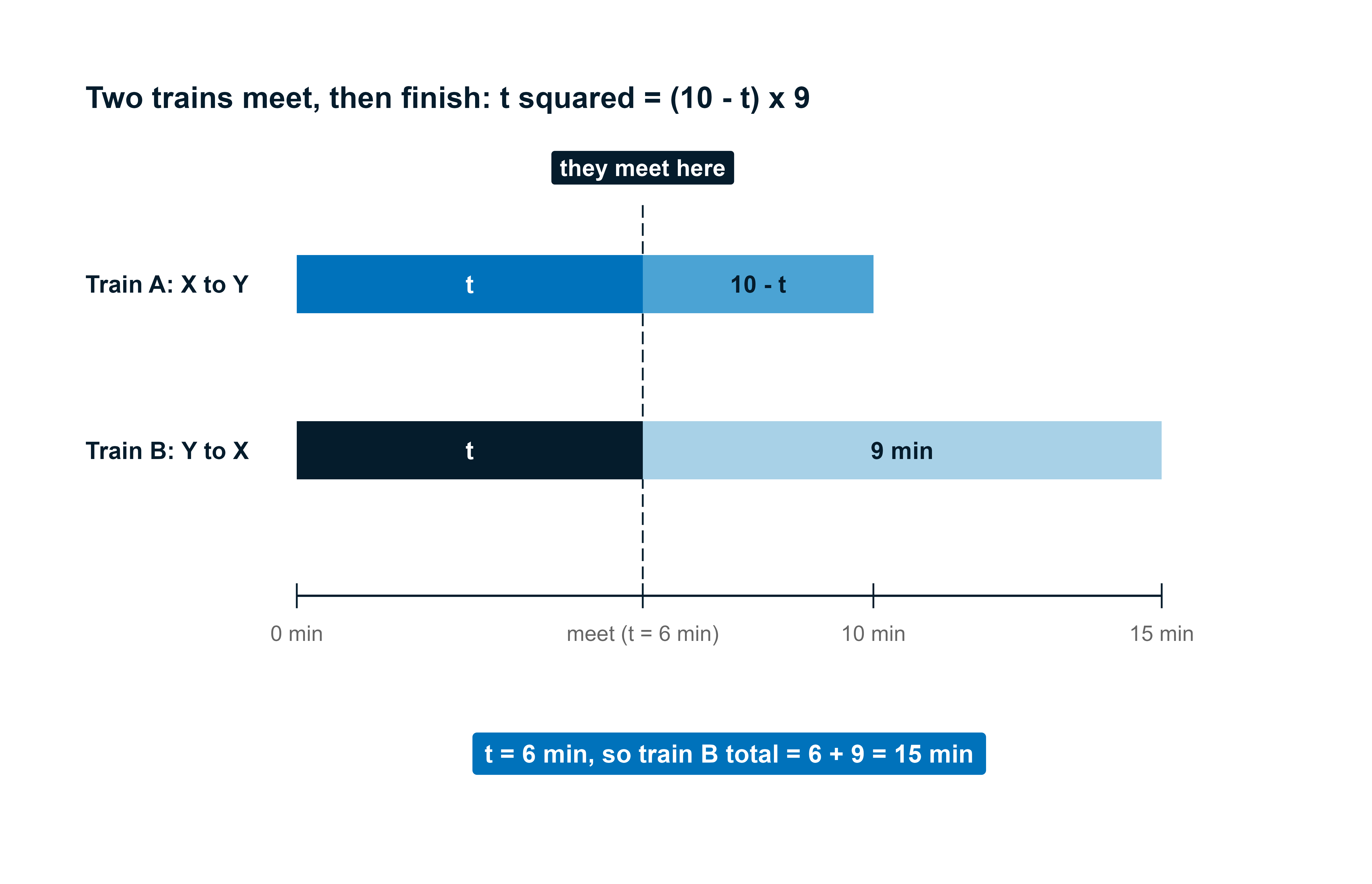
Trains and start traveling at the same time towards each other with constant speeds from stations and , respectively. Train reaches station in minutes while train takes minutes to reach station after meeting train . Then the total time taken, in minutes, by train to travel from station to station is:
A. 6 B. 15 C. 10 D. 12
Answer: B.
Let's imagine the two trains starting at the same time and traveling for minutes before they cross paths.
Train takes a total of minutes to travel from station to station . Since it has already spent minutes reaching the meeting point, we can find the time it has left to complete its journey:
The problem tells us that after meeting Train , Train takes more minutes to reach its destination, station .
The mention of how long a train takes after meeting is a specific clue. When two objects start at the same time and move toward each other, there is a helpful relationship between the time spent before they meet and the time spent after they pass each other:
We can now plug our values into this word equation:
Now we solve for :
To solve this quadratic equation, we move all terms to the left side:
We need to find two numbers that multiply to and add up to . The numbers and fit perfectly:
This gives us two possible values for : or . Because time cannot be negative, we know the meeting time must be minutes.
The question asks for the total time Train takes to travel from station to station . This is the sum of the time it spent getting to the meeting point and the time it spent finishing the trip after the meeting:
The total time taken by Train is 15 minutes.
Question 10 (CAT 2022 Slot 3)
Moody takes seconds to finish riding an escalator if he walks on it at his normal speed in the same direction. He takes seconds to finish riding the escalator if he walks at twice his normal speed in the same direction. If Moody decides to stand still on the escalator, then the time, in seconds, needed to finish riding the escalator is
Type In The Answer.
Answer: 60.
Think of the escalator like a river current. When Moody walks in the same direction the escalator is moving, their speeds add up. If we call the length of the escalator , Moody's normal walking speed , and the speed of the escalator , we can use the basic idea that distance equals speed multiplied by time:
In the first case, Moody walks at his normal speed . So, his total speed is . We are told this takes seconds:
In the second case, he walks at twice his normal speed . His total speed becomes . This takes seconds:
Since the length of the escalator hasn't changed, these two expressions for must be equal to each other. We can set them side by side to see how Moody's speed relates to the escalator's speed:
To make the math easier, let's divide both sides by :
Now, multiply through the parentheses:
If we move the terms to one side and the terms to the other, we find:
This tells us that the escalator is moving at the exact same speed as Moody's normal walking pace.
Now we need to find out how long it takes if Moody just stands still. If he stands still, his walking speed is , so the only speed moving him forward is the escalator's speed, .
Let's go back to our first equation for the total distance and replace Moody's speed with the escalator's speed , since we now know they are the same:
Finally, we find the time it takes to cover that distance using only the escalator's speed:
The cancels out, leaving us with seconds.
Question 11 (CAT 2020 Slot 1)
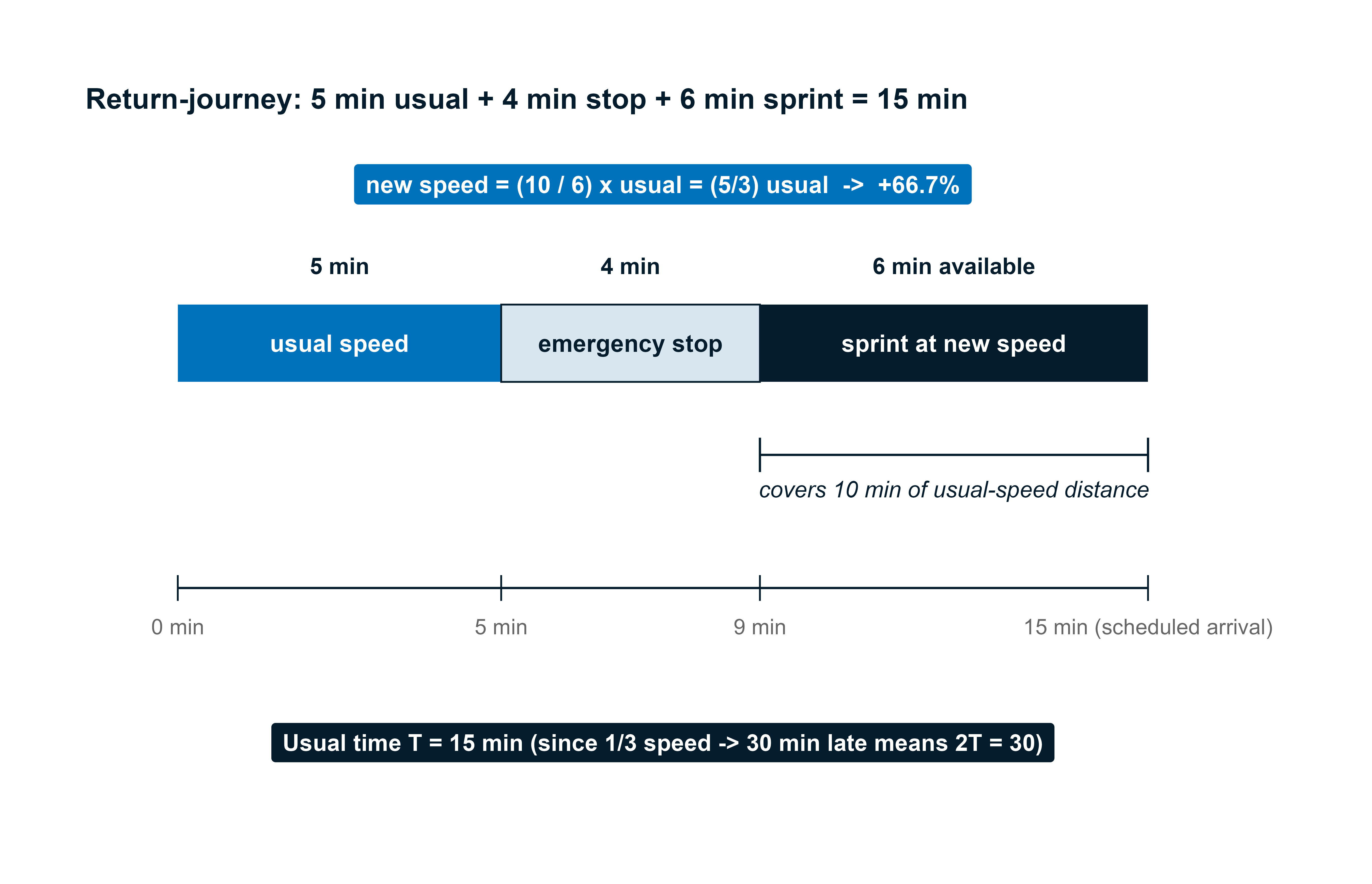
A train travelled at one-third of its usual speed, and hence reached the destination minutes after the scheduled time. On its return journey, the train initially travelled at its usual speed for minutes but then stopped for minutes for an emergency. The percentage by which the train must now increase its usual speed so as to reach the destination at the scheduled time is nearest to:
A. 50 B. 58 C. 67 D. 61
Answer: C.
We start by finding out how long the journey usually takes. There is a helpful relationship in travel: when the distance doesn't change, speed and time work like a see-saw. if one goes down, the other goes up by the same factor.
In this case, the train travels at of its usual speed. This means the time taken will be times as long as usual. Let's call the usual scheduled time .
The new time is . The problem says this makes the train minutes late.
So, the journey normally takes exactly minutes.
Now, let's look at the return journey. The train still needs to finish the whole trip in its "scheduled time" of minutes. Let's see how much time is left after the emergency:
- It travels for minutes at its usual speed.
- It stops for minutes.
Total time used so far: minutes.
Since the total time allowed is minutes, the train has only a small window left to finish the trip:
Next, we need to know how much distance is left to cover.
The whole journey usually takes minutes at the usual speed. Since the train already traveled for minutes at that usual speed, it has minutes worth of "usual distance" left to go.
So, the train must cover a -minute distance in only minutes. To find the new speed needed, we compare the original time to the new time:
To find the percentage increase, we look at how much extra speed was added.
If the new speed is of the usual speed, the increase is:
To turn a fraction into a percentage, we multiply by :
Rounding to the nearest whole number as requested, we get .
Question 12 (CAT 2017 Slot 1)
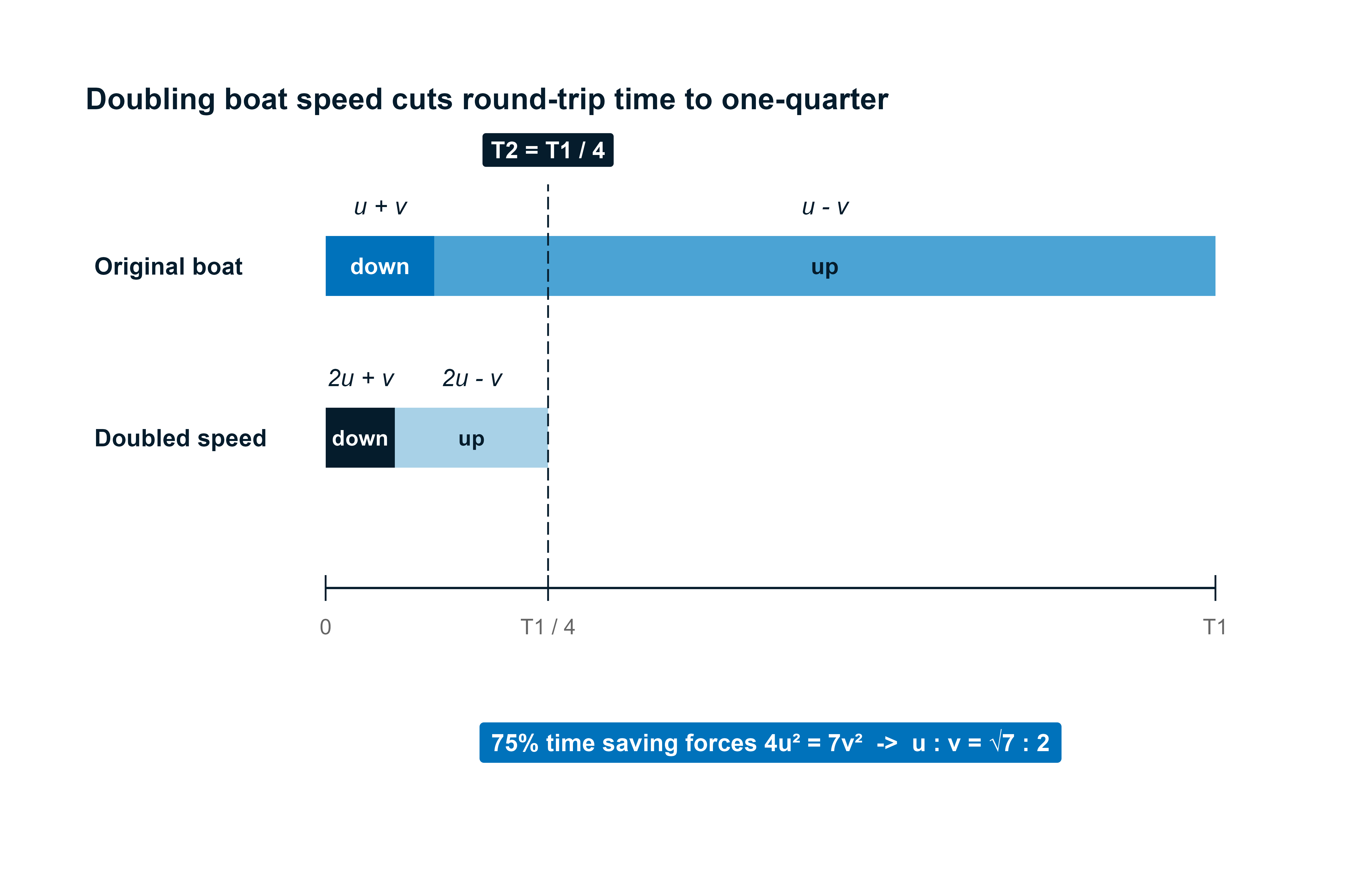
A man travels by a motor boat down a river to his office and back. With the speed of the river unchanged, if he doubles the speed of his motor boat, then his total travel time gets reduced by . The ratio of the original speed of the motor boat to the speed of the river is
A. B. C. D.
Answer: B.
When a boat moves in a river, its actual speed depends on whether it is going with the flow or against it. Let's use for the original speed of the motor boat in still water and for the speed of the river.
When the boat goes downstream (with the flow), the speeds add up to . When it goes upstream (against the flow), the boat has to fight the current, so the speed is . If the distance to the office is , the time taken for the whole round trip is the sum of the downstream time and the upstream time.
Original total time = (Distance / Downstream speed) + (Distance / Upstream speed)
To combine these fractions, we use a common denominator , which is .
Now, the boat's speed is doubled, making it , while the river's speed stays exactly the same. We can find the new total time, which we will call , using the same logic.
New downstream speed =
New upstream speed =
New total time = (Distance / New downstream speed) + (Distance / New upstream speed)
Combining these fractions the same way:
The problem tells us that the total travel time is reduced by . If the time drops by , it means the boat now takes only of the original time. Since is as a fraction, we can set up our relationship.
New time = Original time
Substituting the expressions we built:
Now we solve for the ratio of to . Notice that and appear on both sides of the equation, so they cancel out.
We cross-multiply to get rid of the denominators:
Next, we group the terms on one side and the terms on the other:
To find the ratio of the boat's speed to the river's speed , we rearrange the equation:
Taking the square root of both sides:
The ratio of the original speed of the boat to the speed of the river is .
Question 13 (CAT 2020 Slot 3)
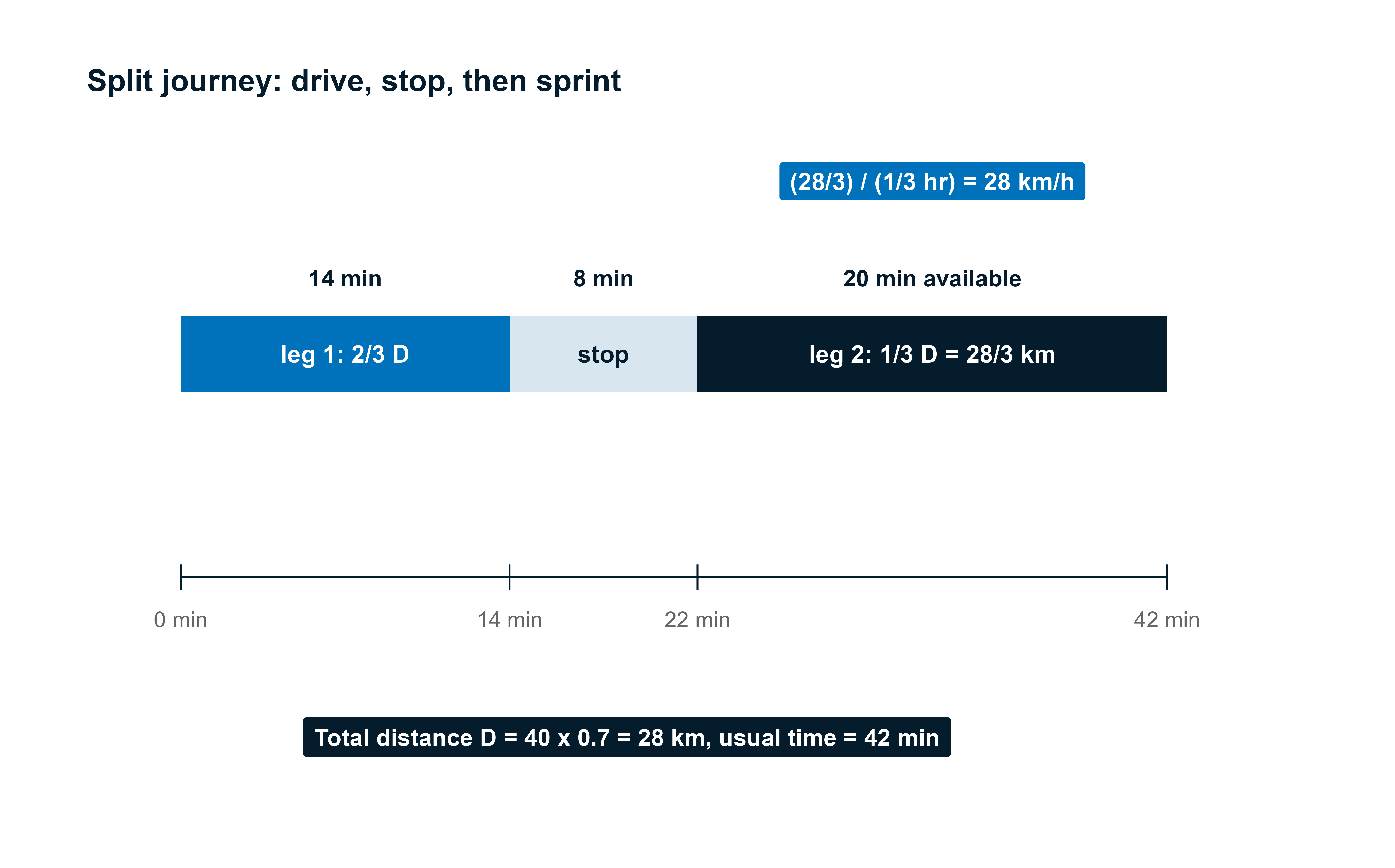
Vimla starts for office every day at am and reaches exactly on time if she drives at her usual speed of km/hr. She is late by minutes if she drives at km/hr. One day, she covers two-thirds of her distance to office in one-thirds of her usual total time to reach office, and then stops for minutes. The speed, in km/hr, at which she should drive the remaining distance to reach office exactly on time is
A. 29 B. 26 C. 28 D. 27
Answer: C.
Vimla's journey has a fixed distance. We know that if she goes slower, she takes longer. Since we have her usual speed and a slower speed , we can compare the two scenarios to find the distance and the time she usually takes.
Let be her usual time in hours. We can express distance in two ways:
- At km/hr:
- At km/hr, she takes minutes longer. Since minutes is hours, the time taken is .
Now, we set these equal:
To make this easier to work with, let's convert the usual time to minutes:
The total distance to her office is:
On this specific day, the journey is split into parts. First, she covers two-thirds of the distance in one-third of her usual time.
Distance covered =
Time used =
After this, she stops for minutes. We need to find the total time spent before she starts the final leg of her trip:
To reach the office exactly on time, she must finish the rest of the trip using only the minutes remaining from her usual -minute budget.
Convert this to hours so we can calculate speed in km/hr:
Now, find the distance left to cover. Since she already finished two-thirds of the km, she has one-third left:
Finally, we find the required speed:
She needs to drive at km/hr to arrive on time.
Question 14 (CAT 2024 Slot 1)
Two places and are kms apart and connected by a straight road. Anil goes from to while Sunil goes from to . Starting at the same time, they cross each other in exactly hour minutes. If Anil reaches exactly hour minutes after Sunil reaches , the speed of Anil, in km per hour, is
A. 18 B. 16 C. 14 D. 12
Answer: D.
Anil and Sunil start at the same time from opposite ends and move toward each other. We know the total distance is km and they meet in hour minutes. Let's convert that time into hours first:
hour minutes hours.
When two people move toward each other, their combined speed determines how quickly they close the gap.
Combined speed
Combined speed km/hr.
Now, let's look at the time they take after they cross each other. There is a helpful relationship for these types of problems: when two people start at the same time and meet, the square of the meeting time is equal to the product of the times they each take to finish the journey after meeting.
Let's call the time Sunil takes to reach after crossing Anil as hours.
The problem tells us that Anil reaches exactly hour minutes after Sunil reaches .
hour minutes hours.
If Sunil takes hours to finish after the meeting, then Anil takes hours to finish after the meeting. Now we can use the meeting time relationship:
To find , we can rearrange this into a quadratic equation:
To make this easier to solve without decimals, let's multiply the whole equation by :
We need to find two numbers that multiply to (from ) and add up to . Those numbers are and . We can use them to split the middle term:
This gives us two possibilities for : or . Since time cannot be negative, hour.
Now we can find the total time Anil spent on the road. His total journey consists of the time before they met plus the time he took after they met.
Anil's time after meeting hours.
Anil's total travel time hours.
Finally, we calculate Anil's speed using the total distance:
Since is the same as , we can rewrite this as:
Anil's speed is km per hour.