

In this reading, you will learn how to recognise the main DI and LR set types, how to read a set in three passes before solving, which wording cues tell you what a set really is, and how to spot the sets that branch into cases.
Types of LRDI sets
Tap a subtopic to see what that set type is.
Data Interpretation
Share of DI questions by subtopic, CAT 2020–2025
A chart is a picture of numbers. Instead of giving values in a table, a chart shows values using shapes. A bar may show sales. A line may show growth over time. A pie slice may show share of total.
A reasoning-based DI set gives you a data object that is partly filled. It may be a table with blanks. It may be a diagram with stations and routes. You have to read what is already given, then use the clues to fill what is missing.
A caselet is a long paragraph-based DI set. There is usually no chart. There is no ready-made table. Instead, the information is hidden inside sentences.
A table is one of the simplest forms of data. It has rows and columns. Each row usually represents one category. Each column usually represents one type of information.
Logical Reasoning
Share of LR questions by subtopic, CAT 2020–2025
Attribute-assignment grid questions are questions where a few people, objects, products, houses, ATMs, time slots, or other items have to be matched with some details. The information is usually shown using a grid.
Venn diagram questions are about groups. A person or item may belong to one group, two groups, three groups, or none of the groups.
Route, network, and spatial reasoning questions use diagrams. The passage may show a town map, a set of roads, a train route, a square grid, a chess board, or a layout of stations and paths.
Scheduling questions are about placing people, events, contracts, performances, tasks, or scores on a time axis. The time axis may be made of years, quarters, days, rounds, heats, or clock times.
Games and tournaments questions are about players, teams, matches, rounds, scores, and rankings.
A quant-based LR set usually gives a logical puzzle, but the key clues are numerical. When these clues appear, use a table for the values and write the equations below it.
Conditional and statement-based questions are built using rules written in plain English. These questions are solved by converting each sentence into a clear rule. Once the rule is written clearly, it can be applied step by step.
Circular arrangement questions are questions where people, friends, objects, or seats are arranged around a round table or in a circle. A circular arrangement is different from a straight-line arrangement because the last seat and the first seat are also next to each other.
Distribution and selection questions are about placing items into groups, boxes, shelves, bloggers, teams, or categories.
Linear arrangement questions are questions where people, objects, ranks, seats, cups, lockers, or values have to be placed in a straight line.
Sets by slot
Every set in every LRDI slot, CAT 2020–2025
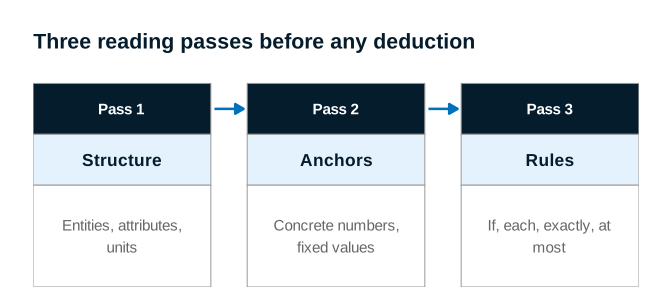
Scan a set in three passes
Do not solve while reading the passage for the first time. Read the passage in three passes. Each pass has a different job.
The example below is a DI caselet, but the same three passes work on an LR set.
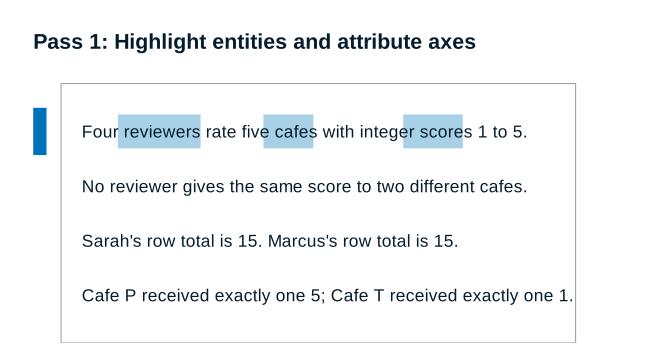
Pass 1: Find the structure
In the first pass, do not focus on numbers. Look for:
- who the entities are
- what the categories are
- what is being measured
- whether the set needs a table, equations, ranking, or a hybrid structure
For example:
Aurevia, Brelosia, Cyrenia, and Zerathania are four countries.
This tells you there are countries.
Jano, Kira, and Lian are travellers.
This tells you there are travellers.
Each traveller visits exactly two countries.
This tells you to draw a traveller-country table. Currencies and exchange rates are mentioned. This tells you to also keep an equation block.
So the structure is:
- a visit table
- a spend table
- an exchange-rate equation block
Pass 2: Find the fixed numbers
In the second pass, look for fixed values. These are numbers directly given in the passage.
Jano's flight cost = 4000
1 Crown = 0.5 Zentars
Put these numbers into the structure immediately. Fixed numbers are anchors. They usually start the solving chain.
Pass 3: Find the rules
In the third pass, look for rules and restrictions. These are not direct values. They tell you how values must behave.
- Each traveller visited exactly two countries.
- Each traveller had different spends in the two countries.
- Values are non-zero multiples of 10.
- Exactly two of the spends are 1000.
Write these rules separately. Do not mix them with fixed values. Fixed values fill cells. Rules control the possible cells.
Why three passes help
A caselet is hard when everything is kept in your head. The three-pass method prevents that.
First, you decide what to draw. Then you enter the given numbers. Then you use the rules. This keeps the work clean.
Structure → Anchors → Rules
Spot the sets that have multiple cases
Some sets cannot be filled in one straight line. A case is needed when one clue gives two possible options and the answer is not yet fixed. This happens in both LR and DI sets, and it is the main reason a set takes longer than its passage suggests.
For example:
Maya visited either Lisbon or Madrid.
This gives two possible cases. Each case can then be checked with the remaining clues. The case is removed if it breaks a given total or clue.
| Situation | Example | Possible cases |
|---|---|---|
| One person has two possible values | Maya visited Lisbon or Madrid | Maya = Lisbon / Maya = Madrid |
| One value has two possible holders | Lisbon was visited by Sarah or John | Sarah = Lisbon / John = Lisbon |
| A total can be made in two ways | Row total can be 7 using different combinations | Test each combination |
| A pair must be together | Kenji and Fatima are on the same floor | Both Floor 2 / Both Floor 3 |
| A conditional clue may or may not apply | If Marcus visited Lisbon, then Anya visited Madrid | Marcus = Lisbon / Marcus ≠ Lisbon |
Cases should be kept separate. Do not mix the reasoning of Case 1 and Case 2 in the same paragraph without making it clear which case is being discussed.
A final flow check
Before committing to a set, run the scan once more:
- Read the full passage once to understand the situation
- Identify the entities
- Identify the attributes or categories
- Decide whether the structure is a table, equation list, rank table, or hybrid
- Draw the structure before solving
- Enter all fixed numbers first
- Write conditional rules separately
- Make cases when two meaningful options remain
- Reject a case only when it breaks a stated clue
- Answer exactly what the question asks
Practice questions
Practice set 1: A caselet with a hybrid structure
This is the set whose structure was scanned in the article. Read it in three passes, draw the visit table, the spend table and the exchange-rate equation block, and then attempt the questions.
Aurevia, Brelosia, Cyrenia and Zerathania are four countries with their currencies being Aurels, Brins, Crowns, and Zentars, respectively. The currencies have different exchange values. Crown's currency exchange rate with Zentars = 0.5, i.e., 1 Crown is worth 0.5 Zentars.
Three travelers, Jano, Kira, and Lian set out from Zerathania visiting exactly two of the countries. Each country is visited by exactly two travelers. Each traveler has a unique Flight Cost, which represents the total cost of airfare in traveling to both the countries and back to Zerathania. The Flight Cost of Jano was 4000 Zentars, while that of the other two travelers were 5000 and 6000 Zentars, not necessarily in that order. When visiting a country, a traveler spent either 1000, 2000 or 3000 in the country's local currency. Each traveler had different spends (in the country's local currency) in the two countries he/she visited. Across all the visits, there were exactly two spends of 1000 and exactly one spend of 3000 (in the country's local currency).
The total “Travel Cost” for a traveler is the sum of his/her Flight Cost and the money spent in the countries visited.
The citizens of the four countries with knowledge of these travels made a few observations, with spends measured in their respective local currencies:
i. Aurevia citizen: Jano and Kira visited our country, and their Travel Costs were 3500 and 8000, respectively.
ii. Brelosia citizen: Kira and Lian visited our country, spending 2000 and 3000, respectively. Kira's Travel Cost was 4000.
iii. Cyrenia citizen: Lian visited our country and her Travel Cost was 36000.
Question 1 (CAT 2025 Slot 3)
What is the sum of Travel Costs for all travelers in Zentars?
Type In The Answer.
Answer: 41000.
The travelers set out from Zerathania, meaning the other three countries (Aurevia, Brelosia, Cyrenia) are their destinations. Since each visits exactly two countries, there are 3 × 2 = 6 total visits. Each destination is visited by exactly two travelers, which perfectly accounts for the 6 visits.
| Traveler | Flight cost (Zentars) | Aurevia (Aurels) | Brelosia (Brins) | Cyrenia (Crowns) |
|---|---|---|---|---|
| Jano | ||||
| Kira | ||||
| Lian |
Let's map out who visits where. From Clue i, Jano and Kira visit Aurevia. From Clue ii, Kira and Lian visit Brelosia. From Clue iii, Lian visits Cyrenia. Since each country gets exactly two visitors, Jano must be the second visitor to Cyrenia. We also know Jano's flight cost is 4000 Zentars.
| Traveler | Flight cost (Zentars) | Aurevia (Aurels) | Brelosia (Brins) | Cyrenia (Crowns) |
|---|---|---|---|---|
| Jano | 4000 | - | ||
| Kira | - | |||
| Lian | - |
Next, let's assign the spends. Across the 6 total visits, the allowed spends are 1000, 2000, and 3000. The passage says there are exactly two 1000s and exactly one 3000. That leaves three 2000s to make up the 6 spends. So the pool of spends is {1000, 1000, 2000, 2000, 2000, 3000}.
From Clue ii, Kira and Lian spent 2000 and 3000 in Brelosia. This uses up the only 3000.
Each traveler must have different spends in their two destinations. Kira already has a 2000. She can't spend 3000 (none left), so her Aurevia spend must be 1000.
Lian already has a 3000. Her Cyrenia spend must be 1000 or 2000. If it were 1000, the remaining two spends for Jano would both be 2000. But Jano needs different spends! So Lian's Cyrenia spend must be 2000, leaving a 1000 and a 2000 for Jano.
| Traveler | Flight cost (Zentars) | Aurevia (Aurels) | Brelosia (Brins) | Cyrenia (Crowns) |
|---|---|---|---|---|
| Jano | 4000 | {1000, 2000} | - | {1000, 2000} |
| Kira | 1000 | 2000 | - | |
| Lian | - | 3000 | 2000 |
Now let's find the exchange rates. Let EA and EB be the value of 1 Aurel and 1 Brin in Zentars. We already know 1 Crown = 0.5 Zentars. A traveler's Travel Cost in Zentars is their flight cost plus their converted local spends.
From Clue i and Clue ii, Kira's Travel Cost is 8000 Aurels and 4000 Brins. Converting both to Zentars gives 8000 · EA = 4000 · EB → EB = 2 · EA.
Kira's Travel Cost in Zentars is FK + 1000 · EA + 2000 · EB. Substituting EB = 2 · EA, her cost becomes FK + 5000 · EA. Since this equals 8000 · EA, we get FK = 3000 · EA.
The remaining flight costs are 5000 and 6000. Let's test them using Jano's Travel Cost from Clue i (3500 Aurels → 3500 · EA Zentars). Let Jano's spends be SA (in Aurels) and SC (in Crowns).
| Branch | Kira flight (FK) | Exchange rates | Jano equation (4000 + SA · EA + SC · 0.5 = 3500 · EA) | Result |
|---|---|---|---|---|
| Case 1 | 5000 | EA = 5/3, EB = 10/3 | 4000 + SA · 5/3 + SC · 0.5 = 3500 · 5/3 | Simplifies to 5 · SA + 1.5 · SC = 5500. Neither order of {1000, 2000} works. Pruned. |
| Case 2 | 6000 | EA = 2, EB = 4 | 4000 + SA · 2 + SC · 0.5 = 7000 | Simplifies to 2 · SA + 0.5 · SC = 3000. Works perfectly if SA = 1000 and SC = 2000. Valid. |
This locks FK = 6000, forcing Lian's flight cost to 5000. It also locks Jano's specific spends. We can now calculate everyone's final Travel Cost in Zentars.
Let's confirm with Clue iii. Lian's Travel Cost is 18000 Zentars. Since 1 Crown = 0.5 Zentars, her cost is 18000 ÷ 0.5 = 36000 Crowns, which perfectly matches the Cyrenia citizen's observation.
The total sum of Travel Costs for all travelers in Zentars is 7000 + 16000 + 18000 = 41000.
Question 2 (CAT 2025 Slot 3)
How many Zentars did Lian spend in the two countries he visited?
Type In The Answer.
Answer: 13000.
Look at Lian's row in the completed table and the exchange rates we derived (EB = 4 Zentars per Brin, EC = 0.5 Zentars per Crown).
Lian visited Brelosia and Cyrenia. Her local spends converted to Zentars are:
- Brelosia: 3000 Brins × 4 = 12000 Zentars
- Cyrenia: 2000 Crowns × 0.5 = 1000 Zentars
Her total spend in the two countries is 12000 + 1000 = 13000 Zentars.
Question 3 (CAT 2025 Slot 3)
What was Jano's total spend in the two countries he visited, in Aurels?
Type In The Answer.
Answer: 1500.
Look at the final table for Jano's local spends. He spent 1000 Aurels in Aurevia and 2000 Crowns in Cyrenia.
To find his total spend in Aurels, we need to convert his Cyrenia spend into Aurels.
First, convert Crowns to Zentars. Since 1 Crown = 0.5 Zentars, his 2000 Crowns equals 1000 Zentars.
Next, convert Zentars to Aurels. From the exchange rates we found (EA = 2), 1 Aurel = 2 Zentars. So, 1000 Zentars equals 500 Aurels.
Jano's total spend in the two countries is 1000 + 500 = 1500 Aurels.
Question 4 (CAT 2025 Slot 3)
One Brin is equivalent to how many Crowns?
- 8
- 0.125
- 0.5
- 4
Answer: A.
From the set derivation, we found the exchange rates for each currency in terms of Zentars:
- 1 Brin = 4 Zentars
- 1 Crown = 0.5 Zentars
To find how many Crowns equal 1 Brin, we divide the Zentar value of a Brin by the Zentar value of a Crown: 4 ÷ 0.5 = 8
So, 1 Brin is equivalent to 8 Crowns.
Question 5 (CAT 2025 Slot 3)
Which of the following statements is NOT true about money spent in the local currency?
- Jano spent 2000 in Aurevia
- Lian spent 2000 in Cyrenia
- Jano spent 2000 in Cyrenia
- Kira spent 1000 in Aurevia
Answer: A.
Look at the final table from our derivation to check the local currency spends for each traveler.
- Option A claims Jano spent 2000 in Aurevia. The table shows Jano spent 1000 in Aurevia. This statement is false.
- Option B claims Lian spent 2000 in Cyrenia. The table confirms this is true.
- Option C claims Jano spent 2000 in Cyrenia. The table confirms this is true.
- Option D claims Kira spent 1000 in Aurevia. The table confirms this is true.
The only statement that is not true is the one in Option A.
Practice set 2: An attribute grid with numerical clues
Scan this set the same way before solving. It needs a value grid plus an equation list — and one clue forces a case table.
The two most populous cities and the non-urban region (NUR) of each of three states, Whimshire, Fogglia, and Humbleset, are assigned Pollution Measures (PMs). These nine PMs are all distinct multiples of 10, ranging from 10 to 90. The six cities in increasing order of their PMs are: Blusterburg, Noodleton, Splutterville, Quackford, Mumpypore, Zingaloo.
The Pollution Index (PI) of a state is a weighted average of the PMs of its NUR and cities, with a weight of 50% for the NUR, and 25% each for its two cities.
There is only one pair of an NUR and a city (considering all cities and all NURs) where the PM of the NUR is greater than that of the city. That NUR and the city both belong to Humbleset.
The PIs of all three states are distinct integers, with Humbleset and Fogglia having the highest and the lowest PI respectively.
Question 6 (CAT 2025 Slot 2)
What is the PI of Whimshire?
Type In The Answer.
Answer: 45.
| State | NUR | City 1 | City 2 | PI |
|---|---|---|---|---|
| Humbleset | ||||
| Whimshire | ||||
| Fogglia |
The 9 Pollution Measures (PMs) are 10, 20, 30, 40, 50, 60, 70, 80, 90. We have 3 states, each with 1 NUR and 2 cities. Let's find out which region gets which PM.
Look at Clue 3. It tells us there is exactly one pair where an NUR has a higher PM than a city. If we list all 9 PMs in increasing order, every time an NUR is placed after a city, it creates a pair where the NUR is greater. To get exactly one pair across the entire set, the third smallest PM must be a city, and the fourth must be an NUR. All other NURs must be smaller than all cities.
So the sequence has to be: NUR, NUR, City, NUR, City, City, City, City, City.
This locks our two groups:
NURs: {10, 20, 40}
Cities: {30, 50, 60, 70, 80, 90}
Since the passage lists the cities in increasing order, we can map them right away: Blusterburg B = 30, Noodleton N = 50, Splutterville S = 60, Quackford Q = 70, Mumpypore M = 80, Zingaloo Z = 90.
Clue 3 also states that this unique pair NUR = 40, City = 30 belongs to Humbleset.
| State | NUR | City 1 | City 2 | PI |
|---|---|---|---|---|
| Humbleset | 40 | 30 B | ||
| Whimshire | ||||
| Fogglia |
Now, let's look at the Pollution Index (PI) formula given in the passage:
PI = 0.5 × NUR + 0.25 × C₁ + 0.25 × C₂ = (2 × NUR + C₁ + C₂) / 4
Clue 4 says the PIs are distinct integers. This means the numerator must be a multiple of 4.
For Humbleset: PI = (2 × 40 + 30 + C₂) / 4 = (110 + C₂) / 4. Since C₂ is a multiple of 10, 110 + C₂ is a multiple of 4 only when C₂ ∈ {50, 70, 90}.
For Whimshire and Fogglia, their NURs are 10 and 20. So 2 × NUR equals 20 and 40, both of which are multiples of 20. To make the whole numerator a multiple of 4, the sum of their two cities (C₁ + C₂) must be a multiple of 20. This forces their two cities to share the same parity for their tens digit (either both odd or both even).
Let's test the three possible cities for Humbleset's second spot to see which one works.
| Branch | Humbleset C₂ & PI | Cities left | Forced pairs & sums | Other state PIs (with NUR 10 & 20) | Status |
|---|---|---|---|---|---|
| Case 1 | 50 → PI = 40 | 60, 70, 80, 90 | (60, 80) = 140, (70, 90) = 160 | 40, 50 OR 45, 45 | Clashes with Humbleset's 40, or not distinct. Pruned. |
| Case 2 | 70 → PI = 45 | 50, 60, 80, 90 | (50, 90) = 140, (60, 80) = 140 | 40, 45 | Clashes with Humbleset's 45. Pruned. |
| Case 3 | 90 → PI = 50 | 50, 60, 70, 80 | (50, 70) = 120, (60, 80) = 140 | 35, 45 OR 40, 40 | Works when sums are split to give 35 and 45. Valid. |
So Humbleset gets 90 (Zingaloo) and a PI of 50. To get the valid PIs of 35 and 45 for the other states: NUR 10 must pair with the 120 sum: PI = (20 + 120) / 4 = 35. NUR 20 must pair with the 140 sum: PI = (40 + 140) / 4 = 45.
From Clue 4, Humbleset and Fogglia have the highest and lowest PIs respectively. We have PIs of 50, 45, and 35. Humbleset is 50 (highest). Fogglia must be 35 (lowest). This leaves Whimshire with 45.
Let's fill in the final assignments: Fogglia gets PI 35, which comes from NUR 10 and cities 50 N and 70 Q. Whimshire gets PI 45, which comes from NUR 20 and cities 60 S and 80 M.
| State | NUR | City 1 | City 2 | PI |
|---|---|---|---|---|
| Humbleset | 40 | 30 B | 90 Z | 50 |
| Whimshire | 20 | 60 S | 80 M | 45 |
| Fogglia | 10 | 50 N | 70 Q | 35 |
Look at the final table. The Pollution Index (PI) for Whimshire is 45.
Question 7 (CAT 2025 Slot 2)
What is the PI of Fogglia?
Type In The Answer.
Answer: 35.
Look at the final consolidated table from the shared derivation.
The Pollution Index (PI) for Fogglia is 35.
Question 8 (CAT 2025 Slot 2)
What is the PI of Humbleset?
Type In The Answer.
Answer: 50.
Look at the final table from our set analysis.
| State | NUR | City 1 | City 2 | PI |
|---|---|---|---|---|
| Humbleset | 40 | 30 B | 90 Z | 50 |
| Whimshire | 20 | 60 S | 80 M | 45 |
| Fogglia | 10 | 50 N | 70 Q | 35 |
The PI of Humbleset is 50.
Question 9 (CAT 2025 Slot 2)
Which pair of cities definitely belong to the same state?
- Mumpypore, Zingaloo
- Splutterville, Quackford
- Blusterburg, Mumpypore
- Noodleton, Quackford
Answer: D.
Look at the final completed table to see where each city ended up. We are checking the options to see which pair of cities is assigned to the same state.
- Option A: Mumpypore is in Whimshire, but Zingaloo is in Humbleset.
- Option B: Splutterville is in Whimshire, but Quackford is in Fogglia.
- Option C: Blusterburg is in Humbleset, but Mumpypore is in Whimshire.
- Option D: Noodleton and Quackford are both assigned to Fogglia.
The only pair that shares the same state is Noodleton and Quackford.
Question 10 (CAT 2025 Slot 2)
For how many of the cities and NURs is it possible to identify their PM and the state they belong to?
Type In The Answer.
Answer: 9.
Look at the final completed table from the main derivation.
| State | NUR | City 1 | City 2 | PI |
|---|---|---|---|---|
| Humbleset | 40 | 30 B | 90 Z | 50 |
| Whimshire | 20 | 60 S | 80 M | 45 |
| Fogglia | 10 | 50 N | 70 Q | 35 |
The problem asks for the number of cities and non-urban regions (NURs) whose Pollution Measure (PM) and state can be perfectly identified.
There are 3 states, meaning there are exactly 3 NURs and 3 × 2 = 6 cities in the problem, for a total of 9 entities. As we can see in the grid, every single one of these 9 entities has been uniquely locked to a specific PM and assigned to a specific state. There are no overlapping cases or unknown values left.
Therefore, we can identify the PM and state for all 9 entities.