Odd one out questions are closely related to Parajumbles. In both question types, you need to understand how sentences connect and how a paragraph develops. The difference is that, in an Odd one out question, one of the given sentences does not belong to the paragraph.
In Parajumbles, every sentence must be used. Your task is only to arrange them. In Odd one out, you are given five sentences. Four form a coherent paragraph, while one sentence remains outside that paragraph.
Looking for a sentence that merely appears unusual is unreliable:
Which sentence looks odd?
A better approach is to identify the four sentences that form the strongest paragraph:
Which four sentences form a paragraph?
Once those four sentences have been identified and arranged, the remaining sentence becomes the odd one out.
In this reading, you will learn how to construct the four-sentence paragraph before deciding which sentence does not belong. You will use opener clues, sentence pairs, pronouns, pointer words, logical links, and changes in focus or scope.
The task in an Odd one out question
An Odd one out question gives you five jumbled sentences. Four can be arranged to form one coherent paragraph. The fifth sentence does not fit that paragraph.
Your answer is the number of the sentence that does not belong.
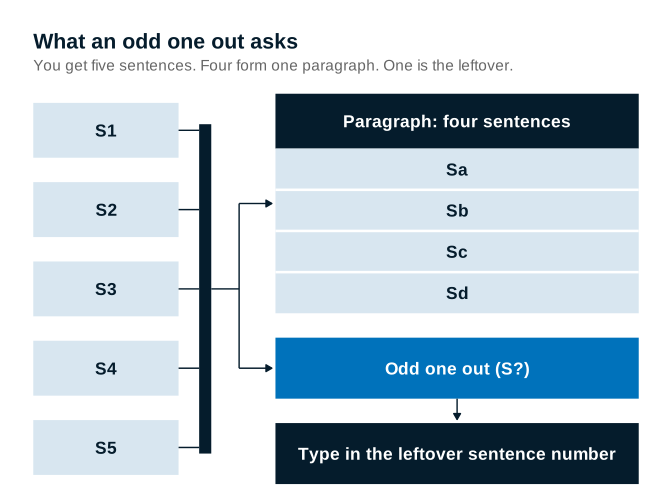
Solving the question involves three connected tasks:
- Identify the four sentences that belong together.
- Arrange those four sentences in a logical order.
- Explain why the fifth sentence does not fit.
A sentence should be removed only after a complete four-sentence paragraph has been formed and the remaining sentence has been checked against it.
Framework
The following method can be used for every Odd one out question.
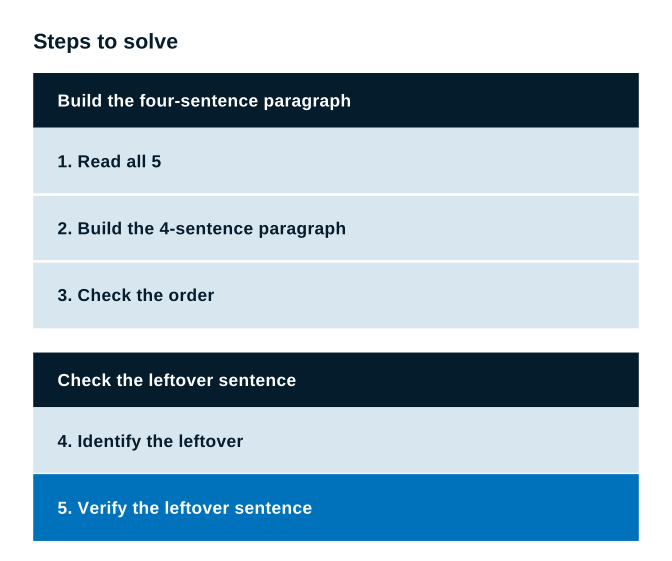
Read all five sentences for the broad topic
Begin by reading all five sentences once. At this stage, do not try to eliminate any sentence.
Identify the broad subject shared by the sentences:
What is the broad subject here?
This first reading gives you a general sense of the material. It does not determine the answer. Sentences can share the same broad topic and still belong to different paragraphs.
Build the strongest four-sentence paragraph
Next, identify the four sentences that connect most naturally.
Use the same structural clues that help in Parajumbles:
- identify a possible opener
- find strong sentence pairs
- trace pronouns and pointer words
- notice contrast words
- connect causes with their effects
- follow time-based links
- build a chain that develops smoothly
The difference from a Parajumble is that one sentence may fail to enter the chain. That sentence becomes a possible misfit, but it is not yet the final answer.
Check the order within the group
Read the four selected sentences in the order you have constructed.
The paragraph should have:
- a clear beginning
- smooth links between the middle sentences
- a natural ending
If the group does not read as one connected paragraph, either the order or the selection may be wrong. Test another arrangement or replace the weakest sentence in the group.
Identify the leftover sentence
Once the four-sentence paragraph has been formed, one sentence will remain unused.
Treat it as a candidate rather than marking it immediately.
Verify the leftover sentence
Compare the leftover sentence with the completed paragraph:
Why does this sentence not belong in the paragraph?
The sentence may:
- change the topic
- shift the focus
- move to a different level of scope
- use a different time frame
- break the paragraph’s logic
- provide an example of a different idea
- fail to connect naturally with any sentence in the group
A clear explanation of the mismatch confirms the answer.
Worked example: Peter Singer and animal rights
Identify the odd sentence.
- Animals have an interest in fulfilling their basic needs, but also in avoiding suffering, and thus we ought to extend moral consideration.
- Singer viewed himself as a utilitarian, and presents a direct moral theory concerning animal rights, in contrast to indirect positions, such as welfarist views.
- He argued for extending moral consideration to animals because, similar to humans, animals have certain significant interests.
- The event that publicly announced animal rights as a legitimate issue within contemporary philosophy was Peter Singer's Animal Liberation text in 1975.
- As such, we ought to view their interests alongside and equal to human interests, which results in humans having direct moral duties towards animals.
How to solve it
The broad topic is animal rights. However, four sentences have a narrower and more specific focus: Peter Singer’s argument about animal rights.
Sentence 4 is the opener. It introduces Peter Singer and his 1975 book Animal Liberation. Sentence 3 begins with “He argued.” The pronoun “He” refers to Singer, who has just been introduced.
This gives the first pair:
4 → 3
Sentence 3 states Singer’s reasoning. Animals have significant interests in the same way that humans do. Sentence 5 begins with “As such,” which signals a conclusion drawn from that reasoning. If animals have significant interests, their interests should be considered alongside human interests.
The chain therefore becomes:
4 → 3 → 5
Sentence 2 then places Singer’s argument within a broader ethical framework. It identifies him as a utilitarian and explains that he presents a direct moral theory of animal rights, unlike indirect positions such as welfarist views.
The complete paragraph is:
4 → 3 → 5 → 2
Sentence 1 is related to animal rights, but it makes a general moral claim. It does not refer to Singer, his book, or his particular ethical position. The other four sentences form a paragraph specifically about Singer’s argument and its place in moral theory.
Therefore, the odd sentence is:
1
Building a strong four-sentence group
A strong four-sentence group usually contains at least two clear structural links:
- a suitable opener
- a pronoun link
- a repeated specific idea
- a cause-and-effect link
- a contrast link
- a time link
- an example supporting a claim
- a conclusion or result
The strength of the group matters more than the unusual appearance of the leftover sentence. When four sentences form a clear chain, the reason for excluding the fifth sentence becomes easier to explain.
Verifying the odd sentence
After constructing the four-sentence paragraph, check the leftover sentence carefully.
A sentence is not the odd one merely because it was not included in the first arrangement. It must fail to fit the paragraph in a clear and explainable way.
Eight tests can help verify the answer.
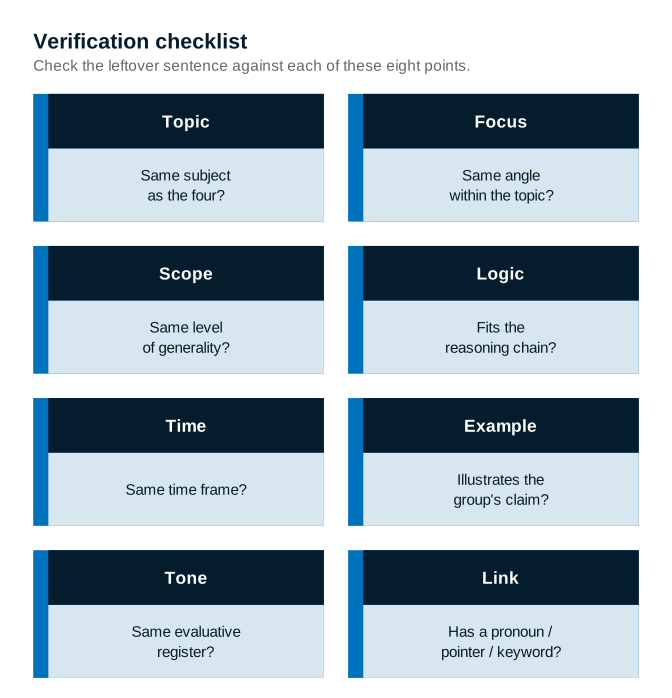
Test 1: Topic
The topic test checks whether the sentence discusses the same broad subject as the paragraph.
However, sharing the topic is not enough. A sentence may be about public transport and still differ from the paragraph in focus, scope, logic, or time frame.
Test 2: Focus
Focus is the particular angle taken within a broad topic.
Five sentences may all discuss English number words. Four may explain how the English number-naming system is structured, while one discusses how children learn those words.
The topic remains the same, but the focus changes. The sentence that changes the angle is likely to be the odd one out.
Test 3: Scope
Scope refers to how broad or narrow a sentence is.
A sentence may discuss the same general subject as the paragraph but operate at a different level. It may be much broader than the group or focus on a narrower issue that the paragraph does not develop.
Test 4: Logic
The logic test checks whether the sentence fits the reasoning developed by the paragraph.
Test 5: Time
The time test checks whether a sentence belongs to the same time frame as the paragraph.
Test 6: Example
The example test checks whether a specific sentence illustrates the idea that the paragraph is actually discussing.
Test 7: Tone
Tone refers to the kind of language a sentence uses and the purpose it serves.
Test 8: Link
The link test checks whether the sentence connects naturally with any part of the paragraph.
If the sentence cannot be placed anywhere in the chain without making the paragraph feel forced, it is likely to be the odd one out.
Final flow check
Before entering the answer, read the four-sentence paragraph once in its complete order.
Check whether:
- the opening sentence introduces the topic clearly;
- every later sentence connects with something stated earlier;
- pronouns and pointer words such as “this,” “it,” “they,” and “the latter” have clear references;
- the paragraph moves forward rather than repeating an idea or jumping between unrelated points;
- the final sentence gives the paragraph a natural ending; and
- the reason for excluding the leftover sentence can be stated clearly.
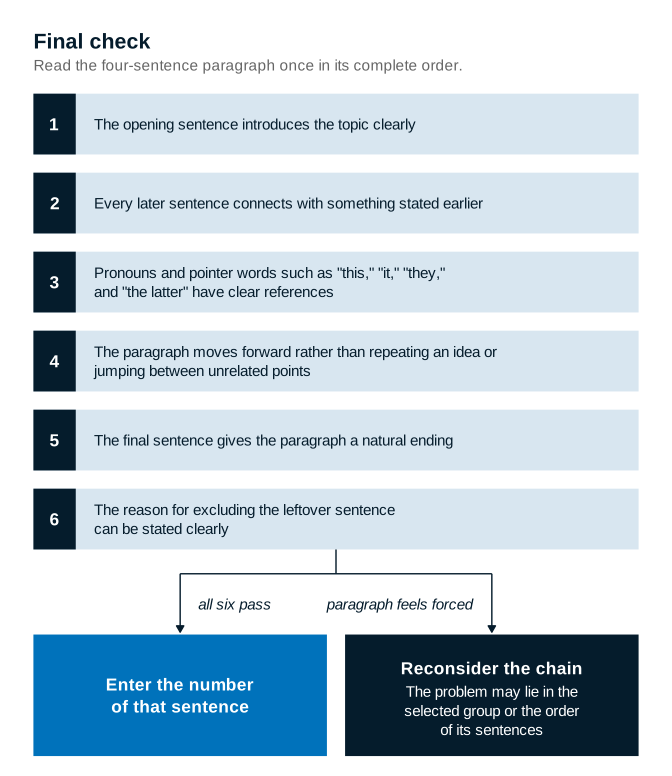
If the four-sentence paragraph reads smoothly and the leftover sentence fails one or more of the verification tests, enter the number of that sentence.
If the paragraph feels forced, reconsider the chain. The problem may lie in either the selected group or the order of its sentences.
Practice questions
Practice set A: Clear four-sentence groups
Question 1 (CAT 2024 Slot 1)
Five jumbled up sentences (labelled 1, 2, 3, 4 and 5), related to a topic, are given below. Four of them can be put together to form a coherent paragraph. Identify the odd sentence and key in the number of that sentence as your answer.
- Animals have an interest in fulfilling their basic needs, but also in avoiding suffering, and thus we ought to extend moral consideration.
- Singer viewed himself as a utilitarian, and presents a direct moral theory concerning animal rights, in contrast to indirect positions, such as welfarist views.
- He argued for extending moral consideration to animals because, similar to humans, animals have certain significant interests.
- The event that publicly announced animal rights as a legitimate issue within contemporary philosophy was Peter Singer's Animal Liberation text in 1975.
- As such, we ought to view their interests alongside and equal to human interests, which results in humans having direct moral duties towards animals.
Answer: 1.
Sentence 4 is the opener because it introduces Peter Singer and his book Animal Liberation. Sentence 3 begins with “He argued,” so the pronoun “He” refers directly to Singer.
4 → 3
Sentence 5 begins with “As such,” which signals a conclusion from Singer’s argument. If animals have significant interests, their interests must be considered alongside human interests.
Sentence 2 then places Singer’s argument within moral theory. It identifies him as a utilitarian and describes his position as a direct theory of animal rights.
The coherent sequence is 4 → 3 → 5 → 2.
Sentence 1 is related to animal rights, but it makes a general claim. The other four sentences focus specifically on Peter Singer, his book, and his ethical position. Sentence 1 therefore shifts from a specific account of Singer’s theory to a broader moral statement.
Question 2 (CAT 2019 Slot 1)
Five sentences related to a topic are given below in a jumbled order. Four of them form a coherent and unified paragraph. Identify the odd sentence that does not go with the four. Key in the number of the option that you choose.
- 'Stat' signaled something measurable, while 'matic' advertised free labour; but 'tron', above all, indicated control.
- It was a totem of high modernism, the intellectual and cultural mode that decreed no process or phenomenon was too complex to be grasped, managed and optimized.
- Like the heraldic shields of ancient knights, these morphemes were painted onto the names of scientific technologies to proclaim one's history and achievements to friends and enemies alike.
- The historian Robert Proctor at Stanford University calls the suffix '-tron', along with '-matic' and '-stat', embodied symbols.
- To gain the suffix was to acquire a proud and optimistic emblem of the electronic and atomic age.
Answer: 2.
Sentence 4 is the opener because it introduces the three suffixes “-tron,” “-matic,” and “-stat.” It also describes them as embodied symbols.
Sentence 1 follows by explaining what each suffix represented. “Stat” suggested measurement, “matic” suggested automatic labour, and “tron” suggested control.
Sentence 5 develops the symbolic value of these suffixes. Acquiring such a suffix gave a technology a proud and hopeful identity associated with the electronic and atomic age.
Sentence 3 continues this idea by comparing the suffixes to heraldic shields. The word “morphemes” refers to meaningful parts of words, such as the suffixes already discussed.
The coherent sequence is 4 → 1 → 5 → 3.
Sentence 2 discusses high modernism as a wider intellectual and cultural movement. It is related to the desire to manage complex systems, but it moves away from the paragraph’s specific focus on technological suffixes and their symbolic use.
Question 3 (CAT 2025 Slot 1)
Five jumbled sentences (labelled 1, 2, 3, 4, and 5), related to a topic, are given below. Four of them can be put together to form a coherent paragraph. Identify the odd sentence out and key in the number of that sentence as your answer.
- The Bayeux tapestry was, therefore, an obvious way to tell people about the downfall of the English and the rise of the Normans.
- So if we take expert in Anglo-Saxon culture Gale Owen-Crocker's idea that the tapestry was originally hung in a square with certain scenes facing each other, people would have stood in the centre.
- Art historian Linda Neagley has argued that pre-Renaissance people interacted with art visually, kinaesthetically (sensory perception through bodily movement) and physically.
- That would make it an 11th-century immersive space with scenes corresponding and echoing each other, drawing the viewer's attention, playing on their senses and understanding of the story they thought they knew.
- The Bayeux tapestry would have been hung at eye level to enable this.
Answer: 1.
Sentence 3 introduces the broad idea that people before the Renaissance interacted with art through sight, movement, and physical position.
Sentence 2 applies this idea to the Bayeux tapestry. If it was hung in a square, viewers could have stood in the centre and experienced different scenes around them.
Sentence 5 says the tapestry would have been placed at eye level “to enable this.” The word “this” refers to the physical interaction described in sentence 2.
Sentence 4 begins with “That,” which refers to the arrangement described in sentences 2 and 5. It explains how this arrangement would create an immersive space.
The coherent sequence is 3 → 2 → 5 → 4.
Sentence 1 discusses the historical and political story told by the tapestry: the fall of the English and the rise of the Normans. The other four sentences focus on how the tapestry may have been displayed and physically experienced. Sentence 1 therefore shifts from the form of presentation to the content of the story.
Question 4 (CAT 2020 Slot 3)
Five jumbled up sentences, related to a topic, are given below. Four of them can be put together to form a coherent paragraph. Identify the odd one out and key in the number of the sentence as your answer.
- Machine learning models are prone to learning human-like biases from the training data that feeds these algorithms.
- Hate speech detection is part of the on-going effort against oppressive and abusive language on social media.
- The current automatic detection models miss out on something vital: context.
- It uses complex algorithms to flag racist or violent speech faster and better than human beings alone.
- For instance, algorithms struggle to determine if group identifiers like "gay" or "black" are used in offensive or prejudiced ways because they're trained on imbalanced datasets with unusually high rates of hate speech.
Answer: 3.
Sentence 2 introduces hate speech detection as a way of dealing with abusive language on social media.
Sentence 4 begins with “It,” which refers to hate speech detection. It explains that the system uses algorithms to identify racist or violent speech.
Sentence 1 then introduces a problem with such models: they may learn human biases from their training data.
Sentence 5 begins with “For instance” and gives a specific example of this problem. Algorithms may treat identifiers such as “gay” or “black” as offensive because the datasets used to train them contain unusually high levels of hate speech.
The coherent sequence is 2 → 4 → 1 → 5.
Sentence 3 identifies a different problem: the models fail to understand context. The other four sentences focus more specifically on bias created by imbalanced training data. Sentence 3 is related to algorithmic limitations, but it changes the precise focus of the paragraph.
Practice set B: Same topic, different focus
Question 5 (CAT 2023 Slot 2)
Five jumbled up sentences (labelled 1, 2, 3, 4 and 5), related to a topic, are given below. Four of them can be put together to form a coherent paragraph. Identify the odd sentence and key in the number of that sentence as your answer.
- Self-care particularly links to loneliness, behavioural problems, and negative academic outcomes.
- "Latchkey children" refers to children who routinely return home from school to empty homes and take care of themselves for extended periods of time.
- Although self-care generally points to negative outcomes, it is important to consider that the bulk of research has yet to track long-term consequences.
- In research and practice, the phrase "children in self-care" has come to replace latchkey in an effort to more accurately reflect the nature of their circumstances.
- Although parents might believe that self-care would be beneficial for development, recent research has found quite the opposite.
Answer: 3.
Sentence 2 defines “latchkey children.”
Sentence 4 follows because it explains that researchers and practitioners now prefer the phrase “children in self-care.” The expression “latchkey” in sentence 4 refers back to the term defined in sentence 2.
Sentence 5 then moves to research findings. It contrasts the belief that self-care may help development with evidence suggesting the opposite.
Sentence 1 specifies the negative outcomes found in the research: loneliness, behavioural problems, and poor academic performance.
The coherent sequence is 2 → 4 → 5 → 1.
Sentence 3 also concerns the effects of self-care, but it changes the time frame. The paragraph presents current findings, while sentence 3 raises uncertainty about long-term consequences that have not yet been studied.
Question 6 (CAT 2023 Slot 2)
Five jumbled up sentences (labelled 1, 2, 3, 4 and 5), related to a topic, are given below. Four of them can be put together to form a coherent paragraph. Identify the odd sentence and key in the number of that sentence as your answer.
- The banning of Northern Lights could be considered a precursor to censoring books for "moral", world view or religious reasons.
- Attempts to ban books are attempts to silence authors who have summoned immense courage in telling their stories.
- Now the banning and challenging of books in the US has escalated to an unprecedented level.
- The widely acclaimed fantasy novel Northern Lights was banned in some parts of the US, and was the second most challenged book in the US.
- The American Library Association documented an unparalleled number of reported book challenges in 2022, about 2,500 unique titles.
Answer: 2.
Sentence 3 introduces the sharp rise in book bans and challenges in the United States.
Sentence 5 supports this claim with data from the American Library Association. It records challenges involving about 2,500 different titles in 2022.
Sentence 4 then provides a specific example: the fantasy novel Northern Lights was banned in some places and became the second most challenged book in the country.
Sentence 1 interprets that example as an early sign of later censorship based on moral, religious, or ideological grounds.
The coherent sequence is 3 → 5 → 4 → 1.
Sentence 2 makes a broad moral claim about book bans silencing courageous authors. The other four sentences form a factual account of the increase in book challenges and use Northern Lights as an example. Sentence 2 changes the tone and moves from reporting a trend to judging the motives behind censorship.
Question 7 (CAT 2019 Slot 2)
Five sentences related to a topic are given below in a jumbled order. Four of them form a coherent and unified paragraph. Identify the odd sentence that does not go with the four. Key in the number of the option that you choose.
- Socrates told us that 'the unexamined life is not worth living' and that to 'know thyself' is the path to true wisdom
- It suggests that you should adopt an ancient rhetorical method favored by the likes of Julius Caesar and known as 'illeism' or speaking about yourself in the third person.
- Research has shown that people who are prone to rumination also often suffer from impaired decision making under pressure and are at a substantially increased risk of depression.
- Simple rumination, the process of churning your concerns around in your head, is not the way to achieve self-realization.
- The idea is that this small change in perspective can clear your emotional fog, allowing you to see past your biases.
Answer: 1.
The main theme here is rumination (overthinking your worries). Four sentences explain why it hurts you and how a specific trick helps.
You can see that Sentence 4 is the topic introducer. It defines rumination as "churning your concerns around." It says this is not the way to understand yourself. Sentence 3 then brings in research on the risks of overthinking. It shows that overthinking leads to depression and bad decisions.
Next, notice how Sentence 3 links to Sentence 2. Sentence 2 uses the word "It" to refer back to the research. It suggests a method called "illeism" where you talk about yourself in the third person. Sentence 2 and Sentence 5 form a mandatory pair. Sentence 5 follows with the anchor word "this." It explains how this small change helps you see past your biases (your own unfair leanings).
The logical flow is: 4 → 3 → 2 → 5.
Sentence 1 is the odd one out. It is a scope shift (a change in focus). The other sentences focus on a specific psychological problem and its fix. Sentence 1 shifts the focus to Socrates and ancient philosophy. It says "the unexamined life is not worth living" (meaning you must think about your life). This is a very broad idea. It does not fit the specific discussion about overthinking.
Question 8 (CAT 2023 Slot 3)
Five jumbled up sentences (labelled 1, 2, 3, 4 and 5), related to a topic, are given below. Four of them can be put together to form a coherent paragraph. Identify the odd sentence and key in the number of that sentence as your answer.
- Boa Senior, who lived through the 2004 tsunami, the Japanese occupation and diseases brought by British settlers, was the last native of the island chain who was fluent in Bo.
- The indigenous population has been steadily collapsing since the island chain was colonised by British settlers in 1858 and used for most of the following 100 years as a colonial penal colony.
- Taking its name from a now-extinct tribe, Bo is one of the 10 Great Andamanese languages, which are thought to date back to pre-Neolithic human settlement of southeast Asia.
- The last speaker of an ancient tribal language has died in the Andaman Islands, breaking a 65,000-year link to one of the world's oldest cultures.
- Though the language has been closely studied by researchers of linguistic history, Boa Senior spent the last few years of her life unable to converse with anyone in her mother tongue.
Answer: 2.
The main point here is the death of the very last speaker of a language. You'll notice that most of these sentences tell a sad story about one woman.
Sentence 4 is your starting point. It breaks the news that the last speaker of an old language has died.
Next, look at Sentence 3. It tells you the language was called Bo. It also mentions that this language is 65,000 years old.
Sentence 1 adds more detail. It gives the speaker a name, Boa Senior. It also confirms she was the final person who knew the language.
Sentence 5 finishes the story. It uses the pronoun "she" to refer back to Boa Senior. It explains how she had nobody to talk to in her "mother tongue" (the language she grew up speaking) for many years.
The flow you're looking for is: 4 → 3 → 1 → 5.
Sentence 2 is the odd one out. It talks about the "indigenous population" (the local people who lived there first) on the islands. It says their numbers fell from 5,000 to 52 since 1858.
This is a scope shift. The other four sentences care about one specific woman. Sentence 2 is a broad history lesson about a whole group over 150 years. It doesn't fit the personal narrative you've found in the other lines.
Practice set C: Scope, logic, and example misfits
Question 9 (CAT 2021 Slot 1)
Directions for sentence exclusion: Five sentences are given below; out of these, four come together to form a coherent paragraph, but one sentence does not fit into the sequence. Choose the sentence that does not fit into the sequence.
- There is a dark side to academic research, especially in India, and at its centre is the phenomenon of predatory journals.
- But in truth, as long as you pay, you can get anything published.
- In look and feel thus, they are exactly like any reputed journal.
- They claim to be indexed in the most influential databases, say they possess editorial boards that comprise top scientists and researchers, and claim to have a rigorous peer-review structure.
- But a large section of researchers and scientists across the world are at the receiving end of nothing short of an academic publishing scam.
Answer: 5.
Predatory journals scam researchers by pretending to be high-quality. Sentence 1 kicks things off (starts the discussion) by defining exactly what these shady journals are. You will notice this sentence works perfectly on its own without needing any previous information to make sense.
Now look at how the journals pull off the trick. Sentence 4 explains the first step where they claim to be peer-reviewed (checked by experts). This leads right into Sentence 3, which mentions their professional look. They use that visual style to make the fake claims from Sentence 4 seem real. Finally, Sentence 2 pulls back the curtain to show they only care about money. You can see the connection here: 1 → 4 → 3 → 2.
Sentence 5 feels different because it shifts focus to the researchers who fall for the scam. This is a scope shift (moving from the thing doing the scamming to the people being scammed). While the other four sentences describe the journal's methods, this one focuses on the victims. Since it changes what the paragraph cares about, it is the odd one out.
Question 10 (CAT 2021 Slot 2)
Directions for sentence exclusion: Five sentences are given below; out of these, four come together to form a coherent paragraph, but one sentence does not fit into the sequence. Choose the sentence that does not fit into the sequence.
- The care with which philosophers examine arguments for and against forms of biotechnology makes this an excellent primer on formulating and assessing moral arguments.
- Although most people find at least some forms of genetic engineering disquieting, it is not easy to articulate why: what is wrong with re-engineering our nature?
- Breakthroughs in genetics present us with the promise that we will soon be able to prevent a host of debilitating diseases, and the predicament that our newfound genetic knowledge may enable us to enhance our genetic traits.
- To grapple with the ethics of enhancement, we need to confront questions that verge on theology, which is why modern philosophers and political theorists tend to shrink from them.
- One argument is that the drive for human perfection through genetics is objectionable as it represents a bid for mastery that fails to appreciate the gifts of human powers and achievements.
Answer: 1.
Most of these sentences care about why gene editing makes us feel so worried. Notice how they describe the actual problems with changing human DNA.
Look at Sentence 2. It acts as the topic introducer because it mentions a "deep unease" (a strong feeling of worry) that many people share. Now, see where that worry leads. Sentence 3 calls this a predicament (a difficult situation with no easy fix). It says the technology is both amazing and scary. This creates a clear link: 2 → 3.
Next, you have two sentences that explain the reasons for this worry. Sentence 4 explains the theological (religious) side of the debate. It mentions the fear of "playing God." Sentence 5 covers the ethical (right versus wrong) side. It asks if we are changing what it means to be human. These two sentences give the specific details that support the main idea. The flow is 2 → 3 → 4 → 5.
Sentence 1 is the outlier (the one that does not fit the pattern). It does not talk about the actual debate over genes. Instead, it says watching this debate helps you learn how to make arguments. Watch how this works: this is a scope shift (a change in what the text is interested in). The other four sentences care about the ethics of science. Sentence 1 only wants to talk about how to win a debate. It treats a serious human issue like a classroom tool. It does not fit the sequence.
Question 11 (CAT 2021 Slot 2)
Directions for sentence exclusion: Five sentences are given below; out of these, four come together to form a coherent paragraph, but one sentence does not fit into the sequence. Choose the sentence that does not fit into the sequence.
- It has taken on a warm, fuzzy glow in the advertising world, where its potential is being widely discussed, and it is being claimed as the undeniable wave of the future.
- There is little enthusiasm for this in the scientific arena; for them marketing is not a science, and only a handful of studies have been published in scientific journals.
- The new, growing field of neuromarketing attempts to reveal the inner workings of consumer behaviour and is an extension of the study of how choices and decisions are made.
- Some see neuromarketing as an attempt to make the "art" of advertising into a science, being used by marketing experts to back up their proposals with some form of real data.
- The marketing gurus have already started drawing on psychology in developing tests and theories, and advertising people have borrowed the idea of the focus group from social scientists.
Answer: 5.
The main theme is the rise of neuromarketing. This is using brain scans to see what customers really want. Four sentences focus on this new science and how people feel about it.
Sentence 3 is the topic introducer. It tells us neuromarketing is the big new trend. Sentence 4 explains the goal. It wants to turn ads into a science. This way, brands do not have to guess.
Now look at the reactions. Sentence 1 shows the ad world loves this idea. But Sentence 2 gives a contrast. It says scientists are skeptical (having many doubts). This creates a clear path: 3 → 4 → 1 → 2.
Sentence 5 is the odd one out. Notice the scope shift here. The other four talk about brain science. This one talks about traditional tools like focus groups. It looks at the past, not the new tech. It breaks the focus on brain scans.
Question 12 (CAT 2019 Slot 1)
Five sentences related to a topic are given below. Four of them can be put together to form a meaningful and coherent short paragraph. Identify the odd one out. Choose its number as your answer and key it in.
- His idea to use sign language was not a completely new idea as Native Americans used hand gestures to communicate with other tribes.
- Ancient Greek philosopher Aristotle, for example, observed that men who are deaf are incapable of speech.
- People who were born deaf were denied the right to sign a will as they were "presumed to understand nothing; because it is not possible that they have been able to learn to read or write."
- Pushback against this prejudice began in the 16th century when Pedro Ponce de León created a formal sign language for the hearing impaired.
- For millennia, people with hearing impairments encountered marginalization because it was believed that language could only be learned by hearing the spoken word.
Answer: 2.
The theme here is the history of how deaf people were treated. Most of these sentences tell a story about their legal rights and the rise of sign language.
Check out Sentence 5. It is the starting sentence for this story. It tells you that for a long time, people with hearing trouble encountered marginalization (being treated as if they don't matter). This happened because others thought you could only learn language by hearing it.
Sentence 3 gives you a specific example of this bias. It shows how deaf people were not allowed to sign a will. They were presumed (assumed without proof) to understand nothing. This fits perfectly after the general rule mentioned in Sentence 5.
Next is Sentence 4. It uses the word pushback. This means people began fighting against the prejudice shown in the previous sentences. It introduces Pedro Ponce de León. He created a formal sign language in the 16th century.
Finally, notice Sentence 1. It starts with the phrase His idea. This pronoun "His" points back to Pedro from the sentence before it. It explains that Pedro's work was not totally new. It compares his signs to the gestures used by Native Americans.
The logical flow is 5 → 3 → 4 → 1.
Sentence 2 is the odd one out. It mentions an observation by Aristotle about deaf people not being able to speak. This is a scope shift. The other sentences form a tight story about legal rights and the history of signing. Aristotle's quote is just a general remark from an ancient philosopher. It does not fit the specific narrative about Pedro's invention or the fight for rights.
Practice set D: Close cases
Question 13 (CAT 2019 Slot 1)
Five sentences related to a topic are given below. Four of them can be put together to form a meaningful and coherent short paragraph. Identify the odd one out. Choose its number as your answer and key it in.
- One argument is that actors that do not fit within a single, well-defined category may suffer an "illegitimacy discount".
- Others believe that complex identities confuse audiences about an organization's role or purpose.
- Some organizations have complex and multidimensional identities that span or combine categories, while other organizations possess narrow identities.
- Identity is one of the most important features of organizations, but there exist opposing views among sociologists about how identity affects organizational performance.
- Those who think that complex identities are beneficial point to the strategic advantages of ambiguity, and organizations' potential to differentiate themselves from competitors.
Answer: 1.
You'll notice that four of these sentences talk about the same thing: how a complex identity affects an organization. They look at the pros and cons for a group's success.
Sentence 4 is your topic introducer. It sets the stage. It tells you there are "opposing views" (different ideas) about how identity affects how well an organization performs. Sentence 3 then builds on this. It explains that some identities are narrow, while others are multidimensional (having many different parts or sides).
Now, you need to find those "opposing views" that Sentence 4 mentioned. You will find them in Sentence 5 and Sentence 2. These two form a mandatory pair (two sentences that must stay together). They show the two sides of the debate. Sentence 5 says complex identities are good because of ambiguity (having more than one meaning or being unclear). It says this helps a company stand out. But Sentence 2 says "Others believe" these identities just confuse people about what the organization does.
So, why is Sentence 1 the odd one? Look at the subject. It talks about actors instead of organizations. It also brings in a new idea called an "illegitimacy discount" (being seen as fake or not valid). This is a scope shift. The other sentences are debating if a complex identity helps a company win or just confuses the crowd. Sentence 1 is about whether an individual is seen as "real." The logic follows a clear path: 4 → 3 → 5 → 2.
Question 14 (CAT 2020 Slot 1)
Five jumbled up sentences, related to a topic, are given below. Four of them can be put together to form a coherent paragraph. Identify the odd one out and key in the number of the sentence as your answer:
- For feminists, the question of how we read is inextricably linked with the question of what we read.
- Elaine Showalter's critique of the literary curriculum is exemplary of this work.
- Androcentric literature structures the reading experience differently depending on the gender of the reader.
- The documentation of this realization was one of the earliest tasks undertaken by feminist critics.
- More specifically, the feminist inquiry into the activity of reading begins with the realization that the literary canon is androcentric, and that this has a profoundly damaging effect on women readers.
Answer: 3.
The theme here is how feminist critics first began to study male-centered literature. You are looking for a sequence that explains the history and specific tasks of these critics.
Sentence 1 is the best starter. It introduces a broad link between how we read and what we read. It says these two things are "inextricably linked" (totally tied together). It sets the stage for a more detailed explanation.
Sentence 5 follows next because it adds detail. Look at the phrase "More specifically." This tells you it will explain the link mentioned in the first sentence. It says the work of reading starts with a "realization" (a new discovery). This discovery is that the "literary canon" (the famous books usually taught in schools) is "androcentric" (centered on men). This has a "profoundly damaging effect" (it is very harmful) on women readers.
Notice the anchor word in Sentence 4: "this realization." For this to make sense, a specific discovery must have been mentioned right before it. Since Sentence 5 just described that new discovery, you have a mandatory pair: 5 → 4. This sentence explains that documenting this discovery was one of the first tasks for feminist critics.
Sentence 2 mentions "this work." This points back to the "documentation" and "tasks" you just saw in Sentence 4. It gives a specific example of a critic doing this work: Elaine Showalter. You now have a clear pronoun chain: 1 → 5 → 4 → 2.
Sentence 3 is the odd one out. It says that "androcentric literature" (books centered on men) changes the reading experience based on the gender of the reader. While it uses the same keywords, it breaks the flow. The other sentences tell a story about the historical tasks of critics. This sentence cares about the theory of how books affect minds. This is a scope shift because it moves away from the history of the critics' work.
Question 15 (CAT 2025 Slot 1)
Five jumbled sentences (labelled 1, 2, 3, 4, and 5), related to a topic, are given below. Four of them can be put together to form a coherent paragraph. Identify the odd sentence out and key in the number of that sentence as your answer.
- Developments both technological and sociocultural have afforded us far greater freedom over death than we had in the past, and while we are still adapting ourselves to that freedom, we now appreciate the moral importance of this freedom.
- But I believe that a type of freedom we can call freedom over death, that is, a freedom in which we shape the timing and circumstances of how we die, should be central to this conversation.
- Legalising assisted dying is but a further step in realising this freedom over death.
- Many people endorse, through their opinions or their choices, our freedom over death, encompassing a right to medical assistance in hastening our deaths.
- Freedom is a notoriously complex and contested philosophical notion, and I won't pretend to settle any of the big controversies it raises.
Answer: 4.
The main theme here is a philosophical argument for control over how we die. You are looking for the sentence that breaks this specific train of thought.
Start with Sentence 5. It introduces "Freedom" as a broad, complex idea. The author calls it contested (widely argued about). This sentence sets up the whole discussion for you. You can tell it is the starter because it does not point back to any previous ideas.
Next, look at Sentence 2. It starts with the word But. This connects it back to the "big controversies" mentioned in Sentence 5. These two form a mandatory pair (two sentences that must stay together). The author is narrowing the focus from general freedom to "freedom over death."
Now, follow the logic to Sentence 1. It explains that sociocultural (social and cultural) changes gave us more freedom over death. Then, Sentence 3 suggests a step to make this real. It uses the phrase this freedom as an anchor word (a word that links two sentences together). This points back to the definition given in the previous sentences.
The logical order is 5 → 2 → 1 → 3. Why is Sentence 4 the odd one out? It is a scope shift (where a sentence focuses on a different aspect). The other sentences explain the author's own philosophical view. Sentence 4 suddenly reports on what "many people" believe. This change from a personal argument to public opinion breaks the flow.
Question 16 (CAT 2023 Slot 3)
Five jumbled up sentences (labelled 1, 2, 3, 4 and 5), related to a topic, are given below. Four of them can be put together to form a coherent paragraph. Identify the odd sentence and key in the number of that sentence as your answer.
- Although hard skills have traditionally ruled the roost, some companies are moving away from choosing prospective hires based on technical abilities alone.
- Companies are shaking off the old definition of an ideal candidate and ditching the idea of looking for the singularly perfect candidate altogether.
- Now, some job descriptions are frequently asking for candidates to demonstrate soft skills, such as leadership or teamwork.
- That's not to say that practical know-how is no longer required, some jobs still call for highly specific expertise
- The move towards prioritising soft skills "is a natural response to three years of the pandemic" says a senior recruiter at Cenlar FSB.
Answer: 2.
Most of these sentences are about how companies now value soft skills (like teamwork) over technical knowledge.
Sentence 1 is our topic introducer. It says technical skills are no longer the top priority. This leads you naturally to Sentence 3. That sentence tells you what companies want instead: soft skills.
Now look for the reason why this changed. Sentence 5 gives you the answer. It says the pandemic started this new hiring trend. Finally, Sentence 4 adds an exception. Even with this new focus, some jobs still require technical skills. This creates a clear flow: Sentence 1 → Sentence 3 → Sentence 5 → Sentence 4.
Sentence 2 is the odd one. It talks about finding a "singularly" (only one specific type) perfect candidate. This sentence never mentions skills. The other four sentences care specifically about the balance between hard and soft skills. This is a scope shift (when the topic changes slightly).
Practice set E: Mixed
Question 17 (CAT 2020 Slot 3)
Five jumbled up sentences, related to a topic, are given below. Four of them can be put together to form a coherent paragraph. Identify the odd one out and key in the number of the sentence as your answer:
- The logic of displaying one's inner qualities through outward appearance was based on a distinction between being a woman and being feminine.
- 'Appearance' became a signifier of conduct, to look was to be and conformity to the feminine ideal was measured by how well women could use the tools of the fashion and beauty industries.
- The makeover-centric media sets out subtly and not-so-subtly, 'good' and 'bad' ways to be a woman, layering these over inequalities of race and class.
- The denigration of working-class women and women of colour often centres on their perceived failure to embody feminine beauty.
- 'Woman' was considered a biological category, but femininity was a 'process' by which women became specific kinds of women.
Answer: 3.
The main theme here is that femininity is something you do through your looks, not just something you are born with.
Look at Sentence 1. It talks about a distinction (a basic difference) between being a woman and being feminine. Sentence 5 is a mandatory pair (two sentences that must stay together) because it explains that difference. It says being a woman is only about biology, while being feminine is a process.
1 → 5
Next, you can link this process to how society judges women. Sentence 2 says appearance became a signifier of conduct (a sign of how someone behaves). It says the feminine ideal is checked by how well women use tools like fashion. Then, Sentence 4 shows the result. It says women face denigration (being treated as if they have little value). This happens when they fail to show this beauty.
5 → 2 → 4
Sentence 3 is the odd one out because of a scope shift. The other four explain a general way of thinking about femininity. Sentence 3 cares about makeover-centric media (like TV shows about changing your look). It talks about how the media sets rules. This introduces a specific industry. That industry is not part of the main point the other sentences make.
Question 18 (CAT 2025 Slot 2)
Five jumbled sentences (labelled 1, 2, 3, 4, and 5), related to a topic, are given below. Four of them can be put together to form a coherent paragraph. Identify the odd sentence out and key in the number of that sentence as your answer.
- Sporting a copper-coloured pixie cut and a pair of pink feather antlers, Torres himself resembles a child's doodle.
- His casual millennial delivery, peppered with "um"s and "ah"s, makes surreal concepts sound like items on a brunch menu.
- Though he may have failed so far in his colour-scouting mission (he hasn't yet found a new one, he admits), this hour leaves you tickled pink.
- Like his previous show, My Favourite Shapes, this is an hour of sit-down comedy aided by an overhead camera which relays Torres's theories, illustrated with crayon squiggles, on to a screen behind him.
- His inquisitive mind produces interconnected ideas about Catholicism, the blandness of Pixar and what orange sounds like, while his insights train us to spot "highly purple behaviour".
Answer: 3.
Most of these sentences describe a comedian's style and his stage setup.
Look at Sentence 4. It describes how the show works, like the camera and the crayon squiggles (messy drawings). Sentence 1 fits right after. It says Torres looks like a doodle himself. He has pink antlers and bright hair.
Sentence 4 → Sentence 1
Next, check out Sentence 2. It talks about his delivery (the way he talks). He uses "ums" and "ahs" to make strange ideas sound normal. Sentence 5 gives you examples of those ideas. He connects things like Pixar and Catholicism.
Sentence 2 → Sentence 5
Sentence 3 is the odd one. It is about a specific mission to find a new color. The other sentences are about his look and his performance style. This sentence talks about one specific story goal. This is a scope shift (a change in the specific topic being discussed).
Question 19 (CAT 2025 Slot 2)
Five jumbled sentences (labelled 1, 2, 3, 4, and 5), related to a topic, are given below. Four of them can be put together to form a coherent paragraph. Identify the odd sentence out and key in the number of that sentence as your answer.
- Pfas are a class of about 15,000 compounds most frequently used to make products water-, stain- and grease-resistant.
- New research suggests exposure to some common perfluoroalkyl and polyfluoroalkyl substances (Pfas) cause changes to gene activity and that these changes are linked to health problems including multiple cancers, neurological disorders and autoimmune disease.
- These Pfas compounds are dubbed "forever chemicals" because they do not naturally break down in the environment.
- The research may also point toward other diseases potentially caused by Pfas that have not yet been identified.
- The findings are a major step toward determining the mechanism by which the chemicals cause disease and could help doctors identify, detect and treat health problems for those exposed to Pfas before the issues advance.
Answer: 3.
Most of these sentences talk about a medical study. You can see a story about how researchers found a link between certain chemicals and human health.
Sentence 1 starts the paragraph by explaining what PFAS are. It says they are used to make products resistant to water and grease.
Sentence 2 follows by introducing "new research" on these chemicals. It says they cause changes to "gene activity."
Sentence 5 connects to the line before it. It mentions "The findings." This refers to the gene changes found in the research. These results help doctors find the mechanism (the specific way something works) behind the diseases.
Sentence 4 wraps up the group. It says "The research" might also help us find other diseases we do not know about yet.
The sequence is 1 → 2 → 5 → 4.
Sentence 3 is the odd one out. It explains why PFAS are called "forever chemicals." It says they do not naturally break down in the environment.
You might notice this is a scope shift (a change in the main topic). The other four sentences focus on a medical study and human health. Sentence 3 focuses on environmental pollution. It does not mention the study or the gene findings, so it does not fit the flow.
Question 20 (CAT 2025 Slot 3)
Five jumbled sentences (labelled 1, 2, 3, 4, and 5), related to a topic, are given below. Four of them can be put together to form a coherent paragraph. Identify the odd sentence out and key in the number of that sentence as your answer.
- About half of all the oxygen we breathe is made near the surface of the ocean by phytoplankton that photosynthesize just like land-dwelling plants.
- A team of scientists that includes Boston University experts has discovered they also produce oxygen on the seafloor.
- The research team used deep-sea chambers that land on the seafloor and enclose the seawater, sediment, polymetallic nodules, and living organisms.
- The discovery is a surprise considering oxygen is typically created by plants and organisms with help from the sun, not by rocks on the ocean floor.
- The deep-sea rocks, called polymetallic nodules, don't only host a surprising number of sea critters.
Answer: 3.
Most of these sentences talk about a shocking new discovery. We found out that rocks on the dark ocean floor are making oxygen. Usually, we think only plants and sunlight can do that.
Notice the connection between Sentence 5 and Sentence 2. Sentence 5 introduces the polymetallic nodules (deep-sea rocks) and says they don't only host sea creatures. Sentence 2 then adds that they also produce oxygen. The words "don't only" in one and "also" in the other lock them together. This is a Mandatory pair (5 → 2).
Now look at Sentence 4 and Sentence 1. Sentence 4 explains why this seafloor oxygen is a surprise. It says we usually expect oxygen to come from plants and the sun. Sentence 1 gives you the background for that thought. It says half our oxygen comes from phytoplankton (tiny plants) near the surface that use light. These four sentences work together to explain the new find and why it is special.
Sentence 3 stands out as the odd one. It describes the deep-sea chambers and the gear the scientists used to catch the water and rocks. While it is about the same study, it focuses on the tools and the method. The other sentences focus on the result and the science itself. This is a Scope shift (moving from the discovery to the equipment), which makes it the Orphan sentence.
Related Articles



Next steps