A Para Summary question gives you a paragraph and four answer options. Your task is to choose the option that expresses the central idea of the paragraph most accurately.
The paragraph is the only source of information. A correct option must stay within what the paragraph says. Incorrect options usually change the paragraph in one of three ways: they add a new idea, leave out an important part, or make the author’s claim stronger or weaker than it is.
In this reading, you will learn how to identify the main thread of a paragraph and compare it with the answer options. You will also learn how examples, contrasts, qualifications, and changes in scope affect the meaning of a summary.
What a Para Summary question asks
A good summary has three qualities:
- It preserves the meaning of the paragraph.
- It covers the main point of the whole paragraph.
- It matches the strength of the author’s claim.
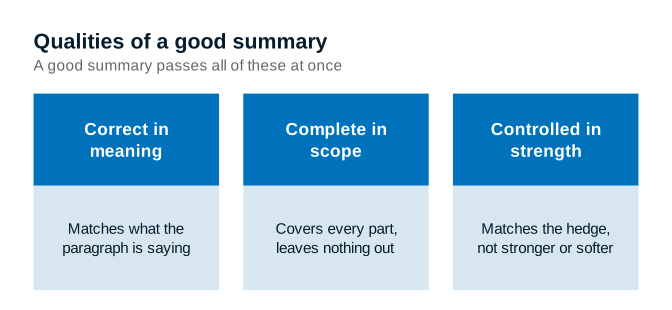
Qualities of a good summary
1. Correct meaning
The correct option must say what the paragraph says. It should not add a new idea, reverse the logic, or change a cause-and-effect relationship.
2. Complete scope
The correct option must cover the central idea of the entire paragraph.
It should not focus on only one example or one part of the argument. At the same time, it should not become so broad that it could summarise many unrelated paragraphs.
3. Controlled strength
The strength of the option must match the strength of the paragraph.
If the paragraph says:
some ancient cities
the option should not say:
all ancient cities
Small words often control the exact strength of a sentence. Words and phrases such as some, several, often, may, partly, usually, and about as likely are part of the author’s meaning. Removing or replacing them can change the claim.
Framework
A Para Summary question can be approached through the same broad sequence.
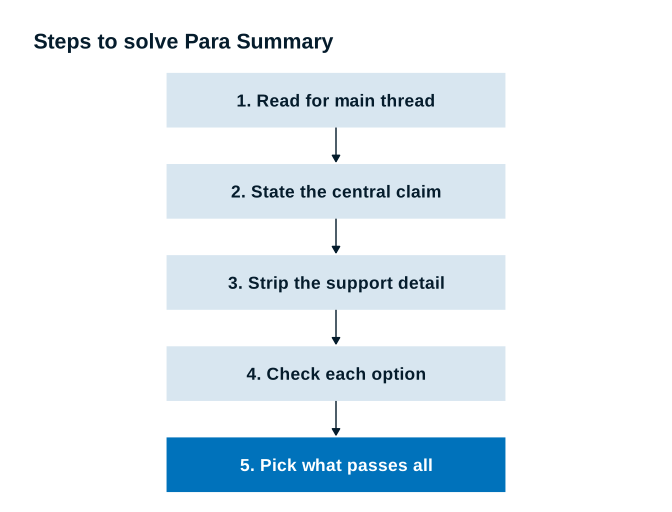
Read for the main thread
Do not try to memorise every sentence. Instead, follow the direction in which the paragraph moves.
A paragraph may:
- move from an older view to a newer one
- use several examples to support one claim
- compare two ideas
- explain a cause-and-effect relationship
- present a problem and then suggest a solution
The summary must capture this overall movement rather than a single sentence or detail.
State the main claim in simple words
After reading the paragraph, reduce its central idea to one clear sentence.
This sentence does not need to reproduce the wording of the paragraph. Its purpose is to preserve the central relationship between the important ideas. It can then be used to test the options.
Separate the claim from its support
Most paragraphs contain material that supports the central claim. This support may include examples, names, studies, dates, numbers, technical details, and additional explanation.
These details help prove or explain the main idea, but they are usually not the main idea themselves.
Check every option against the main claim
Each option should be checked on five grounds:
- Does it preserve the paragraph’s meaning?
- Does it cover the complete main idea?
- Is it too broad or too narrow?
- Does it introduce anything that the paragraph does not say?
- Does it make the claim stronger or weaker?
Select the closest complete match
The correct answer may use different words from those in the paragraph. A summary is not required to copy the original language.
It must preserve the same meaning, scope, and level of certainty or strength.
Worked example: Cartographers and usability
The passage given below is followed by four alternate summaries. Choose the option that best captures the essence of the passage.
Cartographers design and create maps to communicate information about phenomena located somewhere on our planet. In the past, cartographers did not worry too much about who was going to read their maps. Although some simple "usability" research was done, like comparing whether circle or bar symbols worked best, cartographers knew how to make maps. This has changed now, however, due to all kinds of societal and technological developments. Today, map readers are more demanding, mostly because of the tools they use to read maps. Cartographers, who are also influenced by these trends, are now more interested in seeing if their products are efficient, effective, and appreciated.
- New technological developments have prompted cartographers to experiment with their maps by applying these new innovations.
- Today, cartographers also need to look into the usability of maps because of the new technological developments.
- Maps are being used for a variety of reasons and therefore map readers have become more demanding.
- Modern mapmakers evaluate a map's effectiveness, efficiency and satisfaction of the user through a series of experiments.
Answer
Option B is correct.
The paragraph uses a contrast between the past and the present. Earlier, cartographers concentrated mainly on making maps and paid limited attention to the people who would use them. Social and technological developments have changed this situation. Map readers now use different tools and have become more demanding. As a result, cartographers have become more interested in whether their maps are efficient, effective, and appreciated.
The main idea can be stated as:
Technological change has made cartographers more concerned with map usability.
Option C is incorrect. The option includes only the change in map readers. It leaves out the response of cartographers, which is an essential part of the paragraph’s main idea. Its scope is too narrow.
Finding the main idea
Most Para Summary paragraphs contain one central idea. To identify it, the topic must be separated from the main idea.
The topic is the general subject of the paragraph.
The main idea is the claim that the paragraph makes about that subject.
| Topic | Main idea |
|---|---|
| Cartography | Cartographers now care more about usability because technology changed map-reading |
| Animal emotions | Animals show human-like emotions because they share brain structures with humans |
| Information warfare | Governments use monitoring and cyber troops as part of information warfare |
| Ancient cities | Some early cities were less hierarchical than we usually assume |
Where the main idea usually appears
The main idea often appears in one of three places.
It may appear in the opening sentence. In such a paragraph, the author states the claim first and then explains or supports it.
It may appear near the end. The paragraph first develops a line of reasoning and then arrives at a conclusion.
It may also appear after a pivot. A pivot is a point at which the direction of the paragraph changes. Cue words such as but, however, yet, although, and in fact often indicate such a change.
Keeping the right scope
Scope refers to the width of a claim. It determines how much the claim includes.
A correct summary must be wide enough to cover the whole paragraph but narrow enough to remain within what the paragraph supports.
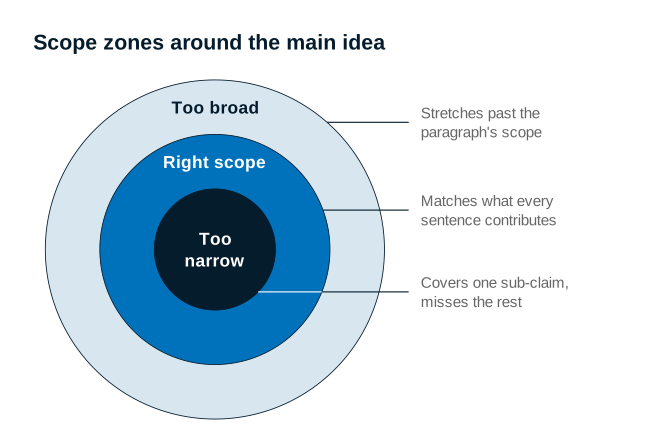
A too-narrow option captures only one example, detail, or part of the paragraph.
A too-broad option makes a claim that extends beyond the paragraph.
A right-scope option covers the complete central idea without adding any unsupported claim.
Handling examples and details
Most paragraphs do more than state a claim. They may include examples, names, studies, dates, numbers, or technical details to explain or support that claim.
These details are useful, but they are usually not the main idea.
An incorrect option may select a striking example and present it as the central point. This can seem convincing because examples are often easier to remember than the larger argument. However, a summary should capture the idea that the example supports, not merely repeat the example.
Handling contrast and qualification
Two features often shape the meaning of a Para Summary paragraph: contrast and qualification.
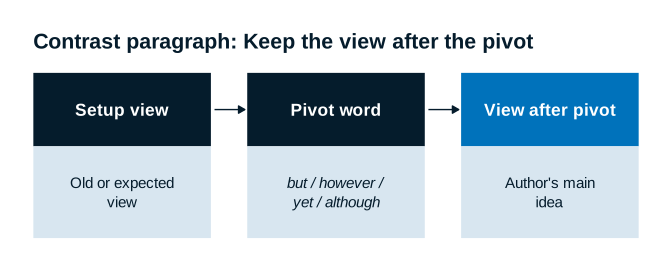
A contrast changes the direction of the paragraph. A qualification limits the strength or scope of a claim. A correct summary must preserve both.
Contrast paragraphs
Contrast paragraphs often use cue words such as but, however, yet, although, on the other hand, and in fact.
A common structure is:
Old view → but → new view
The summary should focus on the newer view while showing how it differs from the earlier position.
Qualified arguments
A qualified argument uses careful language to limit a claim. Common qualifiers include may, often, partly, tends to, in some cases, not necessarily, and about as likely as.
These words are part of the author’s meaning. Removing them can make the summary stronger than the paragraph.
Suppose a paragraph says that human activity is about as likely to increase biodiversity as reduce it. A summary should not say that human activity usually increases biodiversity. The second statement changes a balanced claim into a mainly positive one.
The opposite problem is also possible. If the paragraph makes a definite claim, an option should not weaken it without reason.
The option must match the paragraph’s exact level of certainty.
Practice questions
Practice set 1: Clear main idea
Question 1 (CAT 2019 Slot 2)
The passage given below is followed by four alternate summaries. Choose the option that best captures the essence of the passage.
Privacy-challenged office workers may find it hard to believe, but open-plan offices and cubicles were invented by architects and designers who thought that to break down the social walls that divide people, you had to break down the real walls, too. Modernist architects saw walls and rooms as downright fascist. The spaciousness and flexibility of an open plan would liberate homeowners and office dwellers from the confines of boxes. But companies took up their idea less out of a democratic ideology than a desire to pack in as many workers as they could. The typical open-plan office of the first half of the 20th century was a white-collar assembly line. Cubicles were interior designers' attempt to put some soul back in.
- Wall-free office spaces could have worked out the way their utopian inventors intended had companies cared for workers' satisfaction.
- Wall-free office spaces did not quite work out as desired and therefore cubicles came into being.
- Wall-free office spaces did not quite work out the way their utopian inventors intended, as they became tools for exploitation of labor.
- Wall-free office spaces did not quite work out as companies don't believe in democratic ideology.
Answer: C.
The paragraph describes how the original purpose of open-plan offices was changed.
Architects believed that removing physical walls would also weaken social divisions. They expected open spaces to give people greater freedom. Companies, however, adopted the design mainly because it allowed them to place more workers in the same area. The open office therefore became what the author calls a “white-collar assembly line.”
Option C captures both parts of this movement: the idealistic intention of the designers and the later use of open offices to exploit labour.
Option A is incorrect. The option speculates about what might have happened if companies had cared more about worker satisfaction. The paragraph describes what actually happened; it does not discuss an alternative outcome.
Option B is incorrect. The option says only that open-plan offices did not work as intended and that cubicles followed. It leaves out the central reason for the failure: companies used the design to crowd workers into an assembly-line arrangement.
Option D is incorrect. The option reduces the issue to companies not believing in democratic ideology. The paragraph’s main point is more specific. Companies adopted the design because it allowed them to fit more workers into the available space.
Question 2 (CAT 2018 Slot 1)
The passage given below is followed by four summaries. Choose the option that best captures the author's position.
Artificial embryo twinning is a relatively low-tech way to make clones. As the name suggests, this technique mimics the natural process that creates identical twins. In nature, twins form very early in development when the embryo splits in two. Twinning happens in the first days after egg and sperm join, while the embryo is made of just a small number of unspecialized cells. Each half of the embryo continues dividing on its own, ultimately developing into separate, complete individuals. Since they developed from the same fertilized egg, the resulting individuals are genetically identical.
- Artificial embryo twinning is low-tech and mimetic of the natural development of genetically identical twins from the embryo after fertilization.
- Artificial embryo twinning is low-tech and is close to the natural development of twins where the embryo splits into two identical twins.
- Artificial embryo twinning is low-tech unlike the natural development of identical twins from the embryo after fertilization.
- Artificial embryo twinning is just like the natural development of twins, where during fertilization twins are formed.
Answer: A.
The paragraph explains artificial embryo twinning as a simple cloning method that copies the natural formation of identical twins.
In both processes, an embryo splits shortly after fertilisation. Each part then develops into a separate individual. Because both individuals come from the same fertilised egg, they are genetically identical.
Option A includes all the central points: the technique is low-tech, it imitates a natural process, the split happens after fertilisation, and the resulting individuals are genetically identical.
Option B is incorrect. The option explains that the embryo splits into two, but it does not clearly preserve the important result that the two individuals are genetically identical. Since the paragraph is explaining a cloning method, this is a major omission.
Option C is incorrect. The word unlike reverses the relationship in the paragraph. Artificial embryo twinning does not differ from the natural process; it imitates it.
Option D is incorrect. The option places the formation of twins during fertilisation. The paragraph says that twinning occurs in the first few days after the egg and sperm join. This changes the timing of the process.
Question 3 (CAT 2020 Slot 2)
The passage given below is followed by four alternate summaries. Choose the option that best captures the essence of the passage.
All humans make decisions based on one or a combination of two factors. This is either intuition or information. Decisions made through intuition are usually fast, people don't even think about the problem. It is quite philosophical, meaning that someone who made a decision based on intuition will have difficulty explaining the reasoning behind it. The decision-maker would often utilize her senses in drawing conclusions, which again is based on some experience in the field of study. On the other side of the spectrum, we have decisions made based on information. These decisions are rational - it is based on facts and figures, which unfortunately also means that it can be quite slow. The decision-maker would frequently use reports, analyses, and indicators to form her conclusion. This methodology results in accurate, quantifiable decisions, meaning that a person can clearly explain the rationale behind it.
- It is better to make decisions based on information because it is more accurate, and the rationale behind it can be explained.
- Decisions based on intuition and information result in differential speed and ability to provide a rationale.
- While decisions based on intuition can be made fast, the reasons that led to these cannot be spelt out.
- We make decisions based on intuition or information on the basis of the time available.
Answer: B.
The paragraph compares two bases for decision-making: intuition and information.
Decisions based on intuition are usually quick but difficult to explain. They draw on the decision-maker’s senses and earlier experience.
Decisions based on information use facts, reports, analyses, and indicators. They are slower, but they are more measurable and easier to justify.
The paragraph can therefore be represented as:
Intuition → faster but harder to explain
Information → slower but easier to justify
Option B captures both differences: speed and the ability to provide a clear rationale.
Option A is incorrect. The option claims that information-based decisions are better. The paragraph compares the two methods but does not rank one above the other. The option changes the author’s neutral position.
Option C is incorrect. The option accurately describes intuition-based decisions but leaves out information-based decisions. It covers only one half of the comparison.
Option D is incorrect. The paragraph says that the two methods differ in speed. It does not say that people choose between them according to the amount of time available. The option introduces a cause that the paragraph does not provide.
Practice set 2: Scope control
Question 4 (CAT 2022 Slot 2)
The passage given below is followed by four alternate summaries. Choose the option that best captures the essence of the passage.
Several of the world's earliest cities were organised along egalitarian lines. In some regions, urban populations governed themselves for centuries without any indication of the temples and palaces that would later emerge; in others, temples and palaces never emerged at all, and there is simply no evidence of a class of administrators or any other sort of ruling stratum. It would seem that the mere fact of urban life does not, necessarily, imply any particular form of political organization, and never did. Far from resigning us to inequality, the picture that is now emerging of humanity's past may open our eyes to egalitarian possibilities we otherwise would have never considered.
- We now have the evidence in support of the existence of an egalitarian urban life in some ancient cities, where political and civic organisation was far less hierarchical.
- Contrary to our assumption that urban settlements have always involved hierarchical political and administrative structures, ancient cities were not organised in this way.
- The emergence of a class of administrators and ruling stratum transformed the egalitarian urban life of ancient cities to the hierarchical civic organisations of today.
- The lack of hierarchical administration in ancient cities can be deduced by the absence of religious and regal structures such as temples and palaces.
Answer: A.
The paragraph presents evidence that some of the earliest cities had egalitarian political and social structures. These cities could function without palaces, temples, administrators, or a separate ruling class.
The words several, some regions, and in others limit the author’s claim. The paragraph does not say that every ancient city was egalitarian. It shows that urban life did not always require a fixed hierarchy.
Option A preserves this limited scope by referring to “some ancient cities.” It also captures the broader conclusion that their political and civic organisation was less hierarchical.
Option B is incorrect. The option makes a general claim about ancient cities as a whole. The passage only says that several early cities were organised along egalitarian lines. By removing this qualification, the option turns a limited claim into a universal one.
Option C is incorrect. The option describes a transition from egalitarian ancient cities to the hierarchical cities of the present. The paragraph does not explain such a historical change. Its focus is the evidence that egalitarian cities existed, not the process through which they later became hierarchical.
Option D is incorrect. The absence of temples and palaces is one piece of evidence used to identify the lack of a ruling class. It is not the paragraph’s complete main idea. The option focuses on the evidence but leaves out the broader conclusion that urban life does not necessarily require hierarchical political organisation.
Question 5 (CAT 2020 Slot 1)
The passage given below is followed by four alternate summaries. Choose the option that best captures the essence of the passage.
For nearly a century most psychologists have embraced one view of intelligence. Individuals are born with more or less intelligence potential (I.Q.); this potential is heavily influenced by heredity and difficult to alter; experts in measurement can determine a person's intelligence early in life, currently from paper-and-pencil measures, perhaps eventually from examining the brain in action or even scrutinizing his/her genome. Recently, criticism of this conventional wisdom has mounted. Biologists ask if speaking of a single entity called "intelligence" is coherent and question the validity of measures used to estimate heritability of a trait in humans, who, unlike plants or animals, are not conceived and bred under controlled conditions.
- Biologists have questioned the long-standing view that 'intelligence' is a single entity and the attempts to estimate it's heritability.
- Biologists have criticised that conventional wisdom that individuals are born with more or less intelligence potential.
- Biologists have started questioning psychologists' view of 'intelligence' as a measurable immutable characteristic of an individual.
- Biologists have questioned the view that 'intelligence' is a single entity and the ways in which what is inherited.
Answer: A.
The paragraph first describes the traditional psychological view of intelligence. According to this view, intelligence is a measurable ability that is strongly influenced by heredity and difficult to change.
It then presents two specific objections raised by biologists:
1. They question whether intelligence can be treated as one single, coherent entity.
2. They question whether the methods used to estimate its heritability in humans are valid.
Option A includes both objections and therefore covers the complete scope of the paragraph.
Option B is incorrect. The option refers generally to the belief that people are born with different levels of intelligence. It does not include the two specific criticisms made by biologists. In particular, it leaves out the doubt about intelligence being a single entity and the problem with estimates of heritability.
Option C is incorrect. The word immutable means incapable of change. Although the traditional view treats intelligence as difficult to alter, the biologists’ main objections concern whether intelligence is one coherent entity and whether its heritability can be measured reliably. The option shifts the focus from heritability to changeability.
Option D is incorrect. The option attempts to include both ideas, but the phrase “the ways in which what is inherited” is unclear. The paragraph does not merely question how inheritance occurs. It questions the validity of the methods used to estimate the heritability of intelligence in human beings.
Question 6 (CAT 2021 Slot 1)
Directions for Summary: A paragraph is followed by four options which have summarized the passage in their own way. Pick the option that best summarizes the passage:
Developing countries are becoming hotbeds of business innovation in much the same way as Japan did from the 1950s onwards. They are reinventing systems of production and distribution, and experimenting with entirely new business models. Why are countries that were until recently associated with cheap hands now becoming leaders in innovation? Driven by a mixture of ambition and fear they are relentlessly climbing up the value chain. Emerging-market champions have not only proved highly competitive in their own backyards, they are also going global themselves.
- Developing countries are being forced to invent new business models which challenge the old business models, so they can remain competitive domestically.
- Production and distribution models are going through rapid innovations worldwide as developed countries are being challenged by their earlier suppliers from the developing world.
- Competition has driven emerging economies, once suppliers of cheap labour, to become innovators of business models that have enabled them to move up the value chain and go global.
- Innovations in production and distribution are helping emerging economies compete with countries to which they once supplied cheap labour.
Answer: C.
The paragraph describes a change in the role of developing countries.
Earlier, these countries were mainly associated with cheap labour. They are now creating new systems of production and distribution and experimenting with new business models. Ambition and competitive pressure have pushed them towards more advanced and valuable business activities.
This movement can be represented as:
Cheap labour → business innovation → higher value activities → global expansion
Option C captures this complete movement. It includes their earlier role, the pressure that encouraged innovation, their movement up the value chain, and their expansion into global markets.
Option A is incorrect. The option limits the purpose of innovation to remaining competitive in domestic markets. The paragraph says that emerging-market companies are also expanding globally. It therefore leaves out an important part of the result.
Option B is incorrect. The option shifts the focus from developing countries to the challenge faced by developed countries. The paragraph is mainly about the transformation of emerging economies themselves. It explains how they have moved from being providers of cheap labour to becoming innovators and global competitors.
Option D is incorrect. The option mentions innovation in production and distribution, but it does not include the movement up the value chain or the expansion into global markets. It captures part of the change but not its complete direction.
Question 7 (CAT 2021 Slot 2)
Directions for Summary: A paragraph is followed by four options which have summarized the passage in their own way. Pick the option that best summarizes the passage:
Biologists who publish their research directly to the Web have been labelled as "rogue", but physicists have been routinely publishing research digitally ("preprints"), prior to submitting in a peer-reviewed journal. Advocates of preprints argue that quick and open dissemination of research speeds up scientific progress and allows for wider access to knowledge. But some journals still don't accept research previously published as a preprint. Even if the idea of preprints is gaining ground, one of the biggest barriers for biologists is how they would be viewed by members of their conservative research community.
- One of the advantages of digital preprints of research is they hasten the dissemination process, but these are not accepted by most scientific communities.
- Compared to biologists, physicists are less conservative in their acceptance of digital pre-publication of research papers, which allows for faster dissemination of knowledge.
- Preprints of research are frowned on by some scientific fields as they do not undergo a rigorous reviewing process but are accepted among biologists as a quick way to disseminate information.
- While digital publication of research is gaining popularity in many scientific disciplines, almost all peer-reviewed journals are reluctant to accept papers that have been published before.
Answer: B.
The paragraph compares how physicists and biologists respond to preprints, which are research papers published online before being submitted to a peer-reviewed journal.
Physicists routinely use preprints. Supporters argue that this allows research to spread quickly, speeds up scientific progress, and gives more people access to knowledge. Biologists, however, are more hesitant because publishing a preprint may be viewed negatively by their conservative research community.
Option B captures this comparison. It correctly states that physicists are less conservative than biologists in accepting digital pre-publication and connects this acceptance with the faster spread of knowledge.
The paragraph’s movement can be represented as:
Physicists → routine use of preprints
Biologists → hesitation because of community opinion
Option A is incorrect. The option includes the faster dissemination of research but leaves out the main comparison between physicists and biologists. It also says that preprints are not accepted by most scientific communities. The paragraph only says that some journals do not accept work previously published as a preprint. The option broadens the claim.
Option C is incorrect. The option reverses the position of biologists. The paragraph says that biologists who publish directly online may be labelled “rogue” and may face disapproval from their conservative community. The option instead says that preprints are accepted among biologists. It also introduces the lack of rigorous review as the reason for opposition. The paragraph does not give this reason.
Option D is incorrect. The option says that almost all peer-reviewed journals are reluctant to accept previously published papers. The paragraph says only that some journals do not accept research already released as a preprint. It also shifts the discussion from the contrast between physicists and biologists to the attitude of journals in general.
Practice set 3: Example-heavy
Question 8 (CAT 2023 Slot 1)
The passage given below is followed by four alternate summaries. Choose the option that best captures the essence of the passage.
Manipulating information was a feature of history long before modern journalism established rules of integrity. A record dates back to ancient Rome, when Antony met Cleopatra and his political enemy Octavian launched a smear campaign against him with "short, sharp slogans written upon coins." The perpetrator became the first Roman Emperor and "fake news had allowed Octavian to hack the republican system once and for all". But the 21st century has seen the weaponization of information on an unprecedented scale. Powerful new technology makes the fabrication of content simple, and social networks amplify falsehoods peddled by States, populist politicians, and dishonest corporate entities. The platforms have become fertile ground for computational propaganda, 'trolling' and 'troll armies'.
- People need to become critical of what they read, since historically, weaponization of information has led to corruption.
- Octavian used fake news to manipulate people and attain power and influence, just as people do today.
- Disinformation, which is mediated by technology today, is not new and has existed since ancient times.
- Use of misinformation for attaining power, a practice that is as old as the Octavian era, is currently fueled by technology.
Answer: D.
The paragraph connects the historical use of misinformation with its modern, technology-driven form.
The example of Octavian shows that information has long been manipulated for political power. In the twenty-first century, however, technology has made false content easier to create and social networks have allowed it to spread on an unprecedented scale.
The movement of the paragraph is:
Historical misinformation → modern technological amplification
Option D captures both parts. It states that misinformation has been used to gain power since the time of Octavian and that technology now fuels this old practice.
Option A is incorrect. The option advises people to become more critical of what they read. The paragraph describes the history and expansion of misinformation but does not recommend how readers should respond. It therefore introduces an unsupported normative claim.
Option B is incorrect. The option focuses mainly on Octavian. His smear campaign is an example used to prove that political misinformation existed in ancient times. The option leaves out the central modern development: technology and social networks have greatly increased the scale of information manipulation.
Option C is incorrect. The option correctly states that disinformation is not new and is now connected with technology. However, it does not adequately capture the paragraph’s emphasis on the weaponisation of information on an unprecedented scale. It understates the change brought about by modern technology and social networks.
Question 9 (CAT 2022 Slot 1)
The passage given below is followed by four alternate summaries. Choose the option that best captures the essence of the passage.
Petitioning is an expeditious democratic tradition, used frequently in prior centuries, by which citizens can bring issues directly to governments. As expressions of collective voice, they support procedural democracy by shaping agendas. They can also recruit citizens to causes, give voice to the voteless, and apply the discipline of rhetorical argument that clarifies a point of view. By contrast, elections are limited in several respects: they involve only a few candidates, and thus fall far short of a representative democracy. Further, voters' choices are not specific to particular policies or laws, and elections are episodic, whereas the voice of the people needs to be heard and integrated constantly into democratic government.
- By giving citizens greater control over shaping political and democratic agendas, political petitions are invaluable as they represent an ideal form of a representative democracy.
- Petitioning has been important to democratic functioning, as it supplements the electoral process by enabling ongoing engagement with the government.
- Petitioning is definitely more representative of the collective voice, and the functioning of democratic government could improve if we relied more on petitioning rather than holding periodic elections.
- Citizens become less inclined to petitioning as it enables vocal citizens to shape political agendas, but this needs to change to strengthen democracies today.
Answer: B.
The paragraph explains how petitions support democracy by addressing some of the limits of elections.
Petitions allow citizens to bring particular issues directly to the government. They help shape political agendas, draw people towards causes, give a voice to those who cannot vote, and encourage clear argument.
Elections are more limited. They involve a small number of candidates, do not allow voters to express separate views on individual laws or policies, and take place only at intervals. Petitions allow public opinion to remain part of government between elections.
The relationship can be represented as:
Elections → periodic and limited choices
Petitions → continuous engagement on specific issues
Option B preserves this relationship. It presents petitioning as a way of supplementing elections by enabling ongoing engagement with government.
Option A is incorrect. The option calls petitions an ideal form of representative democracy. The paragraph describes several benefits of petitions but does not claim that they provide a perfect or ideal democratic system. The option makes the author’s claim stronger than the passage supports.
Option C is incorrect. The option suggests relying on petitions instead of holding periodic elections. The paragraph does not propose replacing elections. It explains that elections have limits and that petitions can supplement them. The option turns two complementary democratic processes into alternatives.
Option D is incorrect. The option says that citizens are becoming less inclined to use petitions. The paragraph does not discuss whether petitioning is becoming more or less popular. It also adds a recommendation that this trend must be reversed. Neither the trend nor the recommendation appears in the passage.
Question 10 (CAT 2019 Slot 1)
The passage given below is followed by four alternate summaries. Choose the option that best captures the essence of the passage.
Vance Packard's The Hidden Persuaders alerted the public to the psychoanalytical techniques used by the advertising industry. Its premise was that advertising agencies were using depth interviews to identify hidden consumer motivations, which were then used to entice consumers to buy goods. Critics and reporters often wrongly assumed that Packard was writing mainly about subliminal advertising. Packard never mentioned the word subliminal, however, and devoted very little space to discussions of "subthreshold" effects. Instead, his views largely aligned with the notion that individuals do not always have access to their conscious thoughts and can be persuaded by supraliminal messages without their knowledge.
- Packard held that advertising as a 'hidden persuasion' understands the hidden motivations of consumers and works at the supraliminal level, though the people targeted have no awareness of being persuaded.
- Packard held that advertising as a 'hidden persuasion' builds on peoples' conscious thoughts and awareness, by understanding the hidden motivations of consumers and works at the subliminal level.
- Packard argued that advertising as a 'hidden persuasion' works at the supraliminal level, wherein the people targeted are aware of being persuaded, after understanding the hidden motivations of consumers and works.
- Packard argued that advertising as a 'hidden persuasion' understands the hidden motivations of consumers and works at the subliminal level, on the subconscious level of the awareness of the people targeted.
Answer: A.
The paragraph explains how advertisers use psychological techniques to discover consumers’ hidden motivations. These motivations are then used to influence buying decisions.
The important distinction is between subliminal and supraliminal messages. Packard was often wrongly linked with subliminal advertising, which involves messages below the level of conscious perception. His actual position was closer to the idea that people can be influenced by supraliminal messages. Such messages can be perceived, but people may not consciously recognise how they are being persuaded.
Option A preserves both parts of this idea: advertising uses hidden consumer motivations, and people may be influenced by supraliminal messages without being aware of the persuasion.
Option B is incorrect. The option says that the persuasion operates through people’s conscious thoughts and at the subliminal level. Both claims conflict with the paragraph. Packard believed that people do not always have access to their conscious thoughts, and his argument concerned supraliminal rather than subliminal messages.
Option C is incorrect. The option correctly mentions supraliminal messages but says that the people targeted are aware of being persuaded. The paragraph states the opposite. Individuals may be persuaded without knowing that the persuasion is taking place.
Option D is incorrect. The option describes the advertising as subliminal. The paragraph specifically explains that Packard did not focus on subliminal or subthreshold effects. It replaces the correct idea of supraliminal influence with a different form of persuasion.
Question 11 (CAT 2024 Slot 2)
The passage given below is followed by four alternate summaries. Choose the option that best captures the essence of the passage.
Different from individuals, states conduct warfare operations using the DIME model "diplomacy, information, military, and economics." Most states do everything they can to inflict pain and confusion on their enemies before deploying the military. In fact, attacks on vectors of information are a well-worn tactic of war and usually are the first target when the charge begins. It's common for telecom data and communications networks to be routinely monitored by governments, which is why the open data policies of the web are so concerning to many advocates of privacy and human rights. With the worldwide adoption of social media, more governments are getting involved in low-grade information warfare through the use of cyber troops. According to a study by the Oxford Internet Institute in 2020, cyber troops are "government or political party actors tasked with manipulating public opinion online." The Oxford research group was able to identify 81 countries with active cyber troop operations utilizing many different strategies to spread false information, including spending millions on online advertising.
- Governments primarily use the DIME model to deploy cyber troops who practise lowgrade information warfare, seeking to manipulate public opinion with the objective of inflicting pain and confusion on their enemies.
- Using the DIME model, together with military operations, many governments simultaneously conduct information warfare with the help of cyber troops and routinely monitor telecom data and communications networks.
- As part of conducting information warfare as per the DIME model, many governments routinely monitor telecom data and communications networks, and use cyber troops on social media to manipulate public opinion.
- Following the DIME model, many governments have taken advantage of open data policies of the web to deploy cyber troops who manipulate domestic public opinion, using advertising and other strategies to spread false information.
Answer: C.
The paragraph introduces the DIME model and then concentrates on the information component of warfare.
It describes two major activities:
1. Governments monitor telecom data and communication networks.
2. Governments use cyber troops on social media to manipulate public opinion.
The Oxford study and the reference to online advertising support the second point. They are examples of how cyber troops operate.
The paragraph’s structure can be represented as:
DIME model → information warfare → network monitoring and cyber troops
Option C includes this complete structure.
Option A is incorrect. The option focuses on cyber troops and the aim of causing pain and confusion. It leaves out the routine monitoring of telecom data and communication networks. It therefore captures only part of the paragraph.
Option B is incorrect. The option says that the DIME model is used “together with military operations.” However, the military component is already included in DIME. It also does not clearly connect cyber troops with social media and the manipulation of public opinion.
Option D is incorrect. The option gives too much importance to open-data policies and online advertising. These are supporting details rather than the main idea. It also limits the manipulation to domestic public opinion, while the paragraph does not impose that restriction.
Practice set 4: Contrast
Question 12 (CAT 2022 Slot 1)
The passage given below is followed by four alternate summaries. Choose the option that best captures the essence of the passage.
It's not that modern historians of medieval Africa have been ignorant about contacts between Ethiopia and Europe; they just had the power dynamic reversed. The traditional narrative stressed Ethiopia as weak and in trouble in the face of aggression from external forces, so Ethiopia sought military assistance from their fellow Christians to the north. But the real story, buried in plain sight in medieval diplomatic texts, simply had not yet been put together by modern scholars. Recent research pushes scholars of medieval Europe to imagine a much more richly connected medieval world: at the beginning of the so-called Age of Exploration, there is evidence that the kings of Ethiopia were sponsoring their own missions of diplomacy, faith and commerce.
- Medieval historical sources selectively promoted the narrative that powerful European forces were called on to protect weak African civilisations such as Ethiopia, but this is far from reality.
- Historians were under the illusion that Ethiopia needed military protection from their neighbours, but in fact the country had close commercial and religious connections with them.
- Medieval texts have documented how strong connections between the Christian communities of Ethiopia and Europe were invaluable in establishing military and trade links between the two civilisations.
- Medieval texts have been 'cherry-picked' to promote a view of Ethiopia as weak and in need of Europe's military help with aggressive neighbours, but recent studies reveal it was a well-connected and outward-looking culture.
Answer: D.
The paragraph corrects the traditional understanding of the relationship between medieval Ethiopia and Europe.
The older account presented Ethiopia as weak and dependent on European military assistance. Recent research presents a different picture. Ethiopian kings actively sponsored missions involving diplomacy, religion, and commerce.
The movement is:
Old view: Weak and dependent Ethiopia → new view: Active and outward-looking Ethiopia
Option D captures both sides of this contrast.
Option A is incorrect. The option describes the older account but does not clearly state the newer interpretation. Saying that the old account is “far from reality” does not explain what the recent evidence reveals. The post-pivot view is incomplete.
Option B is incorrect. The option changes the relationship from Ethiopia and Europe to Ethiopia and its neighbours. The paragraph is specifically about contacts between Ethiopia and Europe and the mistaken interpretation of their power relationship.
Option C is incorrect. The option makes it sound as though the significance of the Ethiopia-Europe relationship had already been clearly understood. The paragraph says that the evidence existed in medieval texts, but modern scholars had not assembled it into the correct account.
Question 13 (CAT 2022 Slot 2)
The passage given below is followed by four alternate summaries. Choose the option that best captures the essence of the passage.
Today, many of the debates about behavioural control in the age of big data echo Cold War-era anxieties about brainwashing, insidious manipulation and repression in the 'technological society'. In his book Psychopolitics, Han warns of the sophisticated use of targeted online content, enabling 'influence to take place on a pre-reflexive level'. On our current trajectory, "freedom will prove to have been merely an interlude." The fear is that the digital age has not liberated us but exposed us, by offering up our private lives to machine-learning algorithms that can process masses of personal and behavioural data. In a world of influencers and digital entrepreneurs, it's not easy to imagine the resurgence of a culture engendered through disconnect and disaffiliation, but concerns over the threat of online targeting, polarisation and big data have inspired recent polemics about the need to rediscover solitude and disconnect.
- The role of technology in influencing public behaviour is reminiscent of the manner in which behaviour was manipulated during the Cold War.
- With big data making personal information freely available, the debate on the nature of freedom and the need for privacy has resurfaced.
- The notion of freedom and privacy is at stake in a world where artificial intelligence is capable of influencing behaviour through data gathered online.
- Rather than freeing us, digital technology is enslaving us by collecting personal information and influencing our online behaviour.
Answer: B.
The paragraph connects present-day concerns about big data with older fears about manipulation and behavioural control.
Digital platforms expose personal and behavioural information to machine-learning systems. This has renewed debates about privacy, freedom, online influence, and the need to disconnect.
The Cold War comparison provides historical context. The main point is the return of concerns about freedom and privacy in the age of big data.
It captures both the cause and the result. Big data has made personal information widely available, and this has revived debates about privacy and freedom.
Option A is incorrect. The option focuses mainly on the comparison with the Cold War. That comparison introduces the issue, but the paragraph’s main focus is the modern debate created by online targeting, algorithms, and the collection of personal data.
Option C is incorrect. The option narrows the discussion to artificial intelligence. The paragraph refers more broadly to big data, machine-learning algorithms, targeted content, polarisation, and digital platforms. It also gives less attention to the fact that an older debate about freedom and privacy has resurfaced.
Option D is incorrect. The option says that digital technology is enslaving people. This is stronger than the paragraph’s position. The author presents fears and concerns about the possible loss of freedom but does not state as a settled fact that people have already been enslaved.
Question 14 (CAT 2023 Slot 1)
The passage given below is followed by four alternate summaries. Choose the option that best captures the essence of the passage.
Colonialism is not a modern phenomenon. World history is full of examples of one society gradually expanding by incorporating adjacent territory and settling its people on newly conquered territory. In the sixteenth century, colonialism changed decisively because of technological developments in navigation that began to connect more remote parts of the world. The modern European colonial project emerged when it became possible to move large numbers of people across the ocean and to maintain political control in spite of geographical dispersion. The term colonialism is used to describe the process of European settlement, violent dispossession and political domination over the rest of the world, including the Americas, Australia, and parts of Africa and Asia.
- Colonialism surged in the 16th century due to advancements in navigation, enabling British settlements abroad and global dominance.
- As a result of developments in navigation technology, European colonialism, led to the displacement of indigenous populations and global political changes in the 16th century.
- Colonialism, conceptualized in the 16th century, allowed colonizers to expand their territories, establish settlements, and exercise political power.
- Technological advancements in navigation in the 16th century, transformed colonialism, enabling Europeans to establish settlements and exert political dominance over distant regions.
Answer: D.
The paragraph explains that colonialism existed before the modern period. Earlier forms generally involved expansion into nearby territories.
Navigation technology changed colonialism in the sixteenth century. European powers could now move large populations across oceans, establish distant settlements, and maintain political control over widely separated regions.
The central movement is:
Expansion into nearby territory → navigation advances → distant European settlement and control
Option D captures this transformation. It connects advances in navigation with the change in colonialism and includes both distant settlement and political domination.
Option A is incorrect. The option limits the colonial project to Britain. The paragraph refers to European colonialism more broadly. This narrows the scope without support.
Option B is incorrect. The option refers vaguely to “global political changes.” The paragraph makes a more specific point about settlement, dispossession, and political control over distant regions. It does not express the full nature of the transformation.
Option C is incorrect. The option says that colonialism was conceptualized in the sixteenth century. The paragraph begins by stating that colonialism is not a modern phenomenon. The sixteenth century changed its form and scale; it did not create the idea of colonialism.
Question 15 (CAT 2022 Slot 2)
The passage given below is followed by four alternate summaries. Choose the option that best captures the essence of the passage.
There's a common idea that museum artworks are somehow timeless objects available to admire for generations to come. But many are objects of decay. Even the most venerable Old Master paintings don't escape: pigments discolour, varnishes crack, canvases warp. This challenging fact of art-world life is down to something that sounds more like a thread from a morality tale: inherent vice. Damien Hirst's iconic shark floating in a tank - entitled The Physical Impossibility of Death in the Mind of Someone Living - is a work that put a spotlight on inherent vice. When he made it in 1991, Hirst got himself in a pickle by not using the right kind of pickle to preserve the giant fish. The result was that the shark began to decompose quite quickly - its preserving liquid clouding, the skin wrinkling, and an unpleasant smell wafting from the tank.
- The role of museums has evolved to ensure that the artworks are preserved forever in addition to guarding and displaying them.
- Artworks may not last forever; they may deteriorate with time, and the challenge is to slow down their degeneration.
- Museums are left with the moral responsibility of restoring and preserving the artworks since artists cannot preserve their works beyond their life.
- Museums have to guard timeless art treasures from intrinsic defects such as the deterioration of paint, polish and canvas.
Answer: B.
The paragraph challenges the belief that artworks are timeless.
Artworks are physical objects, and their materials naturally decay. Pigments fade, varnishes crack, canvases change shape, and organic materials decompose. The phrase inherent vice refers to this natural tendency of materials to deteriorate.
The example of Damien Hirst’s shark shows this process clearly. The incorrect preserving liquid caused the artwork to decay soon after it was created.
The paragraph’s main idea is that deterioration cannot always be prevented completely. Preservation can only slow it down.
It states that artworks may deteriorate and that the practical challenge is to delay this process. It matches the meaning and strength of the paragraph.
Option A is incorrect. The option says that museums preserve artworks forever. The paragraph explains that physical decay makes permanent preservation impossible. It reverses the central claim.
Option C is incorrect. The option introduces a moral responsibility on the part of museums. The paragraph discusses material decay, not ethical responsibility. It also introduces the unsupported idea that artists cannot preserve their works beyond their lifetimes.
Option D is incorrect. The option calls the artworks “timeless.” The paragraph directly challenges the belief that artworks remain unchanged across time. Although it mentions deterioration, its description of art as timeless conflicts with the central argument.
Practice set 5: Qualified arguments
Question 16 (CAT 2021 Slot 1)
Directions for Summary: A paragraph is followed by four options which have summarized the passage in their own way. Pick the option that best summarizes the passage:
Foreign peacekeepers often exist in a bubble in the poor countries in which they are deployed; they live in posh compounds, drive fancy vehicles, and distance themselves from locals. This may be partially justified as they are outsiders, living in constant fear, performing a job that is emotionally draining. But they are often despised by the locals, and many would like them to leave. A better solution would be bottom-up peacebuilding, which would involve their spending more time working with communities, understanding their grievances and earning their trust, rather than only meeting government officials.
- The environment in poor countries has tended to make foreign peacekeeping forces live in enclaves, but it is time to change this scenario.
- Extravagant lifestyles and an aloof attitude among the foreigners working as peacekeepers in poor countries have justifiably make them the target of local anger.
- Peacekeeping forces in foreign countries have tended to be aloof for valid reasons but would be more effective if they worked more closely with local communities.
- Peacekeeping duties would be more effectively performed by local residents given their better understanding, knowledge and rapport with their own communities.
Answer: C.
The paragraph presents a qualified criticism of foreign peacekeepers.
They often remain separated from local communities, but their distance may be partly understandable. They are outsiders, face constant fear, and perform emotionally difficult work.
The paragraph then proposes a more effective approach. Peacekeepers should spend more time with local communities, understand their concerns, and earn their trust.
Option C includes both the qualification and the recommendation. It recognises that peacekeepers may have valid reasons for remaining distant while also stating that closer work with local communities would improve their effectiveness.
Option A is incorrect. The option says that the situation should change but does not explain the specific change proposed in the paragraph. It leaves out community involvement, the understanding of grievances, and the building of trust.
Option B is incorrect. The option presents the peacekeepers’ behaviour as fully deserving of local anger. The paragraph says that their distance may be partly justified. The option removes this qualification and also leaves out the proposed solution.
Option D is incorrect. The option recommends replacing foreign peacekeepers with local residents. The paragraph does not suggest replacement. It argues that foreign peacekeepers should change their approach and work more closely with communities.
Question 17 (CAT 2025 Slot 2)
The passage given below is followed by four summaries. Choose the option that best captures the essence of the passage.
For millennia, in the process of opening up land for agriculture, gardens, grazing and hunting, humans have created ecological "mosaics", or "patchworks": landscapes holding a mixture of habitats, like meadows, gardens and forests. These were not designed as nature reserves, but often catered to hugely diverse animal life. Research indicates that European hay meadows cultivated for animal feed were actually more successful at preserving a vast array of species than meadows explicitly cultivated for biodiversity. Studying the early Holocene, researchers have found that human presence was about as likely to increase biodiversity as reduce it. Of course, not all human-created landscapes have the same value. A paved subdivision with astroturfed lawns is very different to a village with diverse vegetable and flower gardens. But scientists continue to find evidence that the old idea of humans as antithetical to nature is also wrong-headed, and that rosy visions of thriving, human-free environments are more imaginary than real.
- In our attempts to shape the world around us to our needs, humans have often created landscapes like meadows, gardens, and forests, which support hugely diverse species, and are more successful at preserving them, than parks created specifically for this.
- In terms of preserving biodiversity, scientists are finding increasing evidence that human action is not always antithetical to nature, but often assists the preservation of meadows, landscapes, and flourishing of species.
- Studying the early Holocene and human practices over millennia, researchers say that while agricultural meadows, gardens, and forests were not explicitly designed as nature reserves, they actually preserved a vast array of species, belying the idea that humans harm nature.
- Contrary to the idea that humans always hurt nature and that it thrives in their absence, a lot of human action across history has been equally likely to increase biodiversity than reduce it, often creating varied ecological landscapes that support a vast array of species.
Answer: D.
The paragraph challenges the idea that humans are always harmful to nature.
Across history, people have created mixed landscapes containing meadows, gardens, and forests. Some of these landscapes have supported many species. However, the paragraph does not claim that human activity is generally beneficial.
Its position is carefully balanced:
Human presence ≈ as likely to increase biodiversity as reduce it
The paragraph also states that not all human-created landscapes have the same value. Option D preserves both the correction of the older view and the qualification. It rejects the idea that humans always damage nature while preserving the balanced claim that human activity can either increase or reduce biodiversity. It also includes the role of varied ecological landscapes.
Option A is incorrect. The option focuses on the comparison between certain human-created landscapes and areas created specifically for biodiversity. That comparison is one supporting example. The paragraph’s broader point concerns the mixed effects of human presence across history.
Option B is incorrect. The option says that human action often helps species flourish. This gives the argument a mainly positive direction. The paragraph says that human presence was about as likely to reduce biodiversity as increase it.
Option C is incorrect. The option suggests that human-created landscapes disprove the claim that humans harm nature. The paragraph makes a more limited claim. Humans are not always harmful, but their effects can be positive or negative.
Question 18 (CAT 2024 Slot 3)
The passage given below is followed by four alternate summaries. Choose the option that best captures the essence of the passage.
Humans have managed to tweak the underlying biology of various plants and animals to produce high-tech crops and microbes. But regulating these entities is complicated, as the framework of policies and procedures are outdated and not flexible enough to adapt to emerging technology. The question is whether regulation will ever be able to keep up with human innovation, to regulate living things, which are apt to be unpredictable and unique; to capture all the potential risks when new biological entities are introduced, or when they pass on variations of their genes?
- The mercurial nature of biological entities calls for scientists to shape the regulations governing emerging technology, with regular calibration to handle variations in the field.
- A new framework of rules and procedures for regulating the most recent research emerging from biotechnology is urgently needed, to keep up with this rapidly changing discipline.
- Current regulation of biotechnology is outdated, but it is debatable if we can create a framework, imaginative and flexible, to cover all contingencies in this fast-changing area.
- The problem with formulating regulation for innovation in the scientific arena it that it is impossible to imagine the outcomes or risks related to the outcomes of all the research.
Answer: C.
The paragraph explains that biotechnology has advanced faster than the systems used to regulate it.
Existing policies are outdated and lack the flexibility needed for emerging technology. Regulation is especially difficult because living organisms can be unpredictable, differ from one another, and pass genetic variations to later generations.
The paragraph does not simply demand a new framework. It questions whether any regulatory system can remain flexible enough to identify every possible risk.
Option C preserves this uncertainty. It includes both important ideas: present regulations are outdated, and it remains uncertain whether a flexible framework can cover every possible development.
Option A is incorrect. The option says that scientists should shape the regulations. The paragraph discusses the difficulty of regulation but does not identify who should design or control the regulatory system.
Option B is incorrect. The option states firmly that a new regulatory framework is urgently needed. The paragraph goes further by questioning whether any framework could keep up with innovation and cover all possible risks. The option removes this uncertainty.
Option D is incorrect. The option says that imagining the outcomes and risks of scientific research is impossible. The paragraph presents this as a difficult and open question, not as an absolute impossibility. The option makes the claim too strong.
Question 19 (CAT 2025 Slot 1)
The passage given below is followed by four summaries. Choose the option that best captures the essence of the passage.
Zombie cells may contribute to age-related chronic inflammation: this finding could help scientists understand more about the aging process and why the immune system becomes less effective as we get older. Zombie or "senescent" cells are damaged cells that can no longer divide and grow like normal cells. Scientists think that these cells can contribute to chronic health problems when they accumulate in the body. In younger people, the immune system is more effective at clearing senescent cells from the body through a process called apoptosis, but as we age, this process becomes less efficient. As a result, there is an accumulation of senescent cells in different organs in the body, either through increased production or reduced clearance by the immune system. The zombie cells continue to use energy though they do not divide, and often secrete chemicals that cause inflammation, which if persistent for longer periods of time can damage healthy cells leading to chronic diseases.
- Senescent "zombie" cells are inactive or malfunctioning cells that can be found throughout the body.
- A younger person's immune system is healthy and is able to clear the damaged cells, but as people age, the zombie cells resist apoptosis, and start accumulating in the body.
- Aging leads to less effective apoptosis, and therefore zombie cells start to accumulate in the body, causing inflammation, which accelerates aging and leads to chronic diseases.
- Dead cells accelerate chronic inflammation weakening the immune system and lead to aging.
Answer: C.
The paragraph explains a chain connecting ageing, the immune system, senescent cells, inflammation, and chronic disease.
In younger people, the immune system clears damaged cells through apoptosis. As people age, this process becomes less effective. Senescent cells then accumulate in different organs.
Although these cells no longer divide, they continue to use energy and release chemicals that cause inflammation. Persistent inflammation may damage healthy cells and contribute to chronic disease.
The chain is:
Ageing → less effective clearance → senescent-cell accumulation → inflammation → chronic disease
Option C captures this overall movement. It connects reduced apoptosis with the accumulation of zombie cells, inflammation, and chronic disease.
Option A is incorrect. The option only defines senescent cells. It leaves out why they accumulate with age and how they contribute to inflammation and chronic disease.
Option B is incorrect. The option says that zombie cells resist apoptosis. The paragraph instead says that the immune system becomes less efficient at clearing them. It also leaves out the inflammation and chronic disease caused by their accumulation.
Option D is incorrect. The option calls zombie cells dead. The paragraph says that they continue to use energy, even though they no longer divide. It also reverses the relationship by suggesting that the cells weaken the immune system and cause ageing. The paragraph explains that ageing makes the immune system less effective, which allows the cells to accumulate.
Practice set 6: Mixed
Question 20 (CAT 2022 Slot 1)
The passage given below is followed by four alternate summaries. Choose the option that best captures the essence of the passage.
All that we think we know about how life hangs together is really some kind of illusion that we have perpetrated on ourselves because of our limited vision. What appear to be inanimate objects such as stones turn out not only to be alive in the same way that we are, but also in many infinitesimal ways to be affected by stimuli just as humans are. The distinction between animate and inanimate simply cannot be made when you enter the world of quantum mechanics and try to determine how those apparent subatomic particles, of which you and everything else in our universe is composed, are all tied together. The point is that physics and metaphysics show there is a pattern to the universe that goes beyond our capacity to grasp it with our brains.
- The inanimate world is both sentient and cognizant like its animate counterpart.
- The effect of stimuli is similar in inanimate objects when compared to animate objects or living beings.
- Quantum physics indicates that an astigmatic view of reality results in erroneous assumptions about the universe.
- Arbitrary distinctions between inanimate and animate objects disappear at the scale at which quantum mechanics works.
Answer: D.
The paragraph argues that the distinction between animate and inanimate objects breaks down at the scale examined by quantum mechanics.
The reference to stones responding to stimuli supports this larger claim. It is not the complete point by itself.
At the subatomic level, all objects are made of particles that are connected within a pattern that human beings may not fully understand. Option D captures the specific distinction that the paragraph questions and connects it with quantum mechanics.
Option A is incorrect. The words sentient and cognizant suggest feeling and conscious awareness. The paragraph says that inanimate objects may respond to stimuli, but it does not claim that they possess awareness like humans.
Option B is incorrect. The option focuses only on the response of inanimate objects to stimuli. This is a supporting detail. It leaves out the wider claim that the distinction between animate and inanimate objects breaks down at the quantum level.
Option C is incorrect. The option refers broadly to an unclear or defective view of reality. It does not identify the paragraph’s central subject: the distinction between animate and inanimate objects.
Question 21 (CAT 2024 Slot 1)
The passage given below is followed by four alternate summaries. Choose the option that best captures the essence of the passage.
Cartographers design and create maps to communicate information about phenomena located somewhere on our planet. In the past, cartographers did not worry too much about who was going to read their maps. Although some simple "usability" research was done-like comparing whether circle or bar symbols worked best-cartographers knew how to make maps. This has changed now, however, due to all kinds of societal and technological developments. Today, map readers are more demanding-mostly because of the tools they use to read maps. Cartographers, who are also influenced by these trends, are now more interested in seeing if their products are efficient, effective, and appreciated.
- New technological developments have prompted cartographers to experiment with their maps by applying these new innovations.
- Today, cartographers also need to look into the usability of maps because of the new technological developments.
- Maps are being used for a variety of reasons and therefore map readers have become more demanding.
- Modern mapmakers evaluate a map's effectiveness efficiency and satisfaction of the user through a series of experiments.
Answer: B.
The paragraph describes a shift in the priorities of cartographers.
In the past, cartographers concentrated mainly on making maps and paid limited attention to the people who would use them. Social and technological developments have made map readers more demanding.
As a result, cartographers are now more concerned with whether maps are effective, efficient, and appreciated by users.
The central relationship is:
Technological change → more demanding map readers → greater focus on usability
Option B captures this cause-and-effect relationship. It connects new technological developments with the increased need to study the usability of maps.
Option A is incorrect. The option presents experimentation with new innovations as the central point. The paragraph describes a broader change in focus from map-making alone to the experience and needs of map users.
Option C is incorrect. The option says that map readers have become more demanding, which is one part of the paragraph. It leaves out the response of cartographers and their increased interest in usability.
Option D is incorrect. The option focuses on experiments as the method of evaluating maps. The paragraph’s main idea is the broader shift towards usability, not a particular testing method.
Question 22 (CAT 2024 Slot 1)
The passage given below is followed by four alternate summaries. Choose the option that best captures the essence of the passage.
Certain codes may, of course, be so widely distributed in a specific language community or culture, and be learned at so early an age, that they appear not to be constructed - the effect of an articulation between sign and referent - but to be 'naturally' given. Simple visual signs appear to have achieved a 'near-universality' in this sense: though evidence remains that even apparently 'natural' visual codes are culture specific. However, this does not mean that no codes have intervened; rather, that the codes have been profoundly naturalized. The operation of naturalized codes reveals not the transparency and 'naturalness' of language but the depth, the habituation and the near-universality of the codes in use. They produce apparently 'natural' recognitions. This has the (ideological) effect of concealing the practices of coding which are present.
- All codes, linguistic and visual, have a natural origin but some are so widespread that they become universal. This is what hides the mechanism of coding behind signs.
- Not all codes are natural but certain codes are naturalized and made to appear universal. Ideology aims to hide the mechanism of coding behind signs.
- Language and visual signs are codes. However, some of the codes are so widespread that they not only seem naturally given but also hide the mechanism of coding behind the signs.
- Learning linguistic and visual signs at an early age makes all such codes appear natural. This naturalization of codes is the effect of ideology.
Answer: C.
The paragraph explains why some linguistic and visual codes appear natural.
These codes are learned early and used so widely within a culture that people stop noticing that they are constructed systems. Their widespread use makes them appear universal or naturally given.
This naturalisation hides the process through which signs have been connected with meanings.
The movement is:
Widespread and habitual use → appearance of naturalness → concealment of coding
Option C captures this full process. It identifies language and visual signs as codes and explains that widespread use makes them seem natural while hiding the coding process.
Option A is incorrect. The option says that codes have a natural origin. The paragraph argues the opposite. Codes are constructed, but their widespread and habitual use makes them appear natural.
Option B is incorrect. The option says that ideology aims to hide the mechanism of coding. This suggests a planned intention. The paragraph describes concealment as an ideological effect of naturalisation, not as a deliberate goal.
Option D is incorrect. The option focuses only on learning codes at an early age. The paragraph also stresses their wide distribution, habitual use, and near-universality. Early learning is only one part of the explanation.
Question 23 (CAT 2024 Slot 3)
The passage given below is followed by four alternate summaries. Choose the option that best captures the essence of the passage.
When the tradwife puts on that georgic, pinstriped dress, she is not just admiring the visual cues of a fantastical past. She takes these dreams of storybook bliss literally, tracing them backward in time until she reaches a logical conclusion that satisfies her. And by doing so, she ends up delivering an unhappy reminder of just how much our lives consist of artifice and playacting. The tradwife outrages people because of her deliberately regressive ideals. And yet her behaviour is, on some level, indistinguishable from the non-tradwife's. The tradwife's trollish genius is to beat us at our own dress-up game. By insisting that the idyllic cottage daydream should be real, right down to the primitive gender roles, she leaves others feeling hollow, cheated. The hullabaloo and headaches she causes may be the price we pay for taking too many things at face value: our just deserts, served Instagram-perfect by a manicured hand on a gorgeous ceramic dish, with fat, mouthwatering maraschino cherries on top.
- The tradwife's commitment to outdated gender roles and retro fashion critiques the superficiality of today's societal ideals.
- By promoting an idealized past, the tradwife exposes the artifice of contemporary values and mocks societal norms.
- The tradwife, with her vintage dress and traditional roles, highlights the superficiality of modern life and challenges current societal norms.
- The tradwife's vintage dress and adherence to traditional roles reveal the artificial nature of modern life and its superficial values.
Answer: C.
The paragraph presents the tradwife as someone who attempts to turn an idealised image of the past into a real way of life.
Her vintage clothing and regressive gender roles may appear very different from modern behaviour. However, the author argues that her performance resembles the forms of artifice and role-playing already present in contemporary life.
By taking an imagined past literally, she reveals the superficiality of modern social performances and unsettles current social norms.
Option C includes both parts of this idea. It includes the tradwife’s vintage appearance and traditional roles, connects them with the superficiality of modern life, and recognises their challenge to present-day norms.
Option A is incorrect. The option says that the tradwife deliberately critiques contemporary ideals. The paragraph presents the reminder about modern artificiality as an effect of her behaviour. It does not clearly say that she consciously intends to offer such a critique.
Option B is incorrect. The words exposes and mocks make the tradwife’s purpose and tone more aggressive than the paragraph supports. The passage describes her as producing an uncomfortable reminder and challenging others through her behaviour, not as directly mocking society.
Option D is incorrect. The option captures the artificial nature and superficiality of modern life but leaves out the way the tradwife challenges present-day social norms. It covers only part of the paragraph’s main idea.
Related Articles



Next steps