A parajumble presents four or five sentences in a mixed order. Your task is to arrange them so that they form one clear and connected paragraph.
In this reading, you will learn how to identify the opening sentence, connect sentences through strong links, build those links into a complete sequence, and check whether the final paragraph flows naturally.
A correct sequence usually has three qualities.
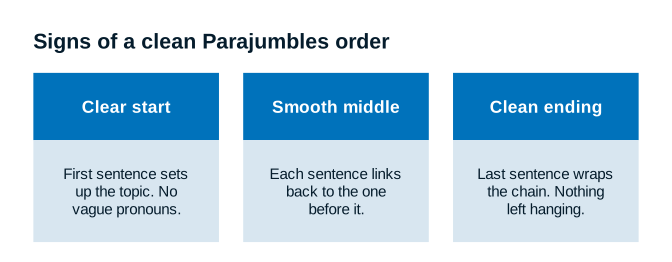
A clear start
The first sentence should introduce the topic in a way that makes sense on its own. It should not depend on information that has not yet appeared.
Words such as the following often point back to an earlier sentence:
- this
- these
- such
- they
- it
- but
- however
- also
- therefore
A sentence beginning with one of these words may still be an opener in some cases, but it usually requires close examination. The opening sentence must remain meaningful even when nothing comes before it.
A smooth middle
Every sentence after the opener should connect with something already introduced.
This connection may be created through:
- a pronoun
- a repeated idea
- a contrast word
- a time cue
- a cause-and-effect relationship
Consider the sentence:
These algorithms have a problem.
The phrase “these algorithms” points back to algorithms that must already have been introduced. The sentence therefore needs an earlier sentence to provide its subject.
A proper ending
The final sentence should provide a natural stopping point. It may present a result, conclusion, final example, or broader implication.
A weak ending leaves an unresolved reference or creates the sense that another sentence must follow.
Framework
The same basic method can be used for most parajumble questions.
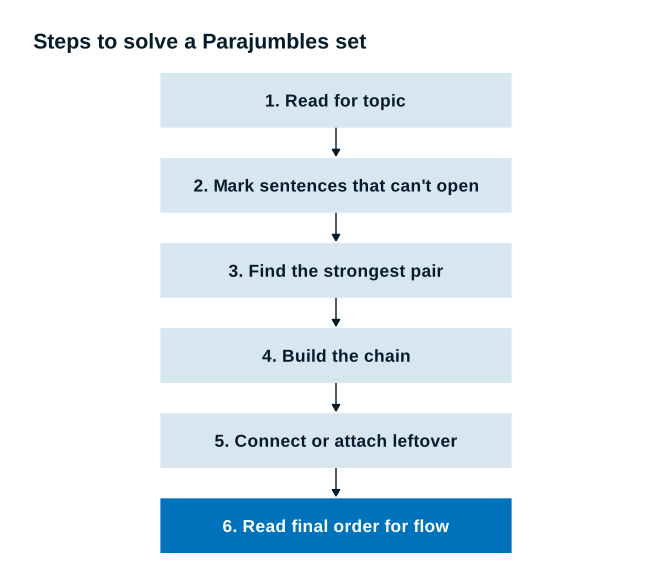
Read all the sentences once
Begin by reading all the sentences to identify the broad subject of the paragraph. Do not try to decide the complete order immediately.
The paragraph may discuss a concept, person, scientific discovery, problem, historical change, or comparison. At this stage, the purpose is only to understand what the sentences are collectively about.
Mark sentences that cannot open
Next, identify weak opening sentences.
A sentence is unlikely to open the paragraph when it begins with a pronoun, contrast word, addition word, or conclusion word.
For instance:
This shows that...
The word “this” must refer to an idea stated earlier. The sentence therefore cannot usually come first.
Similarly:
However,...
“However” introduces a contrast. A contrasting idea must already have appeared, so such a sentence usually needs to follow another sentence.
Find the strongest pair
A strong pair consists of two sentences that have a clear and direct connection. In some cases, the link is strong enough to show that the sentences must appear next to each other.
Suppose one sentence introduces “collaborative filtering” and another refers to “this collaborative filtering.” The second sentence clearly points back to the first, making them a likely pair.
The strongest pair may appear in the middle of the paragraph. It is therefore not always necessary to identify the opener before finding useful links.
Build a chain
After finding a pair, attach a third sentence to it.
The third sentence may:
- explain the idea further
- provide an example
- introduce a contrast
- present a result
Test whether the new sentence fits naturally before or after the pair.
Attach the remaining sentence
Once three sentences form a clear chain, the final sentence often has only two reasonable positions: before the chain or after it.
Test both placements and choose the one that produces the more natural paragraph.
Read the full sequence
Before entering the answer, read the sentences once in the chosen order.
The sequence should sound like a single paragraph. Each sentence should connect with the previous one, and the paragraph should end without leaving any idea incomplete.
Worked example: Collaborative filtering
Arrange the sentences in the correct order.
- If you've seen a little line of text on websites that says something like “customers who bought this also enjoyed that”, you have experienced this collaborative filtering firsthand.
- The problem with these algorithms is that they don't take into account a host of nuances and circumstances that might interfere with their accuracy.
- If you just bought a gardening book for your cousin, you might get a flurry of links to books about gardening, recommended just for you; the algorithm has no way of knowing you hate gardening and only bought the book as a gift.
- Collaborative filtering is a mathematical algorithm by which correlations and co-occurrences of behaviours are tracked and then used to make recommendations.
How to solve it
Sentence 4 should come first. It defines collaborative filtering without relying on any earlier information.
Sentence 1 refers to:
this collaborative filtering
The word “this” points back to the concept introduced in sentence 4. This creates the first pair:
4 → 1
Sentence 2 then refers to:
these algorithms
This phrase points back to collaborative filtering. The paragraph now moves from defining the algorithm to identifying a problem with it:
4 → 1 → 2
Sentence 3 provides a concrete example of that problem. The gardening-book example shows how the algorithm may misunderstand the reason behind a purchase.
The complete order is:
4 → 1 → 2 → 3
The answer is:
4123
Sentence 1 may initially appear to be a suitable opener because it begins with a familiar website example. However, the phrase “this collaborative filtering” requires the concept to be introduced first. Sentence 4 must therefore come before sentence 1.
Finding the opening sentence
The opener is the sentence that can begin the paragraph independently. It usually introduces the topic, provides background, defines a term, states a problem, or presents the main question.
A suitable opener does not depend on a word, idea, or event mentioned in an earlier sentence.
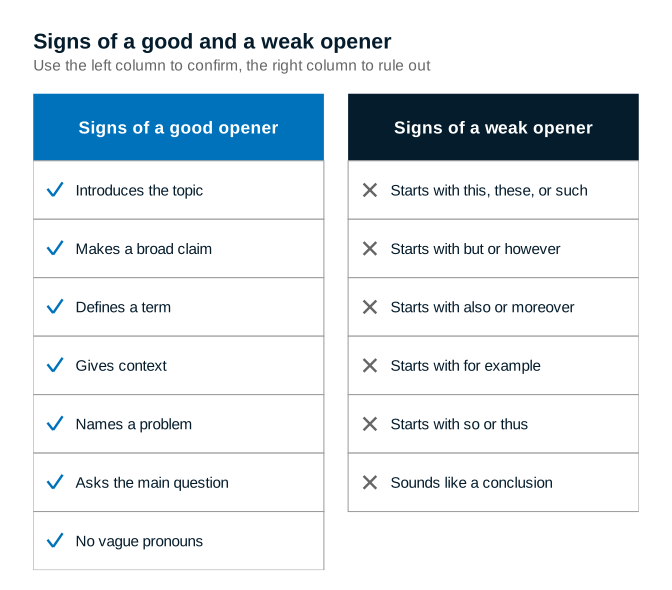
Signs of a suitable opener
A sentence is likely to be the opener when it:
- introduces the main topic by name
- presents a broad claim
- defines a term
- provides the setting or background
- states the problem that the paragraph will discuss
- presents the main question that the paragraph will answer
- does not begin with a backward-pointing word
Consider the sentence:
Collaborative filtering is a mathematical algorithm…
This sentence can open the paragraph because it introduces and defines the main topic.
Signs of a weak opener
A sentence is usually not the opener when it begins with:
- this, these, such, it, they, he, she
- but, however, yet, nevertheless
- also, moreover, furthermore, in addition
- for example, for instance
- so, therefore, thus, as a result
- in conclusion, in sum, ultimately
These expressions usually connect the sentence to something stated earlier.
Consider the sentence:
This configuration enables one to distinguish an astronaut on the Moon.
The phrase “this configuration” must refer to a configuration that has already been described. The sentence therefore cannot open the paragraph.
Finding sentence pairs
After identifying the opener, look for strong sentence pairs. You can also search for these pairs while the opener is still uncertain.
A strong pair is formed when one sentence clearly depends on another sentence beside it. This dependence is often revealed by cue words.
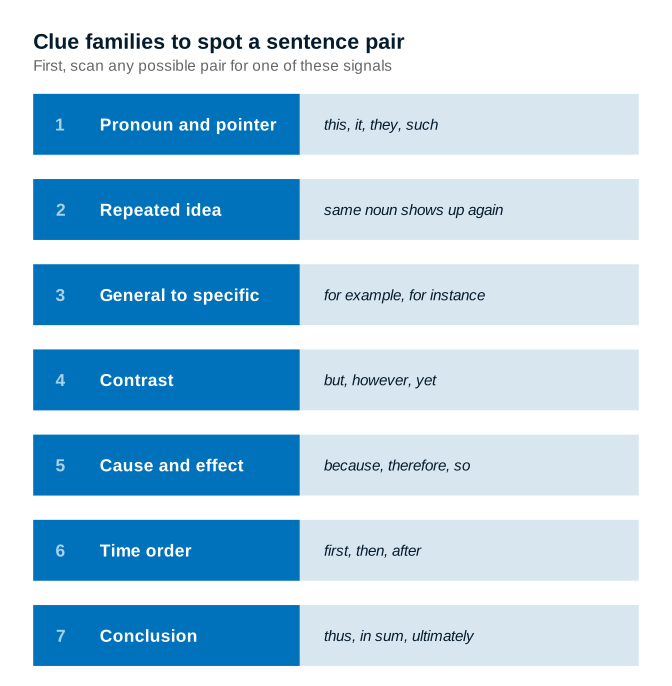
Pronoun and pointer links are usually the strongest. Words such as “this” and “these” need a clear earlier reference.
Contrast and cause-and-effect links are also strong because they establish a particular direction between two ideas.
Repeated ideas and addition words can help, but they require more care. Two sentences may discuss the same broad subject without forming a direct pair.
Pronoun and pointer links
Pronouns need a clear earlier reference.
When a sentence begins with:
They...
identify the people or things to which “they” refers.
Similarly, when a sentence says:
This method...
another sentence must have already introduced the method.
The reference is usually found in a nearby sentence, often the sentence immediately before it. However, a pronoun link is valid only when the earlier sentence provides a clear and grammatically suitable reference.
Contrast links
Words such as but, however, and yet introduce a contrast. A sentence containing one of these words must usually follow the idea that it opposes, corrects, or qualifies.
When a sentence begins with:
However,...
the previous sentence should present the view being challenged or limited.
The usual movement is:
view → however, correction
If the sentence before “however” does not establish a clear opposing view, the connection is probably incorrect.
Final flow check
Before entering the answer, read the sentences once in the chosen order and check four parts of the sequence.
First, the opening sentence should make sense independently.
Second, every pronoun or pointer word should have a clear earlier reference.
Third, every connector should express a logical relationship with the sentence before it. Contrast, addition, cause, result, and time cues must all fit the surrounding ideas.
Fourth, the final sentence should provide a complete and natural ending.
When a link feels forced, examine the two sentences around that point. The error is often in the pair immediately before or after the break.
Practice questions
Practice set 1: Openers
Question 1 (CAT 2018 Slot 2)
The four sentences (labelled 1, 2, 3, and 4) given in this question, when properly sequenced, form a coherent paragraph. Decide on the proper order for the sentences and key in this sequence of four numbers as your answer.
- Self-management is thus defined as the 'individual's ability to manage the symptoms, treatment, physical and psychosocial consequences and lifestyle changes inherent in living with a chronic condition'.
- Most people with progressive diseases like dementia prefer to have control over their own lives and health-care for as long as possible.
- Having control means, among other things, that patients themselves perform self-management activities.
- Supporting people in decisions and actions that promote self-management is called self-management support requiring a cooperative relationship between the patient, the family, and the professionals.
Answer: 2314.
Sentence 2 is the opener. It introduces people with progressive diseases such as dementia and states that they prefer to retain control over their lives and health care. The sentence makes sense independently and does not point back to an earlier idea.
Sentence 3 continues the idea of “control.” It explains that having control includes carrying out self-management activities. The repeated idea creates a strong pair:
2 → 3
Sentence 1 begins with “thus,” which signals that a definition is being drawn from the previous discussion. Sentence 3 introduces self-management activities, and sentence 1 formally defines self-management as the ability to handle the symptoms, treatment, consequences, and lifestyle changes linked to a chronic condition.
3 → 1
Sentence 4 then extends the discussion from self-management to self-management support. It explains how patients, families, and professionals work together to help a person make decisions and take actions that support self-management.
1 → 4
The complete order is:
2 → 3 → 1 → 4
Question 2 (CAT 2019 Slot 1)
The four sentences (labelled 1, 2, 3, 4) given below, when properly sequenced would yield a coherent paragraph. Decide on the proper sequence of the order of the sentences and key in the sequence of the four numbers as your answer.
- People with dyslexia have difficulty with print-reading, and people with autism spectrum disorder have difficulty with mind-reading.
- An example of a lost cognitive instinct is mind-reading: our capacity to think of ourselves and others as having beliefs, desires, thoughts and feelings.
- Mind-reading looks increasingly like literacy, a skill we know for sure is not in our genes, since scripts have been around for only 5,000-6,000 years.
- Print-reading, like mind-reading varies across cultures, depends heavily on certain parts of the brain, and is subject to developmental disorders.
Answer: 2341.
Sentence 2 is the opener. It introduces and defines mind-reading as the capacity to understand that people have beliefs, desires, thoughts, and feelings.
Sentence 3 develops this idea by comparing mind-reading with literacy. It states that literacy cannot be an inherited ability because written scripts have existed for only 5,000 to 6,000 years.
Sentence 4 continues the comparison between mind-reading and print-reading. It explains that both vary across cultures, depend on particular parts of the brain, and may be affected by developmental disorders.
Sentence 1 then gives specific examples of those developmental disorders. Dyslexia affects print-reading, while autism spectrum disorder affects mind-reading. The movement is from a general category to particular cases:
4 → 1
The complete order is:
2 → 3 → 4 → 1
Question 3 (CAT 2020 Slot 2)
The four sentences (labelled 1, 2, 3, 4) below, when properly sequenced would yield a coherent paragraph. Decide on the proper sequencing of the order of the sentences and key in the sequence of the four numbers as your answer:
- But the attention of the layman, not surprisingly, has been captured by the atom bomb, although there is at least a chance that it may never be used again.
- Of all the changes introduced by man into the household of nature, [controlled] large-scale nuclear fission is undoubtedly the most dangerous and most profound.
- The danger to humanity created by the so-called peaceful uses of atomic energy may, however, be much greater.
- The resultant ionizing radiation has become the most serious agent of pollution of the environment and the greatest threat to man's survival on earth.
Answer: 2413.
Sentence 2 is the opener. It introduces large-scale nuclear fission and makes the broad claim that it is among the most dangerous and far-reaching changes humans have made to nature.
Sentence 4 follows because “resultant ionizing radiation” refers to radiation produced by the nuclear fission introduced in sentence 2. It explains the major environmental and human danger created by that process.
2 → 4
Sentence 1 begins with “But,” which marks a shift. Although radiation is presented as the larger threat, public attention has been captured mainly by the atom bomb.
Sentence 3 then contrasts the bomb with the peaceful uses of atomic energy. The word “however” qualifies the focus on the bomb by stating that peaceful uses may create an even greater danger to humanity.
1 → 3
The paragraph moves from nuclear fission, to the radiation it produces, to the public focus on the atom bomb, and finally to the less dramatic but potentially greater danger of peaceful atomic energy.
The complete order is:
2 → 4 → 1 → 3
Question 4 (CAT 2025 Slot 1)
The four sentences (labelled 1, 2, 3, and 4) given below, when properly sequenced, would yield a coherent paragraph. Decide on the proper sequencing of the order of the sentences and key in the sequence of the four numbers as your answer.
- It can in fact be integrated into any function (education, medical treatment, production, punishment); it can increase the effect of this function, by being linked closely with it; it can constitute a mixed mechanism in which relations of power (and of knowledge) may be precisely adjusted, in the smallest detail, to the processes that are to be supervised; it can establish a direct proportion between 'surplus power' and 'surplus production'.
- It's a case of 'it's easy once you've thought of it' in the political sphere.
- The panoptic mechanism is not simply a hinge, a point of exchange between a mechanism of power and a function; it is a way of making power relations function in a function, and of making a function function through these power relations
- In short, it arranges things in such a way that the exercise of power is not added on from the outside, like a rigid, heavy constraint, to the functions it invests, but is so subtly present in them as to increase their efficiency by itself increasing its own points of contact.
Answer: 2143.
Sentence 2 is the opener. The phrase “it’s easy once you’ve thought of it” functions as a complete expression and introduces a political idea that will be explained in the following sentences.
Sentence 1 develops that idea. It explains that the mechanism can be integrated into several functions, including education, medical treatment, production, and punishment. Within these functions, relations of power and knowledge can be closely adjusted to the processes being supervised.
Sentence 4 begins with “In short,” so it must summarise the explanation that comes before it. It states that power is not imposed as a heavy external restriction. Instead, it becomes part of the function itself and increases the function’s efficiency.
Sentence 3 concludes by naming and defining the system as the “panoptic mechanism.” It explains that the mechanism joins power and function so closely that each operates through the other.
The complete order is:
2 → 1 → 4 → 3
Practice set 2: Pronoun and reference links
Question 5 (CAT 2019 Slot 1)
The four sentences (labelled 1, 2, 3, 4) given below, when properly sequenced would yield a coherent paragraph. Decide on the proper sequence of the order of the sentences and key in the sequence of the four numbers as your answer.
- Metaphors may map to similar meanings across languages, but their subtle differences can have a profound effect on our understanding of the world.
- Latin scholars point out carpe diem is a horticultural metaphor that, particularly seen in the context of its source, is more accurately translated as “plucking the day,” evoking the plucking and gathering of ripening fruits or flowers, enjoying a moment that is rooted in the sensory experience of nature, unrelated to the force implied in seizing.
- The phrase carpe diem, which is often translated as “seize the day and its accompanying philosophy, has gone on to inspire countless people in how they live their lives and motivates us to see the world a little differently from the norm.
- It's an example of one of the more telling ways that we mistranslate metaphors from one language to another, revealing in the process our hidden assumptions about what we really value.
Answer: 3241.
Sentence 3 is the opener. It introduces the phrase carpe diem and explains its familiar translation, “seize the day.” It also shows how this interpretation has influenced the way people approach life.
Sentence 2 follows by correcting this familiar translation. Latin scholars describe carpe diem as a horticultural metaphor. “Plucking the day” suggests gathering ripe fruit or flowers and enjoying a moment through direct sensory experience. This meaning is gentler than the force suggested by the word “seize.”
The movement is:
3 → 2
Sentence 4 begins with “It’s an example.” The word “It” refers to the mistranslation of carpe diem explained in sentences 3 and 2. The sentence then broadens the discussion by showing that mistranslated metaphors can reveal hidden assumptions about what people value.
2 → 4
Sentence 1 provides the conclusion. It moves from the single example of carpe diem to a general point about metaphors across languages. Even when metaphors appear to have similar meanings, small differences between them can shape how people understand the world.
The complete order is:
3 → 2 → 4 → 1
Question 6 (CAT 2021 Slot 2)
Four sentences that are a part of paragraph are given below; the sentences may or may not be in the right order; create the sequence that forms a coherent paragraph.
- The US has long maintained that the Northwest Passage is an international strait through which its commercial and military vessels have the right to pass without seeking Canada's permission.
- Canada, which officially acquired the group of islands forming the Northwest Passage in 1880, claims sovereignty over all the shipping routes through the Passage.
- The dispute could be transitory, however, as scientists speculate that the entire Arctic Ocean will soon be ice-free in summer, so ship owners will not have to ask for permission to sail through any of the Northwest Passage routes.
- The US and Canada have never legally settled the question of access through the Passage, but have an agreement whereby the US needs to seek Canada's consent for any transit.
Answer: 2143.
Sentence 2 is the opener. It introduces the Northwest Passage and explains Canada’s claim over it. Canada believes that the shipping routes through the passage fall under its sovereignty.
Sentence 1 presents the opposing position. The US considers the Northwest Passage an international strait. It therefore claims that its commercial and military vessels can pass through without seeking Canada’s permission.
The two competing claims create the first movement:
2 → 1
Sentence 4 explains the present legal position. The two countries have never formally settled the dispute. However, they follow a practical agreement under which the US seeks Canada’s consent before using the passage.
Sentence 3 comes last because it looks towards the future. The word “however” qualifies the earlier discussion by suggesting that the dispute may not last. If the Arctic Ocean becomes ice-free during summer, ships may be able to avoid the recognised Northwest Passage routes altogether.
The paragraph therefore moves from Canada’s claim, to the US position, to the current arrangement, and finally to a possible future development that may make the dispute less relevant.
The complete order is:
2 → 1 → 4 → 3
Question 7 (CAT 2020 Slot 2)
The four sentences (labelled 1, 2, 3, 4) below, when properly sequenced would yield a coherent paragraph. Decide on the proper sequencing of the order of the sentences and key in the sequence of the four numbers as your answer:
- While you might think that you see or are aware of all the changes that happen in your immediate environment, there is simply too much information for your brain to fully process everything.
- Psychologists use the term 'change blindness' to describe this tendency of people to be blind to changes though they are in the immediate environment.
- It cannot be aware of every single thing that happens in the world around you.
- Sometimes big shifts happen in front of your eyes and you are not at all aware of these changes.
Answer: 1342.
Sentence 1 is the opener. It introduces the main idea: the brain receives more information than it can fully process. The sentence makes sense independently and establishes the reason people may fail to notice changes around them.
Sentence 3 begins with “It.” This pronoun refers to the brain introduced in sentence 1. The sentence continues the same idea by stating that the brain cannot remain aware of everything happening in the surrounding world.
1 → 3
Sentence 4 presents the result of this limitation. Since the brain cannot process every detail, even large changes may occur directly in front of a person without being noticed.
3 → 4
Sentence 2 refers to “this tendency.” The phrase points back to the tendency described in sentence 4: failing to notice changes in the immediate environment. Sentence 2 then gives this tendency its psychological name, “change blindness.”
The complete order is:
1 → 3 → 4 → 2
Question 8 (CAT 2023 Slot 3)
The four sentences (labelled 1, 2, 3 and 4) given below, when properly sequenced, would yield a coherent paragraph. Decide on the proper sequencing of the order of the sentences and key in the sequence of the four numbers as your answer.
- Veena Sahajwalla, a materials scientist at the University of New South Wales, believes there is a new way of solving this problem.
- Her vision is for automated drones and robots to pick out components, put them into a small furnace and smelt them at specific temperatures to extract the metals one by one before they are sent off to manufacturers for reuse.
- E-waste contains huge quantities of valuable metals, ceramics and plastics that could be salvaged and recycled, although currently not enough of it is.
- She plans to build micro factories that can tease apart the tangle of materials in mobile phones, computers and other e-waste.
Answer: 3142.
Sentence 3 is the opener. It introduces e-waste and identifies the main problem. Electronic waste contains valuable materials that could be recovered, but too little of it is currently recycled.
Sentence 1 follows because it refers to “this problem.” The phrase points directly to the failure to recover and recycle enough material from e-waste. The sentence then introduces materials scientist Veena Sahajwalla and states that she has a possible solution.
3 → 1
Sentence 4 begins with “She,” which refers to Veena Sahajwalla in sentence 1. It introduces her plan to build micro factories that can separate the different materials found in electronic waste.
1 → 4
Sentence 2 explains how this plan would operate. “Her vision” refers to Sahajwalla’s plan, while the description of drones, robots, furnaces, and metal extraction develops the idea of the micro factories introduced in sentence 4.
The process ends with the recovered metals being sent to manufacturers for reuse.
The complete order is:
3 → 1 → 4 → 2
Practice set 3: Example, contrast, cause-effect
Question 9 (CAT 2019 Slot 2)
The four sentences (labelled 1, 2, 3, 4) given below, when properly sequenced would yield a coherent paragraph. Decide on the proper sequence of the order of the sentences and key in the sequence of the four numbers as your answer.
- To the uninitiated listener, atonal music can sound like chaotic, random noise.
- Atonality is a condition of music in which the constructs of the music do not 'live' within the confines of a particular key signature, scale, or mode.
- After you realize the amount of knowledge, skill, and technical expertise required to compose or perform it, your tune may change, so to speak.
- However, atonality is one of the most important movements in 20th century music.
Answer: 2143.
Sentence 2 is the opener. It defines atonality and introduces the subject without depending on any earlier sentence.
Sentence 1 then describes how atonal music may sound to an inexperienced listener. Because it does not follow the usual structure of a key, scale, or mode, it may initially seem like random noise.
Sentence 4 begins with “However,” so it must contrast with the negative impression in sentence 1. Although atonal music may sound chaotic, it was one of the most important musical movements of the twentieth century.
Sentence 3 completes the paragraph by explaining how a listener’s opinion may change after understanding the knowledge and technical skill required to compose or perform atonal music. The pronoun “it” refers to the music already being discussed.
The complete order is:
2 → 1 → 4 → 3
Question 10 (CAT 2021 Slot 2)
Four sentences that are a part of paragraph are given below; the sentences may or may not be in the right order; create the sequence that forms a coherent paragraph.
- But today there is an epochal challenge to rethink and reconstitute the vision and practice of development as a shared responsibility – a sharing which binds both the agent and the audience, the developed world and the developing, in a bond of shared destiny.
- We are at a crossroads now in our vision and practice of development.
- This calls for the cultivation of an appropriate ethical mode of being in our lives which enables us to realize this global and planetary situation of shared living and responsibility.
- Half a century ago, development began as a hope for a better human possibility, but in the last fifty years, this hope has lost itself in the dreary desert of various kinds of hegemonic applications.
Answer: 2413.
Sentence 2 is the opener. It introduces the broad situation by stating that the current vision and practice of development have reached a crossroads.
Sentence 4 explains how this situation arose. Development began half a century ago as a hope for improving human life, but that hope was weakened by various hegemonic applications. The historical failure described here explains the crossroads mentioned in sentence 2.
Sentence 1 begins with “But today,” which marks a shift from the past to the present. It argues that development must now be rethought as a shared responsibility connecting the developed and developing worlds.
Sentence 3 begins with “This,” which refers to the new vision of shared responsibility in sentence 1. It explains that such a vision requires an ethical way of living based on shared global and planetary responsibility.
The complete order is:
2 → 4 → 1 → 3
Question 11 (CAT 2022 Slot 1)
The four sentences (labelled 1, 2, 3 and 4) below, when properly sequenced, would yield a coherent paragraph. Decide on the proper sequencing of the order of the sentences and key in the sequence of the four numbers as your answer:
- Some company leaders are basing their decisions on locating offices to foster innovation and growth, as their best-performing inventors suffered the greatest productivity losses when their commutes grew longer.
- Shorter commutes support innovation by giving employees more time in the office and greater opportunities for in-person collaboration, while removing the physical strain of a long commute.
- This is not always the case: remote work does not automatically lead to greater creativity and productivity as office water-cooler conversations are also very important for innovation.
- Some see the link between long commutes and productivity as support for work-from-home scenarios, as many workers have grown accustomed to their commute-free arrangements during the pandemic.
Answer: 2143.
Sentence 2 is the opener. It makes the broad claim that shorter commutes can support innovation by reducing physical strain and allowing more time for in-person collaboration.
Sentence 1 provides a specific application of this claim. Some company leaders are choosing office locations based on evidence that longer commutes caused greater productivity losses among their strongest inventors.
This creates the first pair:
2 → 1
Sentence 4 introduces another response to the problem of long commutes. Instead of placing offices closer to employees, some people see the evidence as support for working from home.
Sentence 3 begins with “This is not always the case.” The word “This” refers to the belief that remote work will improve creativity and productivity. Sentence 3 qualifies that view by noting that informal office conversations can also support innovation.
This creates the second pair:
4 → 3
The complete order is:
2 → 1 → 4 → 3
Question 12 (CAT 2022 Slot 2)
The four sentences (labelled 1, 2, 3 and 4) below, when properly sequenced, would yield a coherent paragraph. Decide on the proper sequencing of the order of the sentences and key in the sequence of the four numbers as your answer:
- From chemical pollutants in the environment to the damming of rivers to invasive species transported through global trade and travel, every environmental issue is different and there is no single tech solution that can solve this crisis.
- Discourse on the threat of environmental collapse revolves around cutting down emissions, but biodiversity loss and ecosystem collapse are caused by myriad and diverse reasons.
- This would require legislation that recognises the rights of future generations and other species that allows the judiciary to uphold a much higher standard of environmental protection than currently possible.
- Clearly, our environmental crisis requires large political solutions, not minor technological ones, so, instead of focusing on infinite growth, we could consider a path of stable-state economies, while preserving markets and healthy competition.
Answer: 2143.
Sentence 2 is the opener. It introduces the broad problem: discussions about environmental collapse often focus on emissions, even though biodiversity loss and ecosystem damage have many different causes.
Sentence 1 lists some of those causes, including chemical pollution, river dams, and invasive species. It then concludes that no single technological solution can address every environmental problem.
Sentence 4 follows because it responds directly to the failure of small technological solutions. It argues that the environmental crisis requires large political changes, including a move away from unlimited economic growth towards stable-state economies.
Sentence 3 begins with “This would require,” referring to the political path proposed in sentence 4. It gives a specific legal requirement: legislation that recognises the rights of future generations and other species and allows courts to enforce stronger environmental protection.
The complete order is:
2 → 1 → 4 → 3
Practice set 4: Building chains
Question 13 (CAT 2020 Slot 1)
The four sentences (labelled 1, 2, 3, 4) below, when properly sequenced would yield a coherent paragraph. Decide on the proper sequencing of the order of the sentences and key in the sequence of the four numbers as your answer:
- Tensions and sometimes conflict remain an issue in and between the 11 states in South East Asia (Brunei Darussalam, Cambodia, Indonesia, Laos, Malaysia, Myanmar, the Philippines, Singapore, Thailand, Timor-Leste and Vietnam).
- China's rise as a regional military power and its claims in the South China Sea have become an increasingly pressing security concern for many South East Asian states.
- Since the 1990s, the security environment of South East Asia has seen both continuity and profound changes.
- These concerns cause states from outside the region to take an active interest in South East Asian security.
Answer: 3124.
Sentence 3 is the opener. It introduces the security environment of South East Asia and provides a roadmap for the paragraph by mentioning both continuity and major change.
Sentence 1 develops the idea of continuity. Tensions and conflicts within and between the region’s eleven states remain an ongoing issue.
Sentence 2 then describes a major change: China’s rise as a military power and its claims in the South China Sea have created a growing security concern.
Sentence 4 begins with “These concerns.” This phrase refers to the security concerns described in sentence 2. It explains that the situation has attracted the attention of countries outside South East Asia.
The paragraph follows the order announced in sentence 3:
continuity → change → result
The complete order is:
3 → 1 → 2 → 4
Question 14 (CAT 2022 Slot 1)
The four sentences (labelled 1, 2, 3 and 4) below, when properly sequenced, would yield a coherent paragraph. Decide on the proper sequencing of the order of the sentences and key in the sequence of the four numbers as your answer:
- The creative element in product design has become of paramount importance as it is one of the few ways a firm or industry can sustain a competitive advantage over its rivals.
- In fact, the creative element in the value of world industry would be larger still, if we added the contribution of the creative element in other industries, such as the design of tech accessories.
- The creative industry is receiving a lot of attention today as its growth rate is faster than that of the world economy as a whole.
- It is for this reason that today's trade issues are increasingly involving intellectual property, as Western countries have an interest in protecting their revenues along with freeing trade in non-tangibles.
Answer: 3214.
Sentence 3 is the opener. It introduces the creative industry and explains why it is receiving attention: it is growing faster than the world economy as a whole.
Sentence 2 begins with “In fact,” which adds further support to the claim in sentence 3. It states that the creative element’s contribution would appear even larger if its role in other industries, such as technology-accessory design, were included.
Sentence 1 narrows the discussion from the creative industry as a whole to the role of creativity in product design. Creative design has become especially valuable because it can help firms maintain an advantage over competitors.
Sentence 4 begins with “It is for this reason.” The phrase refers to the economic and competitive value of creativity explained in sentence 1. Because creative work produces valuable non-physical assets, trade disputes increasingly involve intellectual property.
The complete order is:
3 → 2 → 1 → 4
Question 15 (CAT 2023 Slot 1)
The four sentences (labelled 1, 2, 3 and 4) given below, when properly sequenced, would yield a coherent paragraph. Decide on the proper sequencing of the order of the sentences and key in the sequence of the four numbers as your answer.
- Algorithms hosted on the internet are accessed by many, so biases in AI models have resulted in much larger impact, adversely affecting far larger groups of people.
- Though "algorithmic bias" is the popular term, the foundation of such bias is not in algorithms, but in the data; algorithms are not biased, data is, as algorithms merely reflect persistent patterns that are present in the training data.
- Despite their widespread impact, it is relatively easier to fix AI biases than human-generated biases, as it is simpler to identify the former than to try to make people unlearn behaviors learnt over generations.
- The impact of biased decisions made by humans is localised and geographically confined, but with the advent of AI, the impact of such decisions is spread over a much wider scale.
Answer: 4123.
Sentence 4 is the opener. It introduces the main contrast between human bias and AI bias. Human decisions generally have a local effect, while AI can spread similar decisions across a much larger area.
Sentence 1 explains why AI bias operates on such a large scale. Algorithms available through the internet are used by many people, so biased AI models can affect much larger groups.
Sentence 2 then explains the source of this bias. Although it is commonly called “algorithmic bias,” the bias originates in the training data. Algorithms reproduce patterns already present in that data.
Sentence 3 concludes by qualifying the seriousness of the problem. AI bias has a widespread impact, but it may be easier to identify and correct than biases formed through generations of human behaviour.
The complete order is:
4 → 1 → 2 → 3
Question 16 (CAT 2025 Slot 2)
The four sentences (labelled 1, 2, 3, and 4) given below, when properly sequenced, would yield a coherent paragraph. Decide on the proper sequencing of the order of the sentences and key in the sequence of the four numbers as your answer.
- As books age, the cellulose and lignin in the paper begin to break down, releasing a mix of volatile organic compounds into the air.
- Old books carry a scent that many people instantly recognize—and even love.
- These compounds are benzaldehyde, which gives off an almond-like scent, vanillin, which smells like vanilla, ethyl hexanol (floral scent), toluene (sweet), and furfural (which has a slightly bready scent).
- This familiar aroma isn't just dust or mildew; it's actually a result of slow chemical changes happening inside the paper and ink.
Answer: 2413.
Sentence 2 is the opener. It introduces the familiar scent of old books without depending on any earlier information.
Sentence 4 begins with “This familiar aroma,” which points directly to the scent mentioned in sentence 2. It explains that the smell comes from chemical changes inside the paper and ink rather than only from dust or mildew.
Sentence 1 describes those chemical changes. As paper ages, cellulose and lignin break down and release volatile organic compounds into the air.
Sentence 3 begins with “These compounds,” referring to the compounds introduced in sentence 1. It names several of them and identifies the different scents they produce.
The complete order is:
2 → 4 → 1 → 3
Practice set 5: Chronology and process
Question 17 (CAT 2019 Slot 2)
The four sentences (labelled 1, 2, 3, 4) given below, when properly sequenced would yield a coherent paragraph. Decide on the proper sequence of the order of the sentences and key in the sequence of the four numbers as your answer.
- Living things—animals and plants—typically exhibit correlational structure.
- Adaptive behaviour depends on cognitive economy, treating objects as equivalent.
- The information we receive from our senses, from the world, typically has structure and order, and is not arbitrary.
- To categorize an object means to consider it equivalent to other things in that category, and different— along some salient dimension—from things that are not.
Answer: 2431.
Sentence 2 is the opener. It introduces cognitive economy, which allows the mind to respond efficiently by treating certain objects as equivalent.
Sentence 4 explains what treating objects as equivalent involves. To categorise an object is to place it with similar objects while distinguishing it from objects outside that category.
This creates a definition pair:
2 → 4
Sentence 3 explains why categorisation is possible. The information received through the senses has structure and order rather than being completely random.
Sentence 1 then gives a specific form of this ordered structure. Living things such as animals and plants typically display correlational structure.
The complete order is:
2 → 4 → 3 → 1
Question 18 (CAT 2019 Slot 2)
The four sentences (labelled 1, 2, 3, 4) given below, when properly sequenced would yield a coherent paragraph. Decide on the proper sequence of the order of the sentences and key in the sequence of the four numbers as your answer.
- Such a belief in the harmony of nature requires a purpose presumably imposed by the goodness and wisdom of a deity.
- These parts, all fit together into an integrated, well-ordered system that was created by design.
- Historically, the notion of a balance of nature is part observational, part metaphysical, and not scientific in any way.
- It is an example of an ancient belief system called teleology, the notion that what we call nature has a predetermined destiny associated with its component parts.
Answer: 3421.
Sentence 3 is the opener. It introduces the idea of a balance of nature and states that the idea is partly observational and partly metaphysical rather than scientific.
Sentence 4 begins with “It,” which refers to the notion introduced in sentence 3. It names the belief as teleology: the view that nature has a predetermined purpose connected with its component parts.
Sentence 2 begins with “These parts,” referring to the component parts in sentence 4. It explains that the parts are believed to fit together within an ordered system created by design.
Sentence 1 begins with “Such a belief,” which refers to the designed harmony described in sentence 2. It concludes that this belief requires a purpose imposed by a wise and good deity.
The complete order is:
3 → 4 → 2 → 1
Question 19 (CAT 2022 Slot 2)
The four sentences (labelled 1, 2, 3 and 4) below, when properly sequenced, would yield a coherent paragraph. Decide on the proper sequencing of the order of the sentences and key in the sequence of the four numbers as your answer:
- Women may prioritize cooking because they feel they alone are responsible for mediating a toxic and unhealthy food system.
- Food is commonly framed through the lens of individual choice: you can choose to eat healthily.
- This is particularly so in a neoliberal context where the state has transferred the responsibility for food onto individual consumers.
- The individualized framing of choice appeals to a popular desire to experience agency, but draws away from the structural obstacles that stratify individual food choices.
Answer: 2431.
Sentence 2 is the opener. It introduces the common view that food and healthy eating are matters of individual choice.
Sentence 4 develops this idea by examining the effects of such an individualised framing. It gives people a sense of personal control, but it also shifts attention away from structural barriers that limit their food choices.
Sentence 3 begins with “This is particularly so,” referring to the transfer of responsibility towards individuals. It explains that this tendency is especially strong in a neoliberal system where the state places responsibility for food on individual consumers.
Sentence 1 presents a specific result of this transfer. Women may give cooking greater priority because they feel personally responsible for protecting their families from an unhealthy food system.
The complete order is:
2 → 4 → 3 → 1
Question 20 (CAT 2025 Slot 3)
The four sentences (labelled 1, 2, 3, and 4) given below, when properly sequenced, would yield a coherent paragraph. Decide on the proper sequencing of the order of the sentences and key in the sequence of the four numbers as your answer.
- When I ask the distinguished LGBTQ activist and writer Cherie Moraga whether she uses Latinx to refer to herself, she tells me, 'I worked too hard for the "a" in Latina to give it up! I refer to myself as Xicana.'
- Of our accumulated ethnic population, only a third use Hispanic to identify themselves, a mere 14 percent use Latino, and less than 2 percent recognize Latinx.
- They have done this, although gender in languages is grammatical, not sociological or sexual, and found in linguistic families throughout the world, from French to Russian to Japanese.
- More recently, activists seeking to render our name gender neutral, out of respect for our LGBTQ members, have devised yet another name for us: Latinx.
Answer: 4312.
Sentence 4 is the opener. It introduces the term “Latinx” and explains that activists created it as a gender-neutral name.
Sentence 3 begins with “They have done this.” “They” refers to the activists in sentence 4, while “this” refers to creating a gender-neutral term. Sentence 3 then qualifies this attempt by stating that grammatical gender is not the same as social or sexual gender.
Sentence 1 provides a specific response from LGBTQ activist and writer Cherie Moraga. She rejects “Latinx” for herself because she values the feminine ending in “Latina” and instead identifies as “Xicana.”
Sentence 2 broadens the discussion from one individual to the larger population. Its figures show that “Latinx” has very limited recognition compared with “Hispanic” and “Latino.”
The complete order is:
4 → 3 → 1 → 2
Practice set 6: Mixed
Question 21 (CAT 2021 Slot 2)
Four sentences that are a part of paragraph are given below; the sentences may or may not be in the right order; create the sequence that forms a coherent paragraph.
- Look forward a few decades to an invention which can end the energy crisis, change the global economy and curb climate change at a stroke: commercial fusion power.
- To gain meaningful insights, logic has to be accompanied by asking probing questions of nature through controlled tests, precise observations and clever analysis.
- The greatest of all inventions is the über-invention that has provided the insights on which others depend: the modern scientific method.
- This invention is inconceivable without the scientific method; it will rest on the application of a diverse range of scientific insights, such as the process transforming hydrogen into helium to release huge amounts of energy.
Answer: 3214.
Sentence 3 is the opener. It introduces the modern scientific method and describes it as the invention on which many other inventions depend.
Sentence 2 explains how this method produces meaningful knowledge. Logic must be combined with controlled experiments, precise observation, and careful analysis.
This forms the first chain:
3 → 2
Sentence 1 then introduces commercial fusion power as a future invention that could transform energy production, the global economy, and climate policy.
Sentence 4 begins with “This invention,” referring to commercial fusion power in sentence 1. It explains that fusion power cannot be developed without the scientific method and the knowledge produced through it.
This forms the second chain:
1 → 4
The first chain introduces and explains the scientific method. The second gives a major invention that depends on it.
The complete order is:
3 → 2 → 1 → 4
Question 22 (CAT 2021 Slot 3)
Four sentences that are a part of a paragraph are given below; the sentences may or may not be in the right order; create the sequence that forms a coherent paragraph.
- Restitution of artefacts to original cultures could faces legal obstacles, as many Western museums are legally prohibited from disposing off their collections.
- This is in response to countries like Nigeria, which are pressurising European museums to return their precious artefacts looted by colonisers in the past.
- Museums in Europe today are struggling to come to terms with their colonial legacy, some taking steps to return artefacts but not wanting to lose their prized collections.
- Legal hurdles notwithstanding, politicians and institutions in France and Germany would now like to defuse the colonial time bombs, and are now backing the return of part of their holdings.
Answer: 3214.
Sentence 3 is the opener. It introduces the struggle faced by European museums as they confront their colonial history. Some are considering returning artefacts, but they also wish to retain valuable parts of their collections.
Sentence 2 begins with “This is in response to.” “This” refers to the steps being taken by European museums. These steps are a response to pressure from countries such as Nigeria, which are seeking the return of objects taken during colonial rule.
Sentence 1 then introduces a legal barrier. Many Western museums are not legally permitted to remove objects from their collections, so returning artefacts may be difficult.
Sentence 4 begins with “Legal hurdles notwithstanding,” referring to the legal obstacles in sentence 1. It explains that, despite these barriers, political leaders and institutions in France and Germany support returning at least part of their holdings.
The complete order is:
3 → 2 → 1 → 4
Question 23 (CAT 2023 Slot 3)
The four sentences (labelled 1, 2,3 and 4) given below, when properly sequenced, would yield a coherent paragraph. Decide on the proper sequencing of the order of the sentences and key in the sequence of the four numbers as your answer.
- Centuries later formal learning is still mostly based on reading, even with the widespread use of other possible education-affecting technologies such as film, radio, and television.
- One of the immediate and recognisable impacts of the printing press was on how people learned; in the scribal culture it primarily involved listening, so memorization was paramount.
- The transformation of learners from listeners to readers was a complex social and cultural phenomenon, and it was not until the industrial era that the concept of universal literacy took root.
- The printing press shifted the learning process, as listening and memorisation gradually gave way to reading and learning no longer required the presence of a mentor; it could be done privately.
Answer: 2431.
Sentence 2 is the opener. It introduces the effect of the printing press on learning and describes the earlier scribal culture, in which people mainly learned by listening and memorising.
Sentence 4 explains the change caused by the printing press. Reading gradually replaced listening and memorisation, and learning could take place privately without the physical presence of a teacher or mentor.
Sentence 3 develops the historical process further. It explains that the change from listeners to readers was complex and that universal literacy did not emerge until the industrial era.
Sentence 1 begins with “Centuries later,” bringing the chronology to the present. It concludes that reading remains the main basis of formal learning despite the development of film, radio, television, and other educational technologies.
The complete order is:
2 → 4 → 3 → 1
Question 24 (CAT 2025 Slot 3)
The four sentences (labelled 1, 2, 3, and 4) given below, when properly sequenced, would yield a coherent paragraph. Decide on the proper sequencing of the order of the sentences and key in the sequence of the four numbers as your answer.
- The effigy of a candidate establishes a personal link between him and the voters; the candidate does not only offer a programme for judgement, he suggests a physical climate, a set of daily choices expressed in a morphology, a way of dressing, a posture.
- Some candidates for Parliament adorn their electoral prospectus with a portrait; this presupposes that photography has a power to convert which must be analysed.
- Inasmuch as photography is an ellipse of language and a condensation of an 'ineffable' social whole, it constitutes an anti-intellectual weapon and tends to spirit away 'politics' (that is to say a body of problems and solutions) to the advantage of a 'manner of being', a socio-moral status.
- Photography tends to restore the paternalistic nature of elections, whose elitist essence has been disrupted by proportional representation and the rule of parties (the Right seems to use it more than the Left).
Answer: 2143.
Sentence 2 is the opener. It introduces the use of portraits in election material and states that photography has a persuasive power that needs to be examined.
Sentence 1 explains this power. A candidate’s image creates a personal connection with voters. The candidate is judged not only through a political programme but also through appearance, clothing, posture, and an implied way of life.
Sentence 4 develops the political effect of this personal connection. Photography restores a paternalistic form of election in which voters relate to an individual leader rather than mainly to political parties and programmes.
Sentence 3 concludes by explaining the broader effect of political photography. Because a photograph condenses a person’s social identity into an image, it can shift attention away from politics as a set of problems and solutions. Political judgement is replaced by a response to the candidate’s manner, personality, and social image.
The complete order is:
2 → 1 → 4 → 3
Related Articles



Next steps